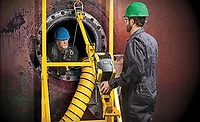
Confined spaces
Allowing employees to work in an enclosed space without following a permit system can be a life or death decision.
OSHA’s standard on permit-required confined spaces (§1910.146) has been around since 1993, but employers still have questions on whether or not they need an entry permit system. A good place to start is to decide if the space is a permit space.
Is it a confined space?
A confined space:
- Is large enough for an employee to bodily enter and work
- Has limited or restricted means of entry and exit
- Is not designed for continuous occupancy.
Questions often arise over the second provision. Having to use a ladder to enter and exit a space is definitely limiting, but what about walking through a door? OSHA guidance indicates that being able to easily get out of the space in an emergency is a prime consideration for determining whether or not a space has limited or restricted access. OSHA’s compliance directive, CPL 2.100 — Application of the Permit-Required Confined Spaces (PRCS) Standards, states that “an access door or portal which is too small to allow an employee to walk upright and unimpeded through it will be considered to restrict an employee’s ability to escape.”
Also consider the worker’s ability to move freely within the space. The directive emphasizes that “a space such as a bag house or crawl space that has a door leading into it, but also has pipes, conduits, ducts, or equipment or materials that an employee would be required to crawl over or under or squeeze around in order to escape, has limited or restricted means of exit.” In fact, OSHA indicates that any space, even one with a standard fixed stairway, would have limited access if the entrants need to climb, crawl, travel a long distance or navigate winding, narrow walkways to reach safety.
The third provision also leaves people in a quandary: What does OSHA mean by “designed for continuous occupancy”? OSHA includes the following in a letter of interpretation dated Oct. 22, 1993, “If ... the designer took into consideration that humans would be entering the space and provided for the human occupancy (such as: provided ventilation, lighting, sufficient room to accomplish the anticipated task, etc.), then the space would be designed for employee occupancy.”
If a space doesn’t meet all three provisions of the definition, it isn’t a confined space. An entry permit isn’t needed, but remember to address any other hazards.
Is it a permit space?
Any space that meets the definition of a confined space must be further evaluated to determine if it’s a permit-required confined space.
A permit-required confined space is a confined space that has one or more of the following characteristics:
- Contains or has a potential to contain a hazardous atmosphere
- Contains a material that has the potential for engulfing an entrant
- Has an internal configuration that could trap or asphyxiate an entrant by inwardly converging walls or a floor which slopes downward and tapers to a small cross section
- Contains any other recognized serious safety or health hazard.
If a space meets the definition of a permit space, use an entry permit system. But in some situations a permit may not be necessary. Consider whether you can reclassify the permit space as a non-permit space or determine if alternate entry procedures are appropriate.
Can the space be reclassified?
In general, for the reclassification provisions at §1910.146(c)(7) to apply, there can be no actual or potential atmospheric hazards in the space, and all other hazards must be eliminated without entry into the space. For example, assume a bin of plastic pellets doesn’t present any atmospheric hazards. By emptying the bin and locking out an auger without going into the bin, the engulfment and mechanical hazards are eliminated, and the space can be entered without a permit.
Can a space be reclassified if it has atmospheric hazards that can be eliminated before the entry? The standard’s definition of “isolation” provides examples of methods to eliminate a hazard. OSHA’s preamble to the final rule notes that eliminating a hazard is not the same as controlling it. Providing continuous forced air ventilation during an entry controls the hazard; it doesn’t eliminate it. OSHA gives the examples of chemical tanks and boilers as spaces having atmospheric hazards that can be eliminated so that a permit space can be reclassified. In these cases, an entry using a permit must be performed to test and inspect the space to confirm the atmospheric hazards have been eliminated. Then, subsequent entries while the hazards remain eliminated can be made without a permit.
Can alternate entry procedures be used?
A permit is not needed when the only hazard is an atmospheric hazard that can be controlled through continuous forced air ventilation. These alternate entry procedures are outlined at §1910.146(c)(5).
The preamble to the final rule says, “The procedures ... are only appropriate for atmospheric hazards, and the spaces for which these procedures can be used pose only this type of hazard. If the space poses other hazards as well, either all the hazards must be eliminated, under paragraph (c)(7) of the final rule, or the space may only be entered following the full permit space procedures.”
How do you know that your ventilation system is adequately controlling the atmospheric hazard? The preamble states, “A guideline of 50 percent of the level of flammable or toxic substances that would constitute a ‘hazardous atmosphere’ may be used by employers in making the determination.” This would translate as a reading of five percent of the lower flammable limit and exposure at half of a toxic chemical’s permissible exposure limit. The air must be periodically tested during alternate entry procedures, but an entry permit isn’t needed.
Err on the side of caution
Before an entry without a permit is allowed, be absolutely certain that the protections provided by a permit system are not necessary. Remember, first determine if the space is a permit space, then consider whether it can be reclassified or if alternate entry procedures are appropriate. For further guidance on evaluating a space, you may want to contact your loss control insurance carrier, hire a safety consultant, or call your local OSHA area office or your state OSHA Consultation Services for their interpretation of your situation.
Looking for a reprint of this article?
From high-res PDFs to custom plaques, order your copy today!