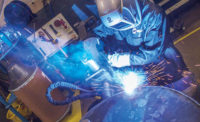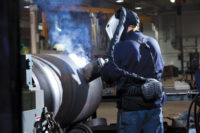
Choosing the right flame resistant (FR) garments for welding applications isn’t as straightforward as it might seem. Unlike foundries, petrochemical plants or other dangerous environments, FR fabrics in welding environments must maintain their protective characteristics through repeated, daily exposures to intense sparks, high heat, molten metal and industrial launderings.
Not all welding applications are alike, and choosing the correct FR garment for your specific application requires taking a number of other factors into account. First consider the welder and their specific application, and then any additional factors such as the environment, cost constraints, product durability, protection, comfort, laundering and disposal requirements.
FR Cotton
Flame resistant cotton is popular because it is relatively inexpensive, lightweight (about 9 ounces per square yard) and breathable. An FR cotton garment often provides the ideal combination of protection, cost and operator comfort in applications where sparks and spatter are relatively mild, ambient heat is of a concern and washability is important.
FR fabrics are treated with a chemical that “off-gasses” when it comes in contact with flames, molten metal or other intense heat sources. This off-gassing process deprives the area of the oxygen that would be required to cause combustion. Although most FR cotton fabrics will not start on fire, they can be charred when exposed to sparks, spatter and molten metal.
Two elements to consider when purchasing an FR cotton jacket are: the quality of the cotton fabric and the flame retardant application process. A higher quality, thicker base cotton will provide improved comfort and durability over the life of the garment.
Flame retardant processes may vary depending on the manufacturer. High quality control standards are needed to ensure that chemicals are applied consistently to garments, resulting in safe, reliable products that protect your workers. Indura® cotton is treated domestically in the United States and guarantees the material’s flame resistance for the life of the garment, regardless of launderings.
Although cotton is an inexpensive, lightweight FR solution, it is not enough protection for all welding applications. Many welding tasks require more durable garments that hold up to intense heat, sparks and spatter.
Leather
Because of its density - roughly 30 ounces per square yard - leather has long been considered the best protective material for welding applications. The relative thickness of leather prevents heat from penetrating through the garment and also provides excellent abrasion and puncture resistance.
There are many different types, cuts and grades of leather designed for welding applications, all of which can impact the product’s quality and cost, as well as the welder’s comfort and mobility.
The top layer of an animal’s hide is the strongest portion and is referred to as grain leather. Because of its strength, grain leather can be made much thinner than the under portions of the hide, which in turn allows it to be lighter and more comfortable. Grain leather garments repel sparks and spatter, making them ideal for welding applications.
Another type of leather used in welding jackets is called split leather and is made from the under portions of the hide. Split leather is characterized by a fuzzy look and feel. While less expensive, this type of leather is also heavier, thicker and more susceptible to absorb dirt and oil.
Leather is the heaviest and most insulating material available. A typical, full-leather welding jacket can weigh upwards of 8 lbs., which can increase welder fatigue. In environments where the ambient temperature can pose heat stress dangers, a leather jacket can compound those dangers by increasing the welder’s internal heat due to its lack of breathability. Another disadvantage of leather is that it becomes stiffer and less pliable over time due to repeated launderings and exposure to intense heat.
Advanced synthetic materials
A new type of synthetic material originally developed for military applications has been introduced to the welding industry.
Based on a flame-inherent fabric, the base material is comprised of a patented blend of oxidized acrylic fibers and modern strengthening fibers. This fabric has proven itself in professions in which catastrophic heat exposure is a concern, including iron production, race car driving, firefighting and high-voltage electrical work.
A proprietary compound is added to the base material, increasing its ability to shed sparks, spatter and other flaming or molten materials, making it applicable for welding.
Flame resistance is also inherent to this advanced synthetic material - laundering will not degrade its performance over time. It weighs approximately 60 percent less than most leathers and has micropores in the fabric that increase breathability and comfort for the welder, while reducing the potential for heat stress-related injuries.
Conclusion
Selecting the right personal protective equipment for your welders is a complex task. Welding applications can vary greatly, and therefore, require a wide variety of protection levels.
A flame-resistant cotton garment might provide an acceptable level of personal protection for low-amperage aluminum TIG welding in a light industrial application.
On the other hand, leather might be the best option in a heavy industrial application in which the welding operator is required to frequently lie down and move along concrete or gravel.
Advanced synthetic materials deliver a new level of protection without a corresponding increase in heat stress. Employees are one of a company’s most important assets, and safety product selection is an important component in eliminating lost time accidents.