Safety and fire protection engineers are well aware of the hazardous properties of flammables. While detailed and comprehensive programs exist to ensure their safe storage and use, even excellent safety programs suffer if there isn’t a periodic survey to make certain that correct procedures are being followed and proper protective equipment is being used.
Conducting such a survey need not be difficult, time-consuming or expensive. The “Quik Chek” system is a simple and quick reference plan to generate awareness, at a very basic level, of the most common safety issues related to flammable and hazardous liquids storage and use.
It begins by determining where your flammable liquids are received, stored and used and then visiting these areas.
Storage
“Quik Chek” your flammable liquid cabinets - do the doors latch properly? If not, you are faced with a code violation and must replace the cabinets. Have holes been drilled into the cabinet? Has a padlock hasp been added? Have screws been attached? If so, you have not only created unsafe conditions, but the modifications have voided the cabinet’s FM certification, requiring it to be removed from service and replaced.
Are unapproved cans and liquids stacked on or around the cabinet? If so, you need additional storage cabinets as well as safety cans. Where are your metal and plastic drums? “Chek” them-are they sitting directly on the floor or on wooden transport pallets? Are they sitting open without lids? If you answered “yes” to one of these questions, you are in violation of EPA regulations. The solution: spill centers, spill containment pallets and approved drum lids.
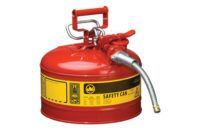
Do your safety cans meet code?
“Quik Chek” your containers. Look for plastic consumer gas cans and any cans not labeled “safety can.” If you find unapproved containers, remove them from service immediately to avoid ongoing OSHA and fire code violations and replace them with approved safety cans. Also “chek” the condition of all safety cans in use. Some of these may need to be replaced. Codes and standards require that safety cans:
- Be self-closing and leak-tight.
- Relieve internal pressure caused by heat.
- Prevent flame from reaching the contents through the spout.
- Prevent contents from spewing or exploding so as to not further spread a fire.
If use or abuse takes away any of these characteristics, the cans should be taken out of service.
Because containment is the fundamental requirement, inspection of a safety can should begin with a manual “chek” of the springloaded closure mechanism. The spout cap should open smoothly against the spring pressure without sticking at any point. A bent or worn portion of the operating mechanism calls for replacement.
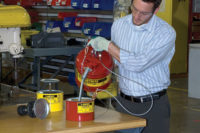
While the cap is open, make sure the flame arrester has no holes or other damage. Cap closures can be checked for leaks by turning a partially filled safety can upside down over an open bench can. Leaks are most frequently caused by worn or damaged cap gaskets or by damage to the rim of the spout.
Select replacement cans that are the most efficient for the intended use. Transferring liquids to containers with small receiving openings requires flexible nozzles for controlled pouring. For storage and transfer to open tanks, be sure to use the appropriate size; don’t use a five-gallon container when a one-gallon container is adequate.
Cans should be color-coded to make it easy to differentiate between various types of liquids. Red designates flammables, yellow is for diesel fuel, blue is for kerosene and green is for oils. For added safety and convenience, look for safety cans that include a large ID zone to make it easy for the user to mark the can contents and designate the department/shift/user, etc.
Flame arresters
FM Global (FM) requires the installation of a flame arrester in all safety cans one gallon and larger in capacity. “Chek” the flame arrester in each can to make sure the arrester is in place; then “chek” its condition. If the arrester is deformed or damaged in any way, replace it. The FM approval standard, “Standard 6051, 6052” specifies precisely how FM tests a flame arrester. Section 3.5 states: “A combustible, hydrocarbon gas-air mixture (natural gas) shall be passed through the flame arrester, ignited and controlled to burn on the flame screen. After one minute, the flow will be cut off abruptly. This procedure will be repeated five times consecutively. No evidence shall be found of flame passing through the flame arrester during or at the conclusion of this test.”
The standard also requires that “no undue restriction to the flow of the liquid either into or out of the can” is caused by the arrester. Select replacement cans that incorporate stainless steel wire mesh flame arresters. They are cost-effective, inexpensive and provide a long service life while offering the free flow you need.
Production line use
Production line use of flammable liquids probably offers more potential for improper handling methods than all other phases of storage and handling combined. That makes use-points of special interest to OSHA inspectors and other safety authorities.
“Chek” for open containers on the line and replace them with approved plunger cans or bench cans. Plunger cans provide the safest way of wetting cloths — this involves placing the cloth on top of the can and pressing downward. A perforated pan screen on top of the can serves as a flame arrester, forcing the liquid up into the tray and wetting the cloth. Excess liquid returns to the can through the flame arrester. Bench-style cans that also feature a flame arrester pan are ideal for wetting small parts; they can hold up to three gallons of solvent.
Waste disposal
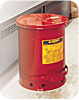
“Chek” your temporary storage and disposal of solvent- or oil-soaked rags and applicators. Are they lying out or tossed into open trash cans? If so, you’ve got another code violation on your hands. Because rags containing solvents, thinners, linseed oil, combustible adhesives and other flammable liquids present a serious fire risk when improperly discarded, specially designed steel oily waste cans are necessary to protect your facility from fires that can start due to spontaneous combustion, sparks or careless use of smoking material. A self-closing lid on the can is an effective block to fire transmission from outside the can. Any fire transmitted to can contents while the lid is open is immediately snuffed out when the lid closes.
This “Quik Chek” of your flammable storage and use practices will pay big dividends. You will reduce possible EPA or OSHA citations, but even more importantly, you will avoid injuries, fire and environmental disaster.