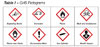
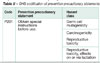
The hazard class (chemicals associated with the health hazard pictogram) are shown in Table II. Collectively these chemicals are known as CMRs — Carcinogens, Mutagens, or toxic to Reproduction. Note: Although chemicals that have “effects on or via lactation” require the P201 statement, they do not require the health hazard pictogram.
Highest precautions
Even brief and small exposures to some CMRs may create irreversible adverse health effects that although delayed, even passing to another generation, may be deadly. This is why CMRs, along with unstable explosives, are given the highest prevention precautionary statement: “Obtain special instructions before use” within GHS.
Other precautionary statements
With the exception for effects on or via lactation, Table III shows each of the GHS precautionary statements for CMRs. The P201 statement is open for interpretation while the other precautionary statements are more direct.Special instructions/expert advice
GHS does not state where to obtain special instructions. Since the precautionary statements in Table III will appear in the safety data sheet (SDS) associated with a CMR, and the SDS is primarily for employee protection, special instructions should be obtained from the employer. GHS supports control banding (CB) strategies (see http://www.cdc.gov/niosh/topics/ctrlbanding/). CB place CMRs into band four: “Seek expert advice.” CB does not define an “expert,” although specialized training, education, or experience with CMRs would be expected.Special instructions depend upon the hazards of the specific CMR and may vary among experts. Instructions will emphasize the serious nature of exposure and will generally follow precautions found in OSHA’s substance-specific standards. Twenty-eight (28) of OSHA’s 30 substance-specific standards are direct CMRs. The other two, bloodborne pathogens and cotton dust, are related indirectly (HBV may cause liver cancer and cotton dust includes pesticide residues).
Precautions within OSHA’s substance-specific standards include: 1) Initial and periodic exposure determination; 2) Communicating hazards to employees; 3) Employee training — prior to initial assignment and at least annually thereafter; 4) Written program (such as policy and procedures); 5) Hierarchy of controls (such as substitution, engineering, PPE, and administrative); 6) Regulated areas; 7) Housekeeping; 8) Hygiene facilities and practices; 9) Medical surveillance; and 10) Recordkeeping.
Behavioral change/standard of care
GHS is not simply a “how to” approach for communicating chemical hazards. It also functions to change behavior and improve standards of care along the supply chain. The speed of behavioral change will differ among regions of the world as GHS is adopted by businesses and governments. Behavioral change/standard of care for some GHS hazard classes, such as CMRs, warrants a priority.In next month’s column we will look at how evolving standards of care in the occupational health and safety profession may lead to OSHA General Duty Clause violations, increased tort liability, and challenges to professional ethics.