Here are six tips that can help prevent dust collector explosions in your plant.
1. Apply relevant NFPA standards
In sorting through the list of combustible dust standards, a good starting point for every EHS professional is NFPA 654, the Standard for the Prevention of Fire and Dust Explosions from the Manufacturing, Processing and Handling of Combustible Particulate Solids. Simply stated, NFPA 654 is an all-encompassing standard on how to design a safe dust collection system. It is the guiding dust document and the most general on this topic, and it will lead you to other relevant documents:
NFPA 68 – Standard on Explosion Protection by Deflagration Venting: This document focuses on explosion venting – i.e., on devices and systems that vent combustion gases and pressures resulting from a deflagration within an enclosure, for the purpose of minimizing structural and mechanical damage. The current edition, published in 2007, contains much more stringent requirements than past editions, essentially elevating it from a guideline to a standard.
NFPA 69 – Standard on Explosion Prevention Systems: This standard covers explosion protection of dust collectors when venting is not possible. It covers the following prevention methods: control of oxidant concentration, control of combustible concentration, explosion suppression, deflagration pressure containment, and spark extinguishing systems.
The NFPA recognizes that different industries have varying requirements, and it relaxes or tightens some aspects of its standards accordingly. Wood dusts, for example, tend to contain high moisture content that make for a potentially less explosive environment, resulting in a less stringent overall standard for that industry. Conversely, metal dusts can be highly explosive and subject to more vigilant regulation.
The industry-specific standards most commonly employed are: NFPA 61 – Standard for the Prevention of Fires and Dust Explosions in Agricultural and Food Processing Facilities; NFPA 484 – Standard for Combustible Metals; and NFPA 664 – Standard for the Prevention of Fire and Explosions in Wood Processing and Woodworking Facilities. One or more of these standards may also apply to your facility.
2. Consider using performance-based codes
The NFPA has been incorporating performance-based options into its standards since 1995. NFPA 654 first adopted this concept in 2006, with the other more specific combustible dust standards following suit since that time.
The NFPA uses relatively conservative textbook calculations in its standards for explosion protection equipment, and justifiably so. However, using performance-based codes, the NFPA allows real-world destructive test data to be used in place of its own standard calculations, provided the dust collection supplier can provide adequate data to prove that the collection system is designed to meet a specific set of criteria for a given situation.
The use of real-world destructive test data is thus a permissible and sometimes overlooked approach. Find out if your dust collection supplier can provide real-world data to assist in a strategy that may help you to avoid over-engineering and save on equipment costs without compromising safety.
3. Conduct a hazard analysis or risk evaluation
The NFPA states that a hazard analysis is needed to assess risk and determine the required level of fire and explosion protection. The first step in this analysis is determining if your dust is explosive.
Most commercial test laboratories offer a low-cost test to establish whether a dust sample is combustible. If the test is positive, then the explosive index (Kst) and the maximum pressure rise (Pmax) of the dust should be determined by ASTM E 1226-10, Standard Test Method for Explosibility of Dust Clouds. Any dust above 0 Kst is now considered to be explosive, and the majority of dusts fall into this category. Your dust collection equipment supplier needs these values to correctly size explosion venting or suppression systems.
4. Use high quality, compliant equipment
It is not uncommon for products such as back flap dampers to be reverse-engineered by suppliers that do not have an expertise in explosion protection or have chosen not to perform the required testing to satisfy the standards and/or performance-based provisions. If an OSHA inspector finds this situation, the plant will have to replace the device and may be fined. Worse still, if a combustible dust problem should occur, there is no guarantee that the device will perform as expected.
Also, there is no such thing as an “NFPA-approved” device. A supplier may correctly state that a device “carries CE and ATEX certifications” and/or is “manufactured in accordance with NFPA standards,” but test data must be available to support these claims.
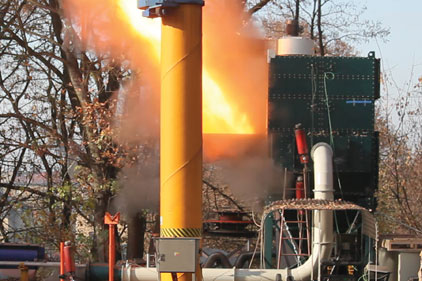
As for the dust collector itself, a well-designed system can pay for itself rapidly in energy and maintenance savings, costing far less to operate than a unit with a low initial price. A high-quality, heavy duty collector can also offer a less obvious advantage in the event of a combustible dust problem. As documented both in full-scale testing and field experience, in the event that a dust explosion occurs in the collector, a low-end model will more than likely require total replacement. A collector made of thicker-gauge metal with higher vessel strength, however, will survive an explosion and can often continue in service with only the explosion vent and filter cartridges needing to be replaced.
5. Keep a clean house
Hazardous levels of dust accumulation are among the most common OSHA violations. Even diligent cleanup of floors and work surfaces is not enough if more elevated areas are neglected. Dust accumulation on rafters and overhead surfaces or on top of machinery is a frequent culprit. Also, the NFPA recently tightened its definition of hazardous surface dust (in NFPA 654), defining it as any dust layer of 1/64 inch (0.4 mm) or greater, compared to a previous limit of 1/32 inch (0.8 mm) of dust.
6. Practice ongoing vigilance
Even if there has never been a problem in your facility before, this is no guarantee of future safety. The level of hazard can change from day to day, and even from moment to moment — whether due to the introduction of a new process, a temporary lapse in housekeeping, or a static electricity discharge caused by improper grounding. It takes ongoing vigilance and management of change to identify conditions in your plant that might cause a potential explosion problem.