Bad news: Despite precautionary measures, falls continue to occur. If and when a fall happens, a prompt and informed response can help prevent serious injury or death. It is vital all employers have a detailed fall rescue plan in place.
Are you prepared?
Successful post-fall rescues depend on the implementation of an established plan.
Ask yourself: If a worker at height were to fall, do we have a well-organized, comprehensive rescue plan at the ready?
The term “rescue plan” doesn’t need to be daunting. There are systems, tools and training to make successful implementation easy and effective.
In creating your rescue plan, be aware of the three main types of rescues:
1. Self- and Assisted Self-Rescue
If proper equipment and training are used, 90 percent of fallen workers will perform a self- or assisted self-rescue using equipment such as self-retracting lifelines (SRLs). If a worker falls, the device locks within two feet, and the worker can generally climb back up to the level where he fell. Some SRLs can automatically lower the worker to safety.
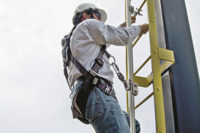
An assisted self-rescue involves the worker rescuing himself, with the minimal assistance of another worker. If the worker’s hands and feet are not hindered, a co-worker can provide a secured ladder for the worker to raise or lower himself to a safe level.
After any self- or assisted self-rescue, it is important to bag all equipment components, tag them with the date, activity and time of fall, and then give the bag to a supervisor.
2. Mechanically Aided Rescue
If self-rescue is not possible, a mechanically aided rescue will be needed. Equipment for mechanically aided rescues includes air hoist lines, aerial lifts, personnel baskets on cranes and scissor lifts. The equipment needed will vary depending on a variety of factors, including job site and the condition of the worker.
Similar to the procedure that follows self- and assisted self-rescues, all equipment involved in a fall should be removed from use until it can be inspected and certified as safe.
3. Pickoff Rescue
In a pickoff rescue, a trained responder repels to a fallen worker, attaches the fallen worker to the responder’s equipment, and brings the fallen worker to safety. Pickoff rescues are the most complex of the three options and require rescue personnel with extensive training.
If your company currently has a pickoff rescue procedure in your plan, you should reevaluate your program and examine the tools available for the other two safer and less complex rescue options. With proper training and equipment, a pickoff rescue is rarely needed.
Your rescue routine
Once you have a robust, well-rehearsed rescue plan in place, there are certain steps to follow after a worker falls.
1. Respond to the fall.
According to OSHA regulations, employers are required to facilitate a prompt rescue of the worker(s) involved in the fall. ANSI requires a response within six minutes to mitigate the risk of unconsciousness or death for a worker suspended in a fall arrest device.
2. Monitor the fallen worker.
Provide comfort and continuously communicate with the worker. To prevent serious medical complications associated with prolonged suspension, encourage the worker to move his or her legs to promote blood flow. If the fallen worker describes symptoms of fainting, nausea, breathlessness, dizziness, sweating, low heart rate, low blood pressure, paleness or loss of vision, immediately notify emergency medical services.
3. Transport to a safe level.
Make sure the fallen worker gets to a safe level. In most situations, the safe level is ground level, but certain job sites might necessitate using a different area. Once there, decide whether to administer first-aid treatment or to ensure hospital transport, if necessary.
Follow-up
Once the fallen worker is safe, move on to documentation and inspection.
Documentation
Follow OSHA requirements (29 CFR 1904) to determine whether or not to document the incident:
1. Must be work-related as defined by OSHA.
2.Must be a new case; injuries stemming from previously reported incidents should be updated in the appropriate file.
3. Must satisfy one or more of the following general reporting criteria:
• Death
• Days away from work
• Restricted work or transfer to another job
• Medical treatment beyond first aid
• Loss of consciousness
• Significant injury or illness diagnosed by a physician or other licensed healthcare professiona
Should a work-related accident result in the death of an employee or the inpatient hospitalization of three or more employees, you must report it directly to OSHA.
Inspection
After a fall event, all components must be pulled from use and inspected by a supervisor. Conduct a thorough inspection of any systems or components exhibiting signs of damage, such as fraying or tearing. If damaged, the equipment should be considered unsuitable for use and removed from service immediately. To ensure optimal safety, visually and manually inspect all other fall protection equipment for wear, damage or deterioration before returning the equipment to work.
Start planning today
Fall protection products represent a great step forward in saving workers’ lives, but dependable post-fall rescue and recovery plans are equally essential to your team’s health and well-being.
Visit osha.gov to read more about how you can do your part in at-height worker safety.