Decontamination Strategies
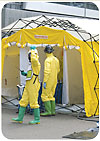
At any given moment, disaster can strike. Natural disasters such as floods or hurricanes and even medical emergencies can leave a wake of destruction in their paths. But it is often the destruction not visible to the eye that causes the most damage. Contaminated victims, disaster scenes and equipment are the first battle emergency workers will fight when responding to a crisis. In the wake of tragic disasters, as we saw with Hurricane Katrina and September 11, restricting contaminated areas is objective number one.
So, how do you determine if someone or something is contaminated? How do you decontaminate the area and yourself? And, most importantly, how do you prevent such things from happening again?
So, how do you determine if someone or something is contaminated? How do you decontaminate the area and yourself? And, most importantly, how do you prevent such things from happening again?
Harmful agents
A major concern with any type of disaster is the safety and protection of emergency responders. Victims, equipment and even environments run the risk of being exposed to a variety of harmful agents, including:- Hazardous chemicals from hazmat incidents or an act of terrorism;
- Chemical warfare agents;
- Toxic chemical pollution like water contamination that resulted from Hurricane Katrina;
- Mold contamination encountered after natural disasters like tsunamis;
- Hazardous chemicals from illegal drug labs;
- Biological agents like bird flu or anthrax.
In an emergency situation the first step is to assess and identify any hazardous materials. This assessment should only be done by qualified professionals, and the proper authorities should be notified of the findings.
Isolation zone
Proper decontamination teams consisting of various technicians should be assembled and be fully equipped with the proper personal protective equipment (PPE) ensembles, including SCBA respirators, suits, gloves and boots.An Initial Isolation Zone is set up surrounding the scene and, in some cases, surrounding populations are evacuated to better isolate any potential hazards. The isolation distance can range from 100 feet to up to 3,000 feet, depending on the size of the incident and type of materials involved.
It is important to remember that simply isolating a hazardous scene or threat does not create a safe environment. Victims and equipment still run the risk of contamination, so it is equally important to collect and secure any water, clothing or dirty equipment. The proper disposal of such items is crucial to avoid further environmental contamination or exposure of unsuspecting personnel involved in cleanup. If a victim is not properly decontaminated, the accepting hospital must become the decontamination zone.
The goal of decontamination is simple: to protect the worker from contamination. Decontamination must result in a “zero” level of exposure for most PPE users. This means hazardous materials must be kept outside the PPE — sometimes easier said than done.
Chemical permeation
Hazardous materials can contain volatile or corrosive chemicals that can, unknowingly, infiltrate personal protective gear. Chemical permeation should be a major consideration when deciding whether to reuse contaminated PPE. There are numerous tests that can be conducted to determine the safety of PPE in chemical environments. In many cases, chemical protective clothing (CPC) must be used. Exposure to chemicals can be especially dangerous. Many chemicals continue to permeate gear even after the exposure has ended. If a product cannot be effectively decontaminated, the CPC must be discarded.
According to the Decontamination Guidelines published by the American Industrial Hygiene Association, reusable PPE and CPC must be decontaminated adequately to ensure the user is not subjected to any residual contamination. There are generally two types of contamination: surface contamination and matrix contamination.
Surface contamination occurs when materials like dirt, mold or oily residues are adhering to the surface of the PPE and can be easily removed with surface washing. Matrix contamination occurs when the chemical or agent is down within the layers of the material of the PPE. Permeation may have occurred and the contamination is much harder or sometimes impossible to remove.
Surface decontamination is the most common. It must be accompanied by intensive visual inspection, air monitoring as well as wipe samplings where applicable. Matrix contamination is much more difficult to deal with. All materials are permeable to some degree, therefore the matrix is always being contaminated. But the concern is with the breakthrough of these contaminants. Numerous variables including temperature, pressure and exposure concentrations make it very difficult to predict breakthroughs. The safest practice for suspected matrix contamination is to establish a set disposal policy, one that is based on researched exposure times.
There is no real effective way of measuring the efficacy of most decontamination procedures for suits and gloves. For most chemical protective gear, it is safer, more practical and cost-effective to discard items after use. Contaminated suits and gloves are normally disposed as special hazardous waste, while respirators and boots are usually reused. In many situations it makes sense to have both nitrile and neoprene gloves that have been certified to NFPA 1992 Standards on Liquid Splash-Protection. Both nitrile and neoprene gloves protect against a variety of substances.
According to the Decontamination Guidelines published by the American Industrial Hygiene Association, reusable PPE and CPC must be decontaminated adequately to ensure the user is not subjected to any residual contamination. There are generally two types of contamination: surface contamination and matrix contamination.
Surface contamination occurs when materials like dirt, mold or oily residues are adhering to the surface of the PPE and can be easily removed with surface washing. Matrix contamination occurs when the chemical or agent is down within the layers of the material of the PPE. Permeation may have occurred and the contamination is much harder or sometimes impossible to remove.
Surface decontamination is the most common. It must be accompanied by intensive visual inspection, air monitoring as well as wipe samplings where applicable. Matrix contamination is much more difficult to deal with. All materials are permeable to some degree, therefore the matrix is always being contaminated. But the concern is with the breakthrough of these contaminants. Numerous variables including temperature, pressure and exposure concentrations make it very difficult to predict breakthroughs. The safest practice for suspected matrix contamination is to establish a set disposal policy, one that is based on researched exposure times.
There is no real effective way of measuring the efficacy of most decontamination procedures for suits and gloves. For most chemical protective gear, it is safer, more practical and cost-effective to discard items after use. Contaminated suits and gloves are normally disposed as special hazardous waste, while respirators and boots are usually reused. In many situations it makes sense to have both nitrile and neoprene gloves that have been certified to NFPA 1992 Standards on Liquid Splash-Protection. Both nitrile and neoprene gloves protect against a variety of substances.
No advance notice
In 2003, there were more than 9,000 reported events in which dangerous or toxic substances were released. Reported by the U.S. Department of Health and Human Services Agency for Toxic Substances and Disease, the substances most commonly released included inorganic substances, volatile organic compounds, acids, pesticides and other agricultural chemicals.
Whether by accident or by mother nature, hazardous situations do arise. By definition, an emergency does not allow us to prepare in advance, so it is critical that all emergency workers be outfitted with the proper equipment. Knowing how to protect yourself and others through proper decontamination processes is the key to preventing any further damage.
Whether by accident or by mother nature, hazardous situations do arise. By definition, an emergency does not allow us to prepare in advance, so it is critical that all emergency workers be outfitted with the proper equipment. Knowing how to protect yourself and others through proper decontamination processes is the key to preventing any further damage.
Links
Looking for a reprint of this article?
From high-res PDFs to custom plaques, order your copy today!