Fall Protection Equipment
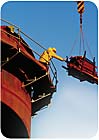
Falls from elevations are a leading cause of injuries and fatalities. Where is this worker’s FP equipment?
ANSI/ASSE Z359.2-2007 is a brand new standard, the first approved standard in a series of new or revised standards that focus on fall protection and related systems. It establishes guidelines and requirements for an employer’s managed fall protection program.
The right equipment
One part of a comprehensive, managed fall protection program is the selection of appropriate FP equipment. In selecting appropriate fall protection equipment, general industry currently utilizes performance standard ANSI Z359.1-1992 (R1999), “Safety Requirements for Fall Arrest Systems, Subsystems and Components.” This standard establishes requirements for the performance, design, marking, qualification, instruction, training, inspection, use, maintenance, and removal from service of connectors, full-body harnesses, lanyards, energy absorbers, anchorage connectors, fall arresters, vertical lifelines and self-retracting lanyards, comprising personal fall arrest systems for users within the capacity range of 130 to 310 pounds (59 to 140 kg).The employer should confirm that the fall protection equipment has been independently tested and certified as complying with the ANSI Z 359.1 standard by an accredited certification organization. The American National Standards Institute (ANSI) operates such a program for accrediting certifiers. To ensure these critical, protective products comply with the performance standard, there is an ANSI-accredited organization that certifies fall protection products used in general industry and construction — the Safety Equipment Institute (SEI). An employer must make the “right buy” in safety equipment to ensure that the product will protect as it claims. Product certification provides a mechanism to assist safety purchasing professionals in the area of safety and protective products.
Product certification
Certification bodies are organizations that verify that a product conforms to a specification or standard through product testing and quality assurance controls. They are unbiased organizations that have formal systems in place, which include examining a product sample, testing, making periodic follow-up visits to the manufacturing facility and auditing the facility’s quality system.SEI encourages safety professionals to look for the SEI label when purchasing PPE. An SEI label on fall protection equipment assures that the product model tested conforms to industry standards, and that the manufacturer has a system in place to consistently produce quality products. The standards used by SEI are approved by the SEI board of directors, which includes representatives from users of safety equipment such as organized labor and corporate safety directors. With certified fall protection equipment, critical purchasing decisions are simplified, and those workers wearing an SEI certified product will have the assurance that their equipment complies with the ANSI Z 359.1 standard.
SEI employs a two-pronged approach to its certification program: testing and quality assurance.
Testing — First, manufacturers’ product models are submitted to SEI’s independent laboratory for product testing. Corrective action is required on any test noncompliance in the case of a new product. For annual testing on a certified product, if a noncompliance occurs, corrective action is required with the possibility of a recall of affected products if so designated by SEI.
Intertek, a renowned safety and protective equipment testing laboratory accredited to ISO/IEC 17025, was recently approved by the SEI board of directors to conduct testing for the SEI fall protection certification program, and has added this capability to its testing scope. Intertek is expanding its laboratory space by an additional 3,500 square feet to accommodate the new test facility, with a drop tower being constructed solely for the SEI certification program, giving the laboratory full capabilities to test to all requirements.
Quality assurance — Quality assurance audits are conducted at the manufacturing facility. The SEI auditor inspects the facilities and audits the quality assurance system through a review of documents and records, and reviews the entire process of manufacturing the certified product. Technical requirements such as applicable specifications, engineering drawings, work instructions, sampling plans, purchasing and inspection procedures are scrutinized. The audit includes facilities maintenance, the inspection function, measuring and test equipment, non-conforming material handling, corrective action procedures, distribution and product traceability. For the SEI fall protection program, each new manufacturer must complete a document, “Self-Evaluation of Compliance to ANSI Z 359.1” for review by the auditor prior to the SEI audit.
New standard coming
The American Society for Safety Engineers (ASSE) serves as the secretariat for the Z359 Accredited Standards Committee (ASC) on fall protection and related systems. The ASSE ASC has submitted four additional Z359 standards to ANSI for approval, one of which will be utilized by SEI to test and certify fall protection equipment. ANSI Z359.1, 2007 - Safety Requirements for Personal Fall Arrest Systems, Subsystems and Components, to be published later this year, will replace ANSI Z359.1 -1992 (R1999).The revised ANSI Z359.1 has some important new requirements. The gate strength requirements have increased for snaphooks and carabiners to 3,600 pounds in all directions of potential loading to the gate. A front attachment element for fall arrest is now included in the standard to, in certain instances, include attachment of the fall arrest system to a front-mounted D-ring. To address concerns over certain practices for twin-leg shock-absorbing lanyards, the new standard will include additional testing and warnings specific to these products.
As part of the suite of new ANSI/ASSE Z359 standards, requirements for third-party certification are being proposed. The ASSE ASC has included these requirements to assist the industry in standardizing testing and certification of products for the benefit of users.
Looking for a reprint of this article?
From high-res PDFs to custom plaques, order your copy today!