Moderate output water temperatures toEncourage emergency equipment use

If you stop and think about it, the use of an emergency shower or eyewash has many of the same characteristics: thermal shock, discomfort and recoil, along with the likely added “bonus†of post-accident panic. The combination of all of these effects can easily lead to industrial accident victims short-cutting the ANSI required 15-minute drench or irrigation protocol.
That probability is what led to the original requirement to provide tempered water through emergency equipment. And confusion about that earlier requirement is what led to the ANSI Z358.1 – 2004 clarification that provided an acceptable initial and sustained use temperature range, in effect creating a “comfort zone.†This “comfort zone†provides an outlet water temperature range that assures comfortable, non-injurious use for the full 15-minute use cycle.
In addition to the ANSI standard, OSHA – 29CFR 1910.151 – broadly requires the availability of suitable first aid treatment facilities. Having adequate emergency first aid facilities available means, among other things, that the employee knows where emergency equipment is located, how to use it and has no hesitation about using it. Hesitation can lead to more serious injury and calls into question whether the facilities are, in fact, “suitable.†Would you jump into a shower you believed was freezing cold or scalding hot… without hesitation?

Finding your comfort zone
So how do we go about developing a comfort zone for a specific facility? For the sake of this discussion, we will assume that the plant has sufficient emergency equipment in the appropriate locations and that tempered water capabilities are being added to the existing emergency equipment assets.We have also adopted the comfort zone temperature range of between 60°F and 100°F (38°C), based on ANSI Z358.1-2004 - Appendix B6 – that states:
“Providing flushing fluid at temperatures conducive to use for the recommended irrigation period is considered an integral part of providing suitable facilities. Medical recommendations suggest a flushing fluid at tepid temperatures be delivered to affected chemically injured tissue. Temperatures in excess of 38°C (100°F) have proven harmful to the eyes and can enhance chemical interaction with the eyes and skin. While cold flushing fluid temperatures provide immediate cooling after chemical contact, prolonged exposure to cold fluids affect the ability to maintain adequate body temperature and can result in cessation of first aid treatment. Recent information indicates that a temperature of 60°F is suitable for the lower parameter for tepid flushing fluid without causing hypothermia to the equipment user.â€
Six safety steps
Now let’s consider the most appropriate steps to be taken:- First, determine your actual inlet water temperatures (immediate and sustained) — This involves checking both the initial and sustained temperature readings at the various emergency equipment assets located throughout the facility. Since conditions can change from location to location, the chore of checking each shower and eyewash is the safest bet. Don’t forget the impact of seasonality on water temperatures. It may be necessary to check several times during the year. Also, consider the impact of isolated ambient temperature changes in certain areas of the plant due to specific industrial processes.
- Identify the overall changes needed — If initial temperatures are either too hot or too cold, while sustained temperatures are within the comfort zone limits, consideration of a recirculation system is appropriate.
If sustained use temperatures fall outside of the comfort zone parameters, you may need warming technologies (such as WarmTechâ„¢), cooling technologies (such as CoolTechâ„¢) or, in certain areas and circumstances, both. In many instances, these types of systems can be sized to handle multiple showers/eyewashes.
Specific applications should take into account the volume of shower and eyewash locations to be included in each comfort zone loop, the maximum distance between components and the impact of exposure of warmed or cooled pipes to ambient air temperatures. It’s highly recommended specifiers work with warming and/or cooling technology manufacturers directly to size the appropriate system. These turnkey Engineered Comfort Solutions (ECS) are designed for your specific location, recognizing geography/climate, business size/personnel volume, risks/processes and ambient temperatures, as well as facility layout and emergency equipment locations. - Determine the number, required location(s) and sizing of the blending valve(s) — This applies only to warming cold input water prior to emergency equipment use. Temperature control for cooling operations is handled integrally within the system’s chiller unit.
The brains of an ideal WarmTechâ„¢ warming system is its blending valve. This device ensures that the safety equipment safely receives water at the required temperature. A good blending valve is actually a system of valves, typically designed by safety equipment manufacturers since they understand their equipment and their specific flow rate requirements.
Knowing what flows are expected is crucial in properly designing a good system. For example, consider a facility that has several pieces of safety equipment and needs tepid water delivered to all of them. First, we must determine how many of those devices may be required to run at once, as the blending valve must be capable of handling the highest demand of multiple uses, as well as the lower demand associated with, say, a single eyewash. Determining flow requirements will not only help the safety equipment manufacturer to properly size the blending valve, it will also allow them to determine the size of the required hot water source.
Once the blending valve capacity is calculated, we need to know the associated pressure drop at the high demand. The most common oversight is underestimating the pressure required to drive the safety equipment after it has passed through the blending valve. The blending valve can have a rather large pressure drop as the flow requirement can be 30 gpm and higher.
Plus, safety equipment is designed so that it will produce the required flow patterns at a minimum pressure of 30 psi. Adding this minimum pressure requirement to the pressure drop of the valve and the associated piping, we can determine what supply pressure is required. We might find that there is insufficient pressure at the facility to run the system. If this is the case, we will have to either add a booster pump to the supply, or limit the number of showers and/or eyewashes on the system. Other options are to look at increasing the pipe size one or two sizes so that the frictional losses are less.
We also need to ensure that the blending valve can offer a full flow bypass of cold water. In the event there is a loss of hot water at the valve, or the cold-water inlet at the valve becomes restricted, it is essential that there is a means to offer a full flow of cold water to the equipment. If we are considering a blending valve stated to have an internal cold water bypass, we need to make certain that the bypass can handle the maximum flow of the system design. If the bypass is less, there is a good possibility that an eyewash will not flow water if it is needed concurrently with a shower, as the shower will take as much as it can receive. The offered blending valve must also have a positive means of hot water shutoff in the event of a cold-water failure. If there is a sudden loss of pressure on the cold side, the blending valve must shut off completely and not allow any hot water to pass.
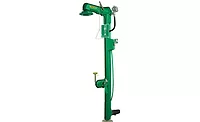
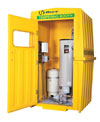
Photo #1 shows a full-feature blending valve system. - Determine your hot and/or cold water source — In sizing the best Engineered Comfort Solution for any particular application, providing a source for sufficient quantities of water is essential. Photos #2 and #3 show typical warming and cooling technology packages and equipment. Recent advancements in instantaneous hot water heaters have made these products practical for use in emergency equipment applications, especially where space for traditional hot water heaters and hot water storage tanks is limited.
- Consider the maximum simultaneous usage — Always work to the maximum use, worst-case volumes. Booster and/or recirculation pumps, as well as storage tanks, may be necessary to assure the availability of the maximum demand volume of tempered water. A variety of products are available to fill these needs.
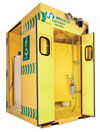
- Enclosed Emergency Environments™ — These custom-engineered solutions are self-contained in a plug-and-play booth configuration. All necessary heating, cooling, recirculation and emergency showers/eyewashes can be designed into these products. Systems such as the one shown in Photo #4 can also extend an Engineered Comfort Solution “umbrella†to nearby existing showers and eyewashes, by designing into the E3 system the capacity to supply water to other equipment.
The science of emergency equipment design and specification continues to advance rapidly, and the clear winners are the specifiers who stay “on top†of the advancements and the employees who are protected by them. Establishing and maintaining an Engineered Comfort Solution that addresses your unique needs provides everyone the maximum peace-of-mind.
Looking for a reprint of this article?
From high-res PDFs to custom plaques, order your copy today!