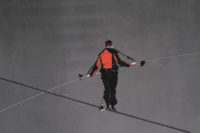
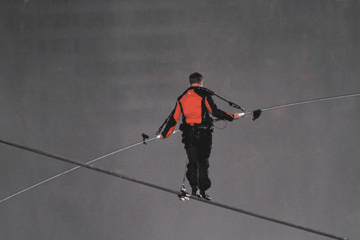
 This summer’s Nik Wallenda tightrope walk across Niagara Falls was not only a marvel of daredevilry, but also a marvel of international co-operation, as regulators on both sides of the border worked together to make the event a reality, according to the Daily Commercial News and Construction Record.
Behind the scenes, Canadian and American construction contractors also worked to ensure the event was executed flawlessly.
Wallenda’s 550-metre tightrope was installed by the O’Connell Electric Company of Victor, N.Y., a firm specializing in the installation of high tension transmission and distribution utility lines.
Nik Wallenda contacted the company’s COO Tom Parkes, late last year.
“My father didn’t know who Nik was and thought it was a joke,” says Michael Parkes, manager of the company’s Power Division. “But in a conference call in the following days we realized this was a serious request.”
While the length of wire was not atypical for an electrical utility river crossing, the weight of the cable was, since such crossings are usually designed for aluminum conductors. At five centimetres in diameter, the steel cable weighed in at more than seven tonnes.
Parkes notes that the initial proposed location for the cable was further downstream, over the gorge.
“When we got to the site visit with Nik, he told us it wouldn’t be wet enough,” he says.
“That’s why it was moved closer to the brink of the falls.
Initial discussions involved splitting the contract between Canadian and U.S. contractors, but after negotiations with regulators and the International Brotherhood of Electrical Workers, it was agreed that the safe execution of the work required the efforts of a single contractor.
“It was our first contract in Canada, other than helping out in the Quebec ice storm a few years back,” says Parkes.
That same rationale led to the selection of Canadian contractor Pacific Blasting of Burnaby, B.C. to install anchors on both sides of the border.
“I received a call from Peter Catchpole, the head engineer of the Wallenda wirewalk with Idaho-based Power Engineers,” says Ron Elliott, vice-president, Blasting Division, with Pacific Blasting.
“He was aware of our work with anchors and asked if we could recommend anyone in the area to work on the Canadian side. It just so happened that we were doing work for Ontario Power Generation in the area, so we took on the project ourselves. We were then offered the American project as well.”
The job called for anchors to be drilled five metres into bedrock, requiring the contractor to drill 20 metres into the ground on the American side of the falls.
“On the Canadian side of the wire, we hit rock much more quickly,” says Elliott.
“Once established, we tested the anchors with hydraulic pullers.”
To position the cable, a helicopter initially dropped a thick microfibre pilot line across the falls during the night, to avoid interfering with the operations of the Maid of the Mist attraction.
“We wanted to keep that rope in the air as it was pulling the cable into place,” says Parkes.
“At five to 10 thousand pounds of tension, we didn’t want to see it hung up or nicked on a rock.”
Once pulled up, the end of the cable was fixed to yoke plates attached to the anchors.
The cable was then tensioned by a pull truck and a large bull wheel tensioner on the U.S. side and a pull truck alone on the Canadian shore.
The cable was pulled to 60,000 lbs. of tension at which point Wallenda approved of its slope.
The centre of the cable sagged only 11 metres, ensuring the “uphill” portion of the walk wouldn’t be too taxing.
O’Connell workers then ventured out in suspended baskets to install the cable dampeners — rigid steel conduits hung as pendulum anchors from the wire to prevent it from rolling.
Employees of both contracting firms had a ringside seat for the actual wire walk on June 15.
The same basket system remained in place so the electrical workers could double as a rescue crew, in case Wallenda fell and was left hanging from the cable by his safety tether.
“Our workers were suspended above the falls before Nik’s crossing,” says Parkes.
“They told me it was a unique experience. Given the mist and the wind they experienced, they gained newfound respect for what Nik had done.”