ISHN logo
search
cart
facebook twitter linkedin youtube
  • Sign In
  • Create Account
  • Sign Out
  • My Account
ISHN logo
  • NEWS
    • Today's News
    • Global Safety News
    • Government Regulations
  • PRODUCTS
    • Product Innovations
    • Featured Products
  • TOPICS
    • Environmental Health and Safety
    • Facility Safety
    • Workplace Health
    • Occupational Safety
    • PPE
    • More Topics
  • CONSTRUCTION
  • TECHNOLOGY
  • COLUMNS
    • Best Practices
    • Dave Johnson: What’s going on
    • Editorial Comments
    • Leading Safety
  • MULTIMEDIA
    • ISHN Podcast
    • Videos
    • Cold Stress Education Quiz
    • Webinars
    • White Papers
  • MORE
    • Buyer's Guide
    • Newsletters
    • Convention Companion
    • Polls
    • Events
    • ISHN Store
    • Sponsor Insights
  • EMAGAZINE
    • eMagazine
    • Archived Issues
    • Contact
    • Advertise
  • JOIN TODAY!
ColumnsSafety & Health Best Practices

Make way for Germany’s MAK

Maximum concentration values should be used at U.S. worksites

By Dan Markiewicz MS, CIH, CSP, RMP
August 1, 2012

Six reasons why Germany’s MAK — Maximum Concentration Values in the Workplace — should be recognized and applied in U.S. worksites:

1. ACGIH® Reference

The ACGIH® Guide to Occupational Exposure Values is a standard reference used by people who prepare a OSHA GHS-compliant Safety Data Sheet (SDS). Table headings for each chemical in the Guide include: ACGIH® TLV®; OSHA PELs; NIOSH RELs; DFG MAKs; AIHA WEELs; and, Carcinogenicity Category. The ACGIH® Guide considers the MAK a standard reference OEL.ISHN0812_C3_inBodyTable_300px.jpg
2. International Chemical Safety Cards (ICSCs)

OSHA suggests in the preamble to HazCom/Global Harmonization Standard (GHS) (ref. FR Vol. 77, No. 58, March 26, 2012, page 17723) that ICSCs, currently covering 1,650 substances, be a GHS classification database source. The MAK is included at the OEL section of ICSCs.

3. Safety Data Sheets

GHS means that SDSs will have a specific layout and specific content. Within OSHA HazCom/GHS, OELs include PELs and TLVs® but also, “… any other exposure limit used or recommended by the chemical manufacturer, importer, or employer preparing the Safety Data Sheet …” Because of information in #1 and #2 above, look for more MAK data on SDSs.

4. MAK Unique Data

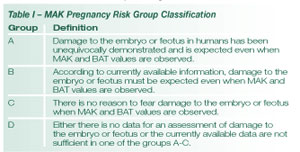
The OSHA HazCom/GHS standard introduces U.S. worksites to the special hazards of chemicals classified for Germ Cell Mutagenicity (ref. Appendix C.4.8) and Toxic to Reproduction (ref. Appendix C.4.10). The MAK provides unique data on mutagens and pregnancy risk that cannot be found with PELs, TLVs, RELs, or WEELs. Table I below is an example of this unique data.

Because the OSHA HazCom/GHS standard now requires where applicable for some chemicals the risk statement, “May damage fertility or the unborn child” MAK information in Table I may be indispensable.

5. Band Wagon

In May 2012, the Federal Advisory Council on Occupational Safety and Health proposed that the U.S. Secretary of Labor adopt OELs “published by other agencies, professional organizations, and other foreign or domestic entities” for use by federal agencies to help protect Federal employees and employees of contractors that provide services to the Federal Government. The MAK was specifically included as a referenced OEL. Actions by FACOSH may prompt other organizations and individuals to follow similar actions.

6. Risk Management

Under ISO 31000:2009 Principles and Guidance on Risk Management, organizations may apply OELs as a risk assessment tool to help meet objectives. The context of risk e.g. regulatory trends, perceptions and values of shareholders, etc. must also be considered during the risk assessment. 

As an independent OSH consultant, I’ve been aware of the MAK my entire career. However, because of recent events, most particularly the risk information in items #1-5 above, as part of my current due diligence and standard of care, I now will advise all clients about use of the MAK at U.S. worksites.

Are you competent to apply the MAK?

Many issues must be considered before your organization applies the MAK. A key understanding for the MAK and all OELs is that they are, in the words of ACGIH® particularly for the TLV®, “not fine lines between safe and dangerous concentrations and should not be used by anyone untrained in the discipline of industrial hygiene.”

The FACOSH report in item #5 above identifies qualifications for someone to apply OELs. Qualifications include holding the CIH®, CSP®, PE, CHMM, QEP or ABT credential. Other qualifications include being a GS-0690-11 or above or having a B.S. degree in science or engineering from an accredited institution, i.e. recognized by the U.S. Secretary of Education along with five years of progressive experience — knock this down to four years of progressive experience if you have a M.S. degree in science or engineering.

Think global, act local

OSHA HazCom/GHS is pushing U.S.-based OSH pros to become more aware of how global information on chemicals impact local actions. As the MAK appears more and more on SDSs there will be an obligation to inform employees of what the letters mean. 

KEYWORDS: chemicals hazard communication (hazCom) risk management

Share This Story

Looking for a reprint of this article?
From high-res PDFs to custom plaques, order your copy today!

Dan markiewicz 200px
Dan Markiewicz, MS, CIH, CSP, RMP, is an independent environmental health and safety consultant and a long-time columnist. He can be reached at (419) 356-3768 or by email at dan.markiewicz@gmail.com.

Recommended Content

JOIN TODAY
to unlock your recommendations.

Already have an account? Sign In

  • forklift safety

    Exploring the latest technologies in forklift safety

    With more staff and more stock in warehousing now more...
    Facility Safety
    By: Josh Cramer
  • welding

    All about welder’s flash or arc eye

    A flash burn is a painful inflammation of the cornea,...
    Environmental Health and Safety
  • dangerous jobs

    The 10 most dangerous jobs in the U.S.

    On-the-job deaths have been rising — hitting the highest...
    Transportation Safety
    By: Benita Mehta
Manage My Account
  • eMagazine Subscriptions
  • ISHN Newsletter & Other Newsletter Alerts
  • Online Registration
  • Manage My Preferences
  • Subscription Customer Service

More Videos

Sponsored Content

Sponsored Content is a special paid section where industry companies provide high quality, objective, non-commercial content around topics of interest to the ISHN audience. All Sponsored Content is supplied by the advertising company and any opinions expressed in this article are those of the author and not necessarily reflect the views of ISHN or its parent company, BNP Media. Interested in participating in our Sponsored Content section? Contact your local rep!

close
  • man wearing the the Sundström SR200 Full Face Mask Respirator
    Sponsored byOHD

    5 Fit Testing Mistakes That Could Cost You

  • This image shows Magid AcuSpex polarized blue mirrored safety glasses.
    Sponsored byMagid Glove and Safety

    Construction PPE Guide: What Crews Need for Each Task

  • lone worker in confined space
    Sponsored byAlphasense Ltd.

    GET THE LEAD OUT of your Safety Oxygen Sensors!

Popular Stories

SpaceX 7 launch

OSHA Investigating Fatal Fall at SpaceX Starbase

Automated loading dock equipment

After March 2026 Rivian Death, Safety Managers Reassess Loading Dock Systems Under OSHA's Warehouse Emphasis Program

psychology in the workplace

Most Workplaces Measure Psychological Safety, Ignoring Psychosocial Risks

top 10 most dangerous jobs

Poll

Seasonal Readiness

With the federal heat stress prevention rule on the horizon, which area of your safety program needs the most attention?
View Results Poll Archive

Products

Surviving an OSHA Audit A Management Guide, 2nd Edition

Surviving an OSHA Audit A Management Guide, 2nd Edition

See More Products

ISHN Podcasts

Related Articles

  • Help on the way for hazmat responders

    See More
  • Carbine Industries ignored smaller incidents that paved way for fatal explosion

    See More
  • New discovery may pave way for non-addictive pain relievers

    See More

Events

View AllSubmit An Event
  • Gas Detectors: The most common mistakes people make when using atmospheric monitors

    Learn the most common mistakes people make when using atmospheric monitors. Join Bob Henderson from GFG Instrumentation for this educational webinar.
View AllSubmit An Event
×

Become a Leader in Safety Culture

Build your knowledge with ISHN, covering key safety, health and industrial hygiene news, products, and trends.

JOIN TODAY
  • RESOURCES
    • Advertise
    • Contact Us
    • Directories
    • Manufacturing Division
    • Store
    • Want More
  • SIGN UP TODAY
    • Create Account
    • eMagazine
    • Newsletters
    • Customer Service
    • Manage Preferences
  • SERVICES
    • Marketing Services
    • Reprints
    • Market Research
    • List Rental
    • Survey/Respondent Access
  • STAY CONNECTED
    • LinkedIn
    • Facebook
    • YouTube
    • X (Twitter)
  • PRIVACY
    • PRIVACY POLICY
    • TERMS & CONDITIONS
    • DO NOT SELL MY PERSONAL INFORMATION
    • PRIVACY REQUEST
    • ACCESSIBILITY

Copyright ©2026. All Rights Reserved BNP Media, Inc. and BNP Media II, LLC.

Design, CMS, Hosting & Web Development :: ePublishing
