Understanding the risks
According to OSHA, noise or unwanted sound is one of the most pervasive occupational health problems. Noise-induced hearing loss can be temporary or permanent. Temporary hearing loss results from short-term exposures to noise, with normal hearing returning after a period of rest. Generally, prolonged exposure to high noise levels over a period of time gradually causes permanent damage. In addition to hearing loss, exposure to high levels of noise may cause other harmful health effects, as well.
One of the dangers of noise is that there is not a big difference between everyday noise and noise that can lead to hearing damage. On the decibel (dBA) scale, a conversation held at a normal volume, for example, is usually in the 70 to 80 dBA range. At 85 dBA, hearing protection is necessary. This means that hearing protection is especially essential for workers who are exposed to noise on a regular basis over their entire working lifetime, such as any industrial workplace where machinery or tools are being used.
Weighing the options
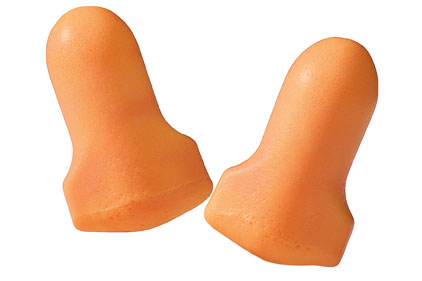
Three main categories of hearing protection are available: earplugs, bands and earmuffs. All three options come in a variety of sizes and styles, and are available at varying price points.
When choosing the proper hearing protection, first consider the noise reduction rating (NRR) of the product. This is a rating given by the manufacturer to indicate how many decibels are blocked out when the product is worn. Most protection will have a rating between 20 and 30 dBA. It is important to know the average noise level of your workplace, and choose a product with an appropriate NRR.
Did You Know?
The true NRR of a hearing protection product depends on several factors, including fit and compliance. Many hearing protection manufacturers are in favor of giving products a lower NRR range, such as 24 – 28, which they believe would help buyers make more informed purchasing decisions. OSHA and the American National Standards Institute (ANSI), which governs hearing protection standards, are considering such a change.
Another important factor in selecting hearing protection is the fit of the product. Proper fit is critical to ensuring full protection. Earplugs should fit in the ear canal snuggly, whereas bands should fit the shape of the head and the ear.
Keep in mind that overprotection can be just as dangerous as under-protection. In some work situations, it is important that some sound get through the hearing protection. For example, an employee working in a confined space may need to hear an emergency alarm. On construction sites, workers might need to hear fire alarms or street traffic such as a honking horn or siren.
One of the biggest challenges with hearing protection is that it often blocks out conversation, so that a worker cannot hear others on the job site. This often leads to workers removing the hearing protection frequently to hold conversations. If done on a frequent basis over a worker’s lifetime career, even for short periods at a time, this can lead to hearing damage.
Luckily, recent advancements in hearing protection help to solve this issue. Earmuffs on the market today that include two-way communication devices allow workers to communicate easily without removing the hearing protection. Such options are becoming more cost effective and readily available.
Hearing conservation programs
OSHA regulates hearing protection standards in the U.S. and requires that “workers exposed to excessive noise must use appropriate personal protective equipment (PPE) including earplugs, muffs or both when engineering or administrative controls are not feasible to reduce exposure.” (OSHA’s regulations can be found in full at OSHA.gov 29 CFR 1910.95.)
Under OSHA’s guidelines, employers must provide hearing protection to employees in work areas where noise exposure exceeds 85 dBA. OSHA also requires the employer to develop and implement a hearing conservation program when noise exposure equals or exceeds an 8-hour time-weighted average of 85 dBA. Such a program must include site evaluations to monitor work area noise exposure levels and identify employees exposed to the noise. According to OSHA, “the exposure measurement must include all continuous, intermittent and impulsive noise within an 80 dBA to 130 dBA range and must be taken during a typical work situation. This requirement is performance-oriented because it allows employers to choose the monitoring method that best suits each individual situation.”
OSHA guidelines for hearing conservation programs also state that:
- Employers must repeat monitoring whenever changes in production, process or controls increase noise exposure.
- These changes may mean that more employees need to be included in the program or that their hearing protection may no longer provide adequate protection.
- Employers must carefully check or calibrate instruments used for monitoring employee exposures to ensure that the measurements are accurate.
- Employees are entitled to observe monitoring procedures and must receive notification of the results of exposure monitoring.
It’s also recommended that employees undergo an annual audiometric test, or hearing test, to ensure that their protection is working effectively. Results of each annual test should be compared to the employee’s baseline test, taken within six months of their first exposure.
Perhaps the most essential component of a hearing conservation program is proper employee training. Employees should be fitted with adequate hearing protection and shown how to properly wear them. Workers should also be educated about the importance of hearing protection and the risks associated with non-compliance. OSHA requires that annual training sessions include:
- the effects of noise;
- the purpose, advantages and disadvantages of various types of hearing protectors;
- the selection, fit and care of protectors; and
- the purpose and procedures of audiometric testing.
If an employer would like assistance in running their own hearing conservation program, they can work with a hearing protection supplier. In most cases, a supplier is more than happy to evaluate a work area, measure the noise level, help determine the hearing protection needs of employees, and assist in developing testing and training programs.