Extreme exposures

While approximately 90 percent of workers in the U.S. have time-weighted average (TWA) noise exposures of 95 dBA or less (OSHA, 1981), situations with much higher noise exposures demand more than casual use of a single hearing protection device (HPD). Specific activities in aviation, mining, maintenance and construction often require more noise reduction, and in many cases, dual hearing protection — earmuffs worn over earplugs.
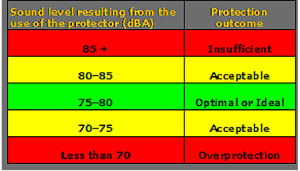
Figure 1 Hearing Protection Guidelines EN 458:2004
How loud does it need to be for dual HPD?
Although the OSHA noise exposure regulation for general industry, 29 CFR 1910.95, does not specifically require that dual hearing protectors be worn, the Mine Safety and Health Administration (MSHA) requires miners to wear dual hearing protection for eight-hour TWA exposures of 105 dBA or greater (MSHA, 2000). NIOSH (1998) recommends that “double” protection be used when eight-hour TWA exposures are 100 dBA or greater.In reality, the question is less about when dual hearing protection should be required and more about the net protected exposure level: the sound level underneath the hearing protector. In other words, taking the hearing protector into account, what is the worker’s noise exposure?
This is the approach taken in the table (Figure 1) from the European guideline EN 458 (2004). As shown, the ideal sound level resulting from the use of the HPDs should be within the range of 75 to 80 dBA. This guideline presumes that HPD attenuation is known, and that workplace noise exposure is well studied and understood. Without individual fit testing of HPDs and rigorous noise exposure monitoring, these can be difficult hurdles to overcome.
Exercise caution when selecting the exposure criteria for requiring dual HPD. At exposure levels below 100 dBA TWA, any benefits derived from additional protection will result in the loss of communication ability. Since people need to use their ears on the job, HPD must be sufficient and adequate, not just used to maximize attenuation.
How much additional noise reduction will dual protection provide?
Laboratory studies of dual hearing protection indicate that a combination of earmuffs and earplugs gives somewhere between 4 and 8 dB more attenuation than the higher-reducing device of the pair (Berger, 1984). The OSHA Technical Manual instructs employers to add 5 dB to the “field adjusted” NRR of the higher rated hearing protector to account for the second protector as shown below (OSHA, 2009).For dual protection:
- Determine the laboratory-based NRR for the higher rated protector (NRRh).
- Subtract 7 dB from NRRh if using A-weighted sound level data.
- Apply a 50 percent correction factor to the NRR of the higher rated protector (NRRh) to account for the lower noise reduction obtained in the workplace when compared to the laboratory; also known as derating.
- Add 5 dB to the field-adjusted NRR to account for the use of the second hearing protector.
- Subtract the remainder from the TWA as
follows:
Estimated Exposure (dBA) = TWA - [(NRRh - 7) x 50%] + 5
Example: TWA = 110 dBA, plug NRR = 29, and muff NRR = 25 dB
Estimated Exposure = 110 - [(29 - 7) + 5] = 83 dBA
Using PAR to quantify dual HPD benefit
Instead of making assumptions about HPD noise reduction based on the average attenuation measured in the laboratory, employers are using hearing protection fit-testing systems to directly measure the noise reduction obtained by each employee, taking into account how well the HPDs are worn and fit by the employee. This provides the employer with a personal attenuation rating (PAR) for each employee who is fit tested. Since this PAR reflects how well the individual employee actually wore the HPDs, it is not necessary to derate the PAR, as OSHA recommends, when the NRR is used. Furthermore, it is not necessary to subtract 7 dB from the PAR in order to use it with dBA noise exposure levels measured by the employer (Berger, 2008). Consequently, employers may be able to simply add 5 dB to the earplug PAR in order to account for the additional noise reduction provided when dual protection is worn.Example: TWA = 110 dBA, earplug PAR = 29, and earmuff NRR = 25 dB
Estimated Exposure = 110 - [29 + 5] = 76 dBA

Figure 2 Effect of earplug selection on dual HPD performance (from E-A-RLOG 13, Berger, 1984)
Selection considerations
Berger (1984) found that large, high NRR earmuffs do not provide significantly more noise reduction than smaller, lower NRR earmuffs when worn with earplugs. This allows employers to select earmuffs based on other criteria such as comfort, weight, size, or quality. A comfortable, lightweight earmuff is often the best choice for a dual hearing protection system since perceived comfort is a significant predictor of earmuff wearing time. (Arezes & Miguel, 2002).On the other hand, the earplug choice matters very much when noise is concentrated at lower and middle frequencies. Figure 2 shows how choosing an appropriate earplug and making sure it is properly fitted can result in significant differences in the overall noise reduction provided. Typically, a well-fitted foam earplug will provide the greatest attenuation, but flanged, push-in style, and custom earplugs can also be used in dual HPD applications.
Balance prevention and communication
Although the overall objective of occupational hearing conservation programs is to prevent noise-induced hearing loss, employers must also do what is necessary to enable workers to communicate on the job. Consequently, dual HPD should be used sparingly and the applications should be carefully considered. Whenever feasible, engineering and administrative controls are the preferred methods of reducing employee noise exposure, but when these are not feasible or adequate to reduce employee noise exposures to acceptable levels, dual hearing protection is often the most effective method for maximizing HPD performance.References
Arezes, P. M., & Miguel, A. S. (2002). Hearing protectors acceptability in noisy environments. Ann. Occup. Hyg. , 46(6), 531-536.Berger, E. H. (1983). Laboratory attenuation of earmuffs and earplugs both singly and in combination. Am. Ind. Hyg. Assoc. J. , 445, 321-329.
Berger, E. H. (1984). E-A-RLOG 13: Attenuation of earplugs worn in combination with earmuffs. Retrieved from http://www.e-a-r.com/hearingconservation/ earlog_main.cfm
Berger, E. H. (2008). What is a personal attenuation rating (PAR)? Retrieved from http://www.e-a-r.com/pdf/hearingcons/par.pdf
EN 458 (2004). Hearing protectors - Recommendations for selection, use, care and maintenance - Guidance document. European Committee for Standardization (CEN). Brussels.
MSHA (2000). Compliance guide to MSHA’s occupational noise exposure standard. U.S. Dept. of Labor, Mine Safety and Health Administration. Retrieved from http://www.msha.gov/REGS/ COMPLIAN/GUIDES/noise/guide303.PDF
NIOSH (1998). Criteria for a recommended standard; Occupational noise exposure. DHHS (NIOSH) publication 98-126. Retrieved from http:// www.cdc.gov/niosh/docs/98-126/
OSHA (1981). Occupational noise exposure; hearing conservation amendment. U.S. Dept. of Labor, Occ. Safety and Health Admin. U.S. Federal Register. 46,(11) p. 4109.
OSHA (2009). Methods for estimating HPD attenuation. Noise and hearing conservation e-tool. Retrieved from http://www.osha.gov/dts/osta/ otm/noise/hcp/attenuation_estimation.html
Looking for a reprint of this article?
From high-res PDFs to custom plaques, order your copy today!