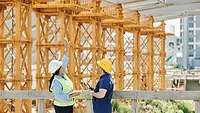
Eye Safety In Construction
"From framing to finish work, I've done everything there is to do in this business," says Zaffino, "and I've come in contact with some pretty hazardous materials."
Shortly after he turned forty, Zaffino began to wear prescription eyewear. When he wore his new glasses and noticed the rate of injuries decrease dramatically, he thought he had solved his eye injury problems. But, he soon learned, it isn't that easy.
Prescription spectacles, by law, have to be impact-resistant, but are not shatterproof and only provide limited frontal protection. Prescription glasses protect your eyes from wood chips, nails and cement rocks. The problem is, they don't protect from smaller particles. "I work outside a lot," says Zaffino. "The wind is constantly blowing things around. When I wear only my prescription glasses, it (the wind) takes the dust, sand and dirt right under, over and around my glasses into my eyes, causing me to slow down.
I spend an awful lot of time wiping my face and flushing my eyes out with water. Soon it begins to cut a lot of production time out of my day."
Summing up his experience with protective eyewear, he advises, "There are more reasons for wearing safety eyewear than there are not to. Don't jeopardize your freedom or your livelihood by not playing it safe."
Construction hazards
Construction is one of the largest and most dangerous industries in the United States. Bodily harm as a result of misusing equipment or through plain negligence can range anywhere from cuts and scrapes to loss of sight or limbs and even death. Because of all the hazards a construction worker encounters in a typical day, injuries occur regularly. And of those injuries, eye injuries, in particular, are the most common.It has been estimated that every day nearly 1,000 eye injuries occur in workplaces across America, which can lead to over $300 million a year when you factor in medical expenses, lost time, and workers' compensation ? all from eye injuries that could have been avoided by wearing proper protective eyewear. The worst part of it is, no amount of money in the world can compensate for the loss that some eye injury victims suffer ? namely, the loss of sight.
What causes eye injuries
Two main reasons for eye injuries on the job are: not wearing eye protection or wearing the wrong kind of eye protection for the job. Not wearing eye protection is obviously dangerous. What most workers don't realize, however, is that wearing the wrong kind of eye protection can be just as hazardous. In fact, most workers who have suffered eye injuries while wearing protective eyewear realize later that the trauma was inflicted from objects or chemicals going around or under their ill-fitting safety eyewear.Unfortunately for construction workers, their line of work puts them in contact with just about every eye hazard known to the safety industry: impact, ultraviolet radiation, liquid splash and infrared radiation. Many construction tasks generate flying debris which can seriously injure the eyes. From wood and paint chips to dirt, concrete particles and even nails, a construction worker's eyes are constantly and most often at risk from impact hazards. Injuries from ultraviolet radiation (UV), liquid splash, and infrared radiation (IR) occur also but are notas common.
If you work outdoors, UV rays are present in ordinary sunlight and can cause great damage to the eyes. Because construction often takes workers both indoors and out, workers in this industry often don't see this hazard as a serious one. Construction workers also come in contact with highly toxic cleaning chemicals, paints and adhesives. For this reason, liquid/chemical splash hazards are prevalent. Contact from these substances can cause momentary vision loss or even blindness, not to mention burning and discomfort in the eyes.
Last but not least is infrared radiation. The torch welding and cutting that construction workers do produces an invisible hazard that can damage the cornea and retina of the eye. In extreme cases, it causes blindness.
First aid
If you've suffered an eye injury, you know how painful it can be. Unfortunately, for this reason it is very difficult to determine how severe the damage is. So, medical help should be sought as soon as possible. Proper treatment following an eye injury can prevent infection and loss of sight.What any doctor or industry expert will tell you is that the best first aid and the key to maintaining good vision is prevention and protection. Make sure you put some extra pairs of safety spectacles and goggles in your tool box and you'll be prepared no matter where your job takes you.
Choose job-specific eyewear
OSHA standards require that employers provide workers with effective eye protection. To be effective, the eyewear must be appropriate for the hazard encountered and must fit properly and comfortably (eye protective devices should allow air to circulate between the eye and the lens). Protective eyewear and equipment should fit snugly and correctly. Straps, frames and other parts should be sturdy and fit comfortably. For protection, the safety industry offers a number of industrial strength safety spectacles, safety goggles, faceshields, welding goggles and shields created to protect you from all of the eye hazards a worker encounters.Once you've purchased safety eyewear, proper maintenance is imperative. Inspect your safety eyewear frequently. Scratched and dirty lenses reduce vision, cause glares and lose their impact resistance. If the frames on your protective eyewear are broken and bent, chances are, your eyewear doesn't fit properly and may contribute to accidents.
Designed to protect from accidental injury, safety eyewear will not withstand repeated impact or abuse. So, inspect it regularly, just as you do your other equipment.
Safety eyewear education is also a must. Most workers suffer eye injuries while doing their regular jobs. Workers who get injured and who do not wear eye protection, usually say that they thought the protection wasn't necessary. When distributing safety eyewear be sure to include information specifically stating what kind of eyewear should be used for which jobs.
Industry statistics
OSHA divides the construction industry into three categories: building construction, heavy construction and special trades. A recent study conducted by OSHA estimated that only 34% of workers in building construction wear non-prescription safety glasses; 22% are estimated to wear goggles. In heavy construction and special trades it was estimated that only 16% and 33% respectively wear non-prescription safety glasses. As for goggles, it was estimated only 11% in heavy construction and 21% in special trades wear them. With statistics like these, it is easy to see why nearly 1,000 eye injuries occur each day!If you don't wear protective eyewear...
On an average day, construction workers often find themselves in situations where there are flying particles or debris, falling objects, swinging objects, sparks and even hazardous chemicals. The possibility for an accident is enormous. If you refuse to wear proper fitting protective eyewear you can quite easily lose your sight. If that's not enough of a threat to your livelihood, consider the time, money and job opportunities you will lose without it. The fact is, construction is a dangerous business. It puts workers in hazardous situations every day. Safety eyewear, needs to be part of the equipment used to get jobs done.David Roll is vice president of marketing at H.L. Bouton Co., Inc., a protective eyewear manufacturer in Wareham, MA. He can be reached at: (508) 295-3300.
Looking for a reprint of this article?
From high-res PDFs to custom plaques, order your copy today!