Personal protection
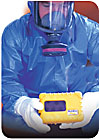
You’ve undoubtedly heard some horror stories about workers who were injured because they weren’t wearing personal protective equipment (PPE) that could have kept them safe. Perhaps you have some stories of your own to tell. Work accident statistics consistently show that an alarming number of injured workers were not wearing PPE that could have prevented or at least lessened the severity of their injuries.
To ensure that your employees are using the required PPE, as per OSHA’s PPE standard (Subpart I), remember these four essential steps:
1) Hazard assessment
Section 1910.132(d)(1) of the OSHA standard says that employers must “assess the workplace to determine if hazards are present, or are likely to be present, which necessitate the use of personal protective equipment.â€Think head-to-toe protection and be sure to consider all the hazards — falling objects, chemical exposures, flying objects, sharp objects, rolling or pinching objects, etc. — as well as all the protections — hard hats, safety glasses and goggles, respirators, gloves, safety shoes, etc. The better you identify and understand the impact of specific hazards, the better able you will be to take the next step and select the most appropriate PPE.
Of course, engineering controls, work practices and administrative controls are the preferred methods of reducing or eliminating hazards. PPE is considered only a supplementary form of protection, necessary when all hazards have not been controlled through other means.
2) Equipment selection
Section 1910.132(d)(1) also says that if such hazards are present, or are likely to be, then you have to:- Select, and have affected employees use, the types of PPE that will protect them from the hazards you have identified.
- Communicate selection decisions to employees.
- Select PPE that fits each affected employee properly.
Try to involve employees in the selection process whenever possible. Let them join you in picking the PPE that they find most comfortable, fashionable, etc. — as long as it can do its job.
These first two steps are actually the easy part. The hard part is encouraging employees to actually use the PPE. The next two steps — training and follow-up — afford you the best opportunity of reaching employees and communicating your important message.
3) Employee training
Section 1910.132(f)(1) requires you to train employees concerning each type of PPE before allowing them to perform any work requiring its use. At a minimum, your PPE training program must include the following information:- when and what PPE is necessary;
- how to properly don, doff, adjust and wear PPE;
- limitations of the PPE; and
- proper care, maintenance, useful life and disposal of the PPE.
The regulations [1910.132(f)(3)] also require you to retrain whenever:
- changes in the workplace render previous training obsolete;
- changes in the types of PPE to be used render previous training obsolete;
- inadequacies in an employee’s knowledge or use of assigned PPE indicate that the employee has not retained the requisite understanding or skill.
Some training tips to encourage employees’ cooperation include:
- explain the need for each type of PPE;
- remind them that OSHA requires it;
- dramatize the consequences of failing to use required PPE;
- lead by example, i.e. use required PPE yourself.
4) Follow-up
No matter how hard you try, some employees will still forget to use their PPE, ignore the rules, think that PPE is for wimps or believe that accidents can’t happen to them. Daily monitoring is essential to see that employees are actually wearing their PPE. Some suggestions to motivate your employees and keep your PPE program on track include:- Use a behavioral approach. Give employees positive feedback each day for using PPE. When you see them not wearing it, rather than scold them, tell them you are concerned about their safety. Have them stop what they are doing and go get their PPE. The next time you see them wearing it, be sure to praise them.
- Recognize and reward employees for using PPE. At safety meetings, praise employees for using PPE. Have a “Safe Employee of the Month†contest and include wearing PPE as one of the main criteria for winning the award.
- Make it easy to get and exchange PPE. Make sure the equipment is readily available and easily accessible at all times.
- Recognize proper use of PPE in performance appraisals. Make sure employees understand that one of the factors you will use to assess their performance is regular use of required PPE.
- Enforce PPE policies. Use discipline if necessary as a last resort to show employees you are serious about their wearing assigned PPE.
If you’re not 100-percent sure that all of your employees are using required PPE right this minute, maybe this is a good time to go and check.
Written for Business & Legal Reports by freelance editor Peter Braver who has contributed regularly to BLR’s OSHA Required Training for Supervisors and other BLR products. Visit BLR’s web site, http://safety.blr.com.
Looking for a reprint of this article?
From high-res PDFs to custom plaques, order your copy today!