The California Division of Occupational Safety & Health (Cal/OSHA) has issued 25 citations against Chevron USA, with proposed penalties totaling nearly $1 million, for state safety standard violations related to the August 6, 2012 fire at Chevron’s Richmond refinery. The citations include eleven “willful serious” and twelve “serious” violations, resulting in the highest penalties in Cal/OSHA’s history.
Chevron today reported a fourth quarter net income of $7.2 billion and 2012 earnings of $26.2 billion.
Fire breaks out; managers don't shut down unit
“Ensuring worker safety is the employer’s responsibility,” said Department of Industrial Relations Director Christine Baker, who oversees Cal/OSHA. “Refineries must take the steps needed to prevent incidents like the August Chevron fire. Failure to do so can pose great dangers to workers, surrounding communities and the environment.”
Cal/OSHA Chief Ellen Widess said the penalties of $963,200 against Chevron are the highest allowed under state law. “Our investigators found willful violations in Chevron’s response before, during and after the fire,” said Widess.
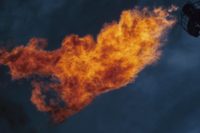
On August 6, 2012, a fire broke out at the refinery when a severely corroded pipe in Chevron’s #4 Crude Unit began leaking. Chevron managers did not shut down the unit but instructed workers to remove insulation, which led to the pipe’s rupture and a massive fire. While there were no serious worker injuries, a reported 15,000 residents of surrounding communities sought treatment after breathing emissions from the fire.
Cal/OSHA immediately launched an investigation into the fire and the leak repair procedures throughout the refinery, and found the following:
Chevron did not follow the recommendations of its own inspectors and metallurgical scientists to replace the corroded pipe that ultimately ruptured and caused the fire. Those recommendations dated back to 2002.
| "Our investigators found willful violations in Chevron’s response before, during and after the fire.” |
Chevron did not follow its own emergency shutdown procedures when the leak was identified, and did not protect its employees and employees of Brand Scaffolding who were working at the leak site.
Twenty-three violations were classified as “serious” due to the realistic possibility of worker injuries and deaths in the fire. Eleven of these serious violations were also classified as “willful” because Cal/OSHA found Chevron did not take reasonable actions to eliminate refinery conditions that it knew posed hazards to employees, and because it intentionally and knowingly failed to comply with state safety standards.
Chevron did not follow its own policies
The “willful serious” violations include the following:
- Chevron did not follow its own policies or act on repeated recommendations to replace the corroded pipe that ultimately ruptured;
- Chevron did not test pipe thickness in areas identified as susceptible to corrosion and leaks because of the high temperature and high-sulfur content of the crude oil;
- Chevron did not implement its own emergency procedures to shut down the Crude Unit where the leak occurred, and exposed workers to harm by directing them to remove insulation;
- Chevron did not recognize the potential for a catastrophic release of ignitable diesel fuel from the leaking pipe, and ordered contractor employees to erect a scaffold at the leak site;
- Chevron allowed workers to enter the hazardous incident zone without proper personal protective equipment;
- Chevron had pervasive violations in its leak repair procedures throughout the refinery. Cal/OSHA investigators identified leaks in pipes that Chevron had clamped as a temporary fix. In some cases the clamps remained in place for years, rather than replacing the pipes themselves.
There were also violations in Chevron’s overall implementation of its own “process safety management” (PSM) procedures, required by Cal/OSHA of all refineries. PSM regulations require refineries to implement a comprehensive safety plan that includes a precise determination of what hazards exist and procedures to eliminate or reduce them. Employers must ensure that machinery and equipment are in good condition, that work procedures are safe, that hazards are controlled, and that workers are trained to safely operate the equipment, recognize hazards and respond appropriately in emergency situations.
“It is Chevron’s responsibility to ensure the safety of its operations. Having an effective workplace safety culture is essential in preventing these kinds of incidents,” said Widess. “This case demonstrates the risks that occur when a refinery does not follow its own safety maintenance program.”
Cal/OSHA has ongoing investigations for Chevron at its El Segundo refinery in the Los Angeles area and its oilfield in Lost Hills near Bakersfield.
Copies of the citations issued today against Chevron as well as Brand Scaffolding are posted online.