2019 top standards- Critical OSHA Standards
OSHA walking-working surfaces standard
29 CFR 1910.21-1910.30 Final Rule Industry Walking-Working Surfaces Standards Personal Protective Equipment

Date adopted: Nov. 17, 2016
Back story
OSHA's efforts to revise and update the existing general industry walking-working surfaces standards have been underway since 1973. The final rule incorporates advances in technology, industry best practices, and national consensus standards to provide effective and cost-efficient worker protection.
It also includes revised and new provisions addressing fixed ladders; rope descent systems; fall protection systems and criteria, including personal fall protection systems; and training on fall hazards and fall protection systems. In addition, the final rule adds requirements on the design, performance, and use of personal fall protection systems.
The rule is intended to increase harmonization between OSHA standards, which many stakeholders requested. Of particular importance, OSHA increased consistency between the final rule and OSHA's construction Scaffolds, Fall Protection, and Stairway and Ladder standards (29 CFR part 1926, subparts L, M, and X), which makes compliance easier for employers who conduct operations in both industry sectors. The revisions in and additions to the final rule will allow employers to use the same fall protection systems and equipment and follow the same practices when they perform either general industry or construction activities.
Scope
The rule applies to all general industry workplaces and covers all walking-working surfaces, which include horizontal and vertical surfaces such as floors, stairs, roofs, ladders, ramps, scaffolds, elevated walkways, and use of fall protection systems.
The final rule covers a wide variety of general industry firms including building management services, utilities, warehousing, retail, window cleaning, chimney sweeping, and outdoor advertising.
Key hazards
Falls from heights and on the same level (a working surface) are among the leading causes of serious work-related injuries and deaths. OSHA estimates that, on average, approximately 202,066 serious (lost-workday) injuries and 345 fatalities occur annually among workers directly affected by the final standard. According to the Bureau of Labor Statistics (BLS) Census of Fatal Occupational Injuries (CFOI), from 1999 to 2010, falls were second only to highway incidents in terms of fatal injuries. From 2011-2012, slips, trips, and falls were the second leading cause of injuries and illnesses, behind only overexertion.
Slips, trips, and falls, including falls on the same level, can result in injuries such as fractures, contusions, lacerations, and sprains, and may even be fatal. Falls to lower levels can increase the severity of injuries as well as the likelihood of death. Falls on the same level can also result in strains and sprains when employees try to “catch” themselves to prevent falling.
There are many walking-working surface hazards that can cause slips, trips, and falls. These hazards include damaged or worn components on personal fall protection systems and rope descent systems; portable ladders used for purposes for which they were not designed; fixed ladders that are not equipped with fall protection; damaged stair treads; snow, ice, water, or grease on walking-working surfaces such as floors; and dockboards that are not properly secured or anchored.
Key provisions
- Fall protection: Employers may choose from the following fall protection options: guardrail system; safety net system; personal fall arrest system; positioning system; travel restraint system; ladder safety system; or rope descent system.
- Ladders: The new rule includes requirements to protect workers from falling off fixed and portable ladders as well as mobile ladder stands and platforms. (The ladder requirements do not apply to ladders used in emergency operations or ladders that are an integral part of or designed into a machine or piece of equipment). In general, ladders must be capable of supporting their maximum intended load, while mobile ladder stands and platforms must be capable of supporting four times their maximum intended load. Each ladder must be inspected before initial use in a work shift to identify defects that could cause injury.
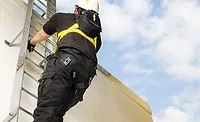
Employers must have ladder safety or personal fall arrest systems for fixed ladders that extend more than 24 feet. The use of cages or wells for fall protection were phased out from the effective date of the final rule under the following timeline: two years for making sure all new fixed ladders and replacement ladder/ladder sections have a ladder safety or personal fall protection system. For existing ladders, within two years, employers had to install a cage, well, ladder safety system, or personal fall arrest system on fixed ladders that do not have any fall protection.
For portable ladders, employers must ensure that rungs and steps are slip resistant; portable ladders used on slippery surfaces are secured and stabilized; portable ladders are not moved, shifted, or extended while a worker is on them; top steps and caps of stepladders are not used as steps; ladders are not fastened together to provide added length unless designed for such use; and ladders are not placed on boxes, barrels, or other unstable bases to obtain added height.
- Training Requirements: The rule adds a requirement that employers ensure workers who use personal fall protection and work in other specified high hazard situations are trained, and retrained as necessary, about fall and equipment hazards, including fall protection systems. A qualified person must train these workers to correctly identify and minimize fall hazards; use personal fall protection systems and rope descent systems; and maintain, inspect, and store equipment or systems used for fall protection.
- Phased in enforcement: While most of the rule became effective in 2017, the provision that cages and wells used as fall protection be replaced with ladder safety or personal fall arrest systems on all fixed ladders over 24 feet will be enforced as of November 18, 2036.
Benefits of the standard
OSHA has determined that the requirements in this final rule will significantly reduce the number of worker deaths and injuries that occur each year due to these hazards, particularly workplace slip, trip, and fall fatalities and injuries. The agency estimates that the rule will prevent 29 fatalities and 5,842 injuries annually.
The rule benefits employers by providing greater flexibility in choosing a fall protection system. For example, it eliminates the existing mandate to use guardrails as a primary fall protection method and allows employers to choose from accepted fall protection systems they believe will work best in a particular situation - an approach that has been successful in the construction industry since 1994. In addition, employers will be able to use non-conventional fall protection in certain situations, such as designated areas on low-slope roofs.
Enforcement case study
The first citations issued under the new standard were to one company — an aluminum manufacturer — and showed the breadth of surfaces covered under the new standard. OSHA inspectors found that fixed ladders, portable ladders, skylights, stairs, loading docks, and other walking-working surfaces were not compliant.
The total of 51 safety and health violations stemming from that inspection came with a proposed penalty totaling $1,922,895. One violation alone — for failure to ensure that the side rails of a ladder extended 42 inches above the top of the access level or landing platform served by the ladder — resulted in a proposed penalty of $9,959.00.
Compliance assistance
OSHA has a Fact Sheet and a “Questions and Answers” compilation that can be accessed from its Walking-Working Surfaces and Fall Protection Rule web page.
Sponsor:
www.tingleyrubber.com
800-631-5498
Looking for a reprint of this article?
From high-res PDFs to custom plaques, order your copy today!