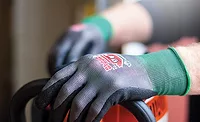
Glove coatings enhance grip and durability
|
Available palm coatings |
| Latex |
| Polyurethane |
| PVC |
| Nitrile |
Beyond the move from plain leather gloves to more complex composite string-knit styles, an advancement in palm coating technology has completely changed the market. Let’s examine the importance of these technologies and how to maximize their benefits.
Hand protection against industrial injury
Statistically, wearing gloves reduces the relative risk of hand injury by 60 percent... making it one of the most effective industrial injury prevention programs. Because of technological advancements, the range of gloves on the market today is geared toward task-specific applications — meaning there is a “right” glove for every worker performing a specific task. (There’s a left glove too, but you see where we’re going with this.)
Today’s consumer wants a glove that offers not only safety, but enhanced dexterity, longevity, comfort and grip. While low-priced options can sometimes appeal to a customer, they prove to perform inadequately and tend to incur higher investment due to replacement costs in the long run (not to mention worker injury costs).
Exploring palm-coated gloves
We’ve established that today’s consumer values dexterity and ergonomics when selecting hand protection products. Seamless palm-coated knit gloves offer these attributes — they are breathable and also provide workers with enhanced grip and durability.
There is a seemingly endless range of combinations — and glove manufactures use a wide range of tough materials in their palm-coated gloves, over a wide range of string knits. Extensive combinations are the result of combining cotton, nylon, Kevlar®, Dyneema® and composite-yarn gloves with palm coatings like latex, PVC, polyurethane, and nitrile, not to mention the foamed versions of some these coatings.
Palm-coated gloves are suited for handling small parts in the automotive industry, metal stamping, construction and general purpose, by offering better grip, dexterity, increased abrasion resistance, puncture resistance and durability.
Available palm coatings
Let’s go over the different coating types, their features and benefits.
Latex is used as a barrier material for gloves or glove coatings, and it is often assumed to be another name for rubber. That is not the case, however, because the process by which latex is created is markedly different from that of natural rubber.
Latex has very high elasticity and good grip compared to other glove materials, and withstands extreme temperature and tear resistance. Chemically, it resists alcohols and some ketones, but performs poorly around most hydrocarbon and organic solvents (i.e. gasoline). However, because of allergy issues, it is not always an option for some workers.
With its great stretch, strength and softness, as well as low particulate shed, polyurethane adds a whole other class of properties to the palm-coated glove category. Although it has been around for roughly 70 years, appreciation for its non-allergenic properties for use in medical equipment has grown only recently.
It is a thermoplastic polymer of urethane that starts out as a hard resin and can be taken in numerous directions from hard to soft, depending on the desired end-use.
Known as having the unique quality of being quite “grippy” without being sticky, finishing processes or substances like powder and chlorination are not required to reduce tackiness. Polyurethane’s softness, combined with good puncture and abrasion resistance, make it a most versatile polymer. It is a desirable coating for cut-resistant gloves because it provides grip and boosts puncture resistance, all without adding bulk or reducing touch sensitivity. Additionally, the low-particulate shed makes it a sound choice for those working with electronics and in cleanrooms.
Chemically, polyurethane has excellent resistance to oils, solvents, fats, greases, gasoline (which makes it the opposite of rubber), oxidation and ozone but has poor resistance to hot water and is not recommended for use above 79°C (175°F).
Polyvinyl Chloride (PVC), a synthetic thermoplastic polymer of vinyl chloride, is a very inexpensive material, making it one of the more common coatings for coated work gloves. The process to make it is fairly simple and very similar to that of rubber production. However, it is 100 percent synthetic, and as such, is stronger, does not cause allergic reaction and therefore has a wider range of applications. It is the synthetic version of latex, and while it lacks the inherent stretch and grip of natural rubber, it is nonetheless prized for its strength.
As a palm coating, PVC offers good abrasion resistance, though it may be susceptible to punctures, cuts and snags. And while it is flexible, it does not provide the tactile sensitivity associated with most rubber products. PVC coating offers similar wear and abrasion resistance to nitrile, but has one major added benefit — many types of glue will not adhere to it. This makes gloves with PVC palm coating ideal for woodworking and many other glue-related jobs. It is also great for automotive assembly and trim applications, as glue won’t stick to the PVC palm surface.
Another benefit of PVC in work gloves is the fact that it stays flexible at lower temperatures, hence it makes a great choice for a palm-coated winter glove. PVC starts to soften at approximately 82°C (180°F). It’s also effective against water and most aqueous solutions, detergents, and diluted bases and acids. It offers limited chemical resistance to organic solvents.
Nitrile rubber does not contain any latex proteins. It offers excellent resistance to punctures and tears, being three times more puncture-resistant than rubber when used in gloves.
With regard to chemical resistance, the principle difference between latex and nitrile is that nitrile stands up well to oil, making it a good choice for metal stamping or handling small oily parts.
Nitrile, while not flame-resistant, does perform well in a range of temperatures between -4°C (25°F) and 149°C (300°F). Additionally, nitrile can be foamed when used as a palm coating, so that when in contact with smooth, oily surfaces, the foamed nitrile behaves like a sponge. Oil on the surface is soaked up, displaced and grip is improved considerably. Another foaming process uses “micropore” technology to create a bubbled surface that will not allow oil to penetrate to the hand while absorbing it at the same time.
With all these options available, EHS specialists, safety buyers and individual workers can choose from a wide selection, knowing they have a choice that won’t compromise either safety or comfort.
Looking for a reprint of this article?
From high-res PDFs to custom plaques, order your copy today!