Five tips for working at height
Falls from height are continually one of the leading causes of workplace deaths. That’s why OSHA requires that fall protection be provided at elevations of 4 feet in general industry and 6 feet in construction.
Safeguarding workers at height takes many forms: guardrails, hole covers, netting or personal protection equipment. Of course, eliminating the need to work at height is clearly the safest solution.
However, fall hazards are built into many jobs, from roofing to building maintenance to transmission-tower repair.
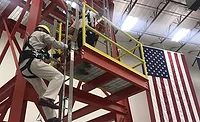
Personal fall-arrest systems provide essential lifelines for many high-risk workers. These systems — which include full-body harnesses, energy-absorbing lanyards or retractable lanyards, and strong anchor points — help to keep a fall victim safe by reducing and distributing the force of a fall on the body, and then safely suspending the person until help arrives.
The effectiveness of this equipment hinges on proper use.
Here are five tips to help both workers and employers gear up and deploy the safest possible fall protection.
Assume you could fall today
Avoiding falls begins with a conscious mindset about the dangers that naturally come with working at height. Common sense dictates that anyone who approaches their worksite with the understanding that they could be injured or killed is far more likely to take the precautions necessary to prevent — or safely survive — a fall.
Those precautions include having the appropriate fall-arrest equipment and knowledge necessary to use it correctly (covered below).
A rescue plan is also critical. OSHA requires employers to establish plans outlining how they will provide “prompt rescue” of a suspended employee or ensure that they are able to rescue themselves.
Workers should know the provisions of that plan and, most importantly, what measures co-workers would follow to perform a rescue. More specifically, before they ascend, employees should be aware of what equipment — be it an aerial work platform, a ladder or a rope rescue system — is on-site to help others retrieve them if they become suspended after a fall.
Self-rescue equipment is also available. Once suspended after a fall, the worker can use the device/equipment to safely descend to a lower level.
If a prompt rescue is not performed, suspension trauma can quickly set in, triggered by lack of adequate blood circulation. No harness should be without a suspension trauma system. A suspension trauma strap, constructed of webbing and stored in a pouch, can be used by fallen workers to help relieve some of the effects of suspension trauma. This helpful tool can buy the victim more time, but can’t be the only resort in a rescue plan.
For prompt rescue where self-rescue is not possible, ensure that a simple-to-use rope rescue system is available and employees are trained to perform a rescue.
Wear your harness correctly
Fall-arrest harnesses are only effective if they fit well. The first step is selecting the right size range for the harness. Universal sized harnesses fit a majority of workers, but some workers may need to buy an extra small or XXL.
Next, make sure the harness is properly adjusted. If the harness is too loose, the person could fall out of it during a fall. The harness must fit snugly, without causing discomfort. The chest strap should hug the upper torso, and the sub-pelvic strap should be securely positioned under the backside.
Securely tighten leg straps. During a fall arrest, the user will naturally sink into the harness. If the leg straps aren’t snug, the person could sink too deeply into the harness, and the chest strap could rise toward the throat, putting excess pressure on the person’s windpipe. Severe groin injuries also can result.
The rule of thumb for leg straps: If you can slide your fingers between your thigh and the strap, and then easily rotate your hand, the strap is too loose.
The harness dorsal D-ring should align squarely between the shoulder blades or slightly higher. The D-ring connects the harness to the anchorage point via lanyards. If the D-ring is improperly located too low on the back, the wearer may be suspended in an extreme forward-leaning position.
The ideal at-rest position after experiencing a fall arrest is vertical.
Think twice when sharing equipment
In general, shared harnesses wear out sooner than “assigned” harnesses because they’re used more often, during multiple shifts. And without an assigned owner, no one has sole responsibility for maintaining the harness.
Instead, shared harnesses often are thrown into the tool crib at the end of the workday, or left outside on an aerial work platform. Improper storage is a leading cause of harness damage and can shorten service life.
Workers who share harnesses must be doubly vigilant in inspecting equipment thoroughly before wearing it.
Employers who provide shared harnesses should consider investing in the highest quality equipment they can afford. They should also opt for harnesses outfitted with grommet-style leg straps. Like a belt, grommet-style straps can be easily readjusted by users.
Don’t re-use a harness after a fall
Fall-arrest equipment is designed for one fall — and one fall only. Under no circumstances should workers use a harness that has been impacted by a fall arrest. Even though the damage may be invisible, fibers in the harness may have undergone stress and become weakened.
A life is too valuable to risk on questionable equipment strength.
Recognizing the danger of damaged harnesses, manufacturers do not guarantee their harnesses will safely arrest more than one fall. Some manufacturers go further to protect workers, installing “impact indicators” on their harness. Often these indicators take the form of special threads sewn into the shoulder webbing. The force of a fall arrest breaks these threads, offering a clear sign that the harness has been impacted. Other manufacturers may build the indicator into the D-ring area. Check the harness user manual to see whether your harness has an impact indicator.
Use anchorage with proper rating and design
OSHA requires 5,000 pounds of anchorage strength for fall arrest, or at least twice the anticipated force. This may seem like a lot, but if a 220-pound person were to freefall for only 6 feet without an energy-absorbing lanyard, they would produce nearly 5,000 pounds of force. The amount of force increases in conjunction with the freefall.
What kinds of structures offer the strength to withstand such force? Major structural elements, such as hefty I-beams on a building or a bridge, or a concrete pad embedded with a concrete anchorage connector, and certain rooftops.
Engineered anchorage solutions for fall-arrest systems can offer solutions for areas frequently accessed that don’t have convenient anchorage. Best-in-class equipment manufacturers have experience providing solutions that meet and exceed federal regulations.
Looking for a reprint of this article?
From high-res PDFs to custom plaques, order your copy today!