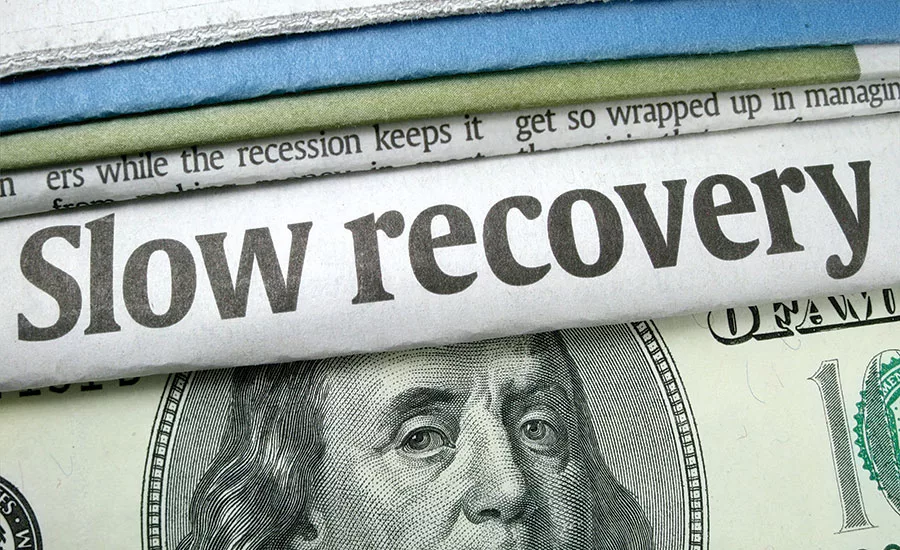
Economic “recovery” continues to crawl
National industrial and safety distributors in their latest earnings reports all strike the same chord: North American sales of safety products and over industrial supplies continue to confront strong headwinds. Organic sales for many distributors in 2016 are either minimally up by a percentage point or two, flat, or down by upwards of 5-7 percent.
What gives?
It’s now been eight years since the Great Recession of 2007 and 2008 ended, and in terms of average annual growth, the pace of this so-called expansion has been by far the weakest of any since 1949, according to a recent analysis by The Wall Street Journal.
The economy has grown at a fragile 2.1 percent annual rate since the U.S. recovery began in mid-2009, according to gross-domestic-product data the Commerce Department released in late July.
Total growth represented by this expansion ranks just 8th of the past 11 cycles of economic comebacks.
The current recovery remains smaller than the one during Richard Nixon‘s administration. And that 16 percent expansion lasted just three years. The economy grew 18 percent from 2001 through 2007. It grew 52 percent from 1961 through 1969.
Recovery for many distributors could be described as durable but diminished. There have only been three longer expansions in the past seven decades. Some experts chalk up the length of the current comeback due to its lack of intensity.
So far, the recovery has occurred entirely during Barack Obama‘s time in the Oval Office, making it the longest expansion under a single president. The growth streak would need to extend just a little more than halfway through the next president’s term to achieve a modern record.
The average economic expansion since 1949 has lasted just more than five years.
Failing to meet expectations
Unfortunately, safety and industrial supply distributors can’t benefit from the strongest segment of the current bounceback – consumer spending. Consumers did their part in the second quarter, but business investment fell, bringing overall quarterly growth to a weak 1.2 percent, well below the 2.6 percent figure forecast by economists. And the first quarter’s growth was revised downward, to a 0.8 percent snail’s pace.
Reactions
Here’s how economists and analysts reacted to the second quarter worse-than-expected GDP report from the Commerce Department, quoted in The Wall Street Journal:
“The good news is that consumption increased by a very strong 4.2 percent annualized in the second quarter and net exports added 0.2 percent points to GDP growth, as exports increased by 1.4 percent, while imports contracted by 0.4 percent. Otherwise, it was all bad news.
“There are some reasons for optimism in the second half of the year. The survey evidence has improved markedly in recent months. The drag from shrinking mining-related investment will fade, residential investment will recover and net exports should benefit from the fading of the 2014-15 dollar surge. Inventories have been a significant drag on GDP growth for five consecutive quarters now, which cannot continue indefinitely. But consumption growth is sure to slow too.” —Paul Ashworth, Capital Economics
“Growth is up only 1.2 percent year over year. This report was very weak, and this report supports our forecast of a coming U.S. recession. Industrial production data convey that we are in a recession right now. We still expect a slowing of U.S. growth in the second half of the year as lower oil prices affect oil and gas credit and financial players. At the same time, we also expect light-vehicle sales are likely to slow, due to oversized used lease fleets crowding out new vehicle sales, as well as a reduction in new issuance of subprime auto loans. We still believe a U.S. recession is likely to begin in late 2016, and today’s GDP report reaffirms our expectations. We also expect no Fed rate hikes this year.” —Jason Schenker, Prestige Economics
Frustration
Distributors will be the first to tell you today’s U.S. economy is anything but dynamic. Burdened by anemic business spending, overflowing factories and warehouses, and a surprisingly weak housing sector, the economy barely improved this spring after the usual winter doldrums.
As mentioned, consumer spending increased at a robust pace, helping to sustain a modest growth rate of 1.2 percent, but the gain was overshadowed by poor results in other sectors of the economy – industries such as manufacturing and oil and gas which are prime targets for safety sales. The April-June quarter was the third consecutive period in which the economy advanced at less than a 2 percent annual rate, the weakest stretch in four years.
Recent economic data underscores distributors’ frustration about the current growth cycle, which has now gone on for seven years — longer than most upswings — but which has never soared to a high performance level.
Distributors aren’t the only ones blue. Ordinary Americans have barely benefited from the seven-year rebound. The unemployment rate, which reached 10 percent after the recession, has fallen back to around 5 percent, while hiring and pay gains have been healthier lately. Still, many American who lost jobs in the Great Recession have had trouble maintaining personal income levels.
Real economic growth
Besides the decrease in inventory accumulation and business investment, weaker government outlays also held back growth in the second quarter, reinforcing a trend that has hobbled the recovery in recent years.
The abrupt falloff in homebuilding caught analysts off guard, but it came after a series of double-digit gains in late 2014 and 2015. And with mortgage rates very low and home prices still rising in many parts of the country, the residential real estate sector is expected to contribute to growth again in the coming quarters.
While grappling with weaker demand from customers in Asia and Europe, many factories and mills in the nation’s heartland have been hit by the drop in energy prices as new drilling for oil and natural gas has collapsed.
Domestically-focused service industries like software, health care and financial services are doing well, lifting incomes among white-collar workers. A strong real estate market in many parts of the country and the run-up on Wall Street are also encouraging more affluent consumers to open their wallets.
A glass half full or half empty?
A report in The New York Times offered a good news-bad news scenario for the economy. The positive vibes:
Overall G.D.P. is better than it looks: OK, the economy grew at only 1.2 percent in second quarter ‘16, far below the 2.5 percent that analysts had forecast. But the shortfall was almost entirely because of contracting business inventories, which generally doesn’t have a long term impact.
In terms of “final sales,” G.D.P. excluding inventories, the economy grew at 2.4 percent, a positive rebound from the winter months and in line with forecasts. Final sales tends to be a better measure of the underlying rate of growth, while inventories swing around without reflecting any long-term trend.
Consumers are spending money: The largest component of the economy, personal consumption expenditures, grew at a strong 4.2 percent rate in the second quarter. That’s evidence that a long-awaited boost in consumer spending from an improving job market and cheaper fuel prices may be finally materializing. Americans are feeling a bit fatter in the wallet, and showing up in stores, restaurants and auto lots ready to spend, according to The New York Times – not that that is much solace for safety and industrial supply distributors. For the first six months of 2016, total retail sales were up 3.1 percent over the same period of 2015.
Wages are rising more quickly: The employment cost index was up 0.6 percent in the second quarter and is up 2.3 percent over the previous year. The wages and salary component of compensation is now up 2.5 percent over the last year; that same reading was only 2 percent in the second quarter. So Americans are starting to see bigger paychecks, and are spending that money.
What’s the bad news?
Business investment is contracting: Things aren’t looking so great in the business sector where distributors live. Investment in business structures, equipment and intellectual property fell for the third consecutive quarter.
A decline in investment in energy exploration, because of a plunge in the price of oil and natural gas, appears to be a major part of that decline. A strong dollar is hurting American export sales, another squeeze to profits that businesses face as they pay higher wages.
Bottom line: consumers are driving the economic engine right now, with businesses pulling up the rear. Experts predict either businesses will ramp up investment to fulfill consumer demand, or weak business investment will lead to fewer jobs and weaker consumer spending.
Productivity growth is poor: Worker productivity determines the wealth of nations: How much economic output can be created from an hour, or a day, of human labor? According to the new G.D.P. numbers, the economy grew at only a 1 percent pace over the six-month span, which doesn’t say much for productivity.
And the labor market might be on the edge of a slowdown in job creation. In the past six years, the U.S. economy has created more than 13.6 million net new jobs, an average of between 175,000 and 200,000 per month. During that time, the unemployment rate has dropped from nearly 10 percent to 4.9 percent, and wage inflation (as measured by the year-over-year gain in average hourly earnings) has moved from a low of near 1.5 percent to over 2.6 percent.
Economic history suggests that seven years into a recovery cycle, and how many jobs have been added, a routine downshift in the labor market may be at hand. “Temporary help” jobs, a key leading indicator of future job growth, have fallen by more than 40,000 jobs in the first six months of 2016. If sustained, we could see a slowdown in overall job creation later this year.
Looking for a reprint of this article?
From high-res PDFs to custom plaques, order your copy today!