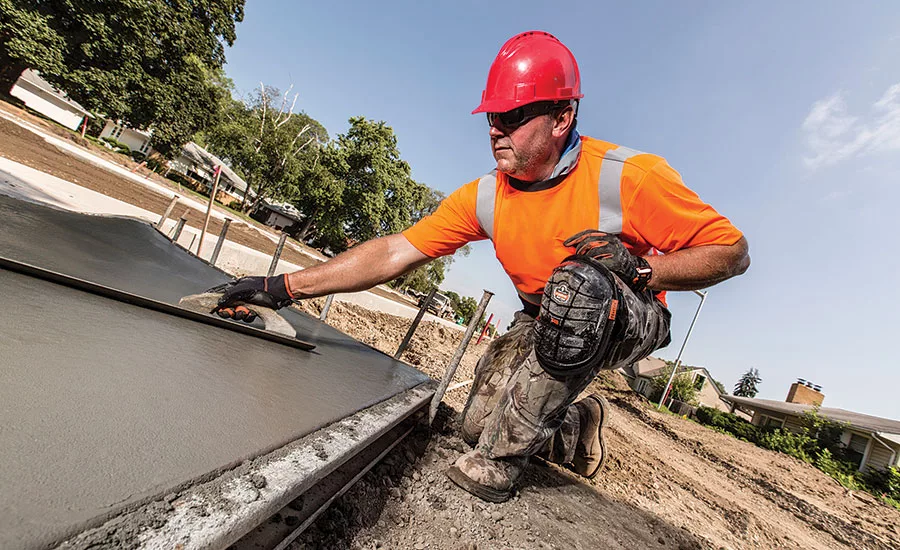
Kneeling on hard surfaces increases risk of injury
No one expects to wear the same footwear for every kind of work. After all, different shoes are designed for rough surfaces, slippery surfaces, finished flooring, construction sites, carpeting, etc. The same thing applies to “shoes” for our knees (more on that later).
The largest joints in our body are complex ones where the three main bones of the leg (femur, tibia, and fibula) meet and are protected by the kneecap (patella). Large ligaments hold each knee together, and tendons attached to the bones allow muscles to extend and flex the lower leg. Cartilage lubricates the movement of the bones where they meet and cushion the knee, along with fluid-filled sacs called bursa.
Knees need support
Knees can be temporarily or permanently damaged by dynamic, athletic actions such as a twist or a fall, but static stresses can also lead to disability. Sustained pressure on the cartilage or bursa can be very painful, especially when paired with osteoarthritis or other ailments associated with aging or overuse. Concentration of pressure on a small part of the knee, such as kneeling or pressing against very hard surfaces, can be distracting enough to interfere with a worker’s concentration and productivity.
Carpet layers, masons, baggage handlers, tile setters, carpenters and other trades do plenty of hard work at or near ground level. In some positions, those knees support a majority of their body weight in a very different way than while standing. These workers don’t want to be distracted by pain, discomfort or concerns about long-term problems.
“Tasks that involve frequent stooping, kneeling, or squatting increase your risk of developing bursitis, tendinitis, or arthritis in the knee. The risk of arthritis increases for workers who already have had a knee injury and work in these positions.”1
“In a national survey of working adults (age 33-41), the incidence of musculoskeletal disorders including knee injuries was found to be linked to the hazardous job activity of kneeling or crouching.”2
Just as shoes do for feet, knee pads should cradle and support all the bones, cartilage, tendons and ligaments in knees. High-quality knee pads should conform to the shape of the knee as they move and change position. Old-school knee pads provided a slightly softer surface to kneel on, but still concentrated pressure on limited areas. Shaped knee pads, with foam lining, gel sheets, or injected gel materials, are designed to surround the knee joint, conform to and cradle it, and most importantly, stabilize it when pressure is applied. The padding is designed to distribute pressure across the entire knee area, as well as to absorb some of the impact associated with moving around, shifting weight when changing positions or “walking” on your knees.
“Workers who spend a good deal of time in the kneeling position put 89 percent of their body weight on a small surface area. Prolonged kneeling can often lead to injury. The rationale for using knee pads is to protect the knee by distributing your weight over a larger surface area and reduce the force passed on to soft tissue.”3
Knee pads increase productivity
For simple or short-term tasks, a pair of inexpensive foam knee pads might suffice, just as a simple pair of flip-flops do for walking to the beach. Beyond the padding, pro-grade knee pads usually incorporate some type of protective shell, analogous to the sole of a shoe. And like shoes, one type of sole may not be best for all situations.
A basic function of the shell is to protect from hard or sharp objects, such as rocks, nails, debris, or even bumps in the floor. Depending on the floor’s surface, desirable attributes may include traction or slip-resistance (roofers); water- or chemical-resistance (custodians and cleaning crews); or non-marring materials (tile installers and finish carpenters). Ironically, some workers may prefer smooth, easy-sliding shells that allow them to scoot around or across certain work surfaces without crawling.
“Reducing discomfort associated with kneeling on hard surfaces for prolonged periods may increase productivity because workers would presumably be able to work for longer periods without standing up.”4
More options available
New generations of knee pads also offer more choices on how they attach to the worker's knee and leg – a common source of user complaints. Straps that are too tight or feel funny can restrict circulation and cause other problems. Whether hook-and-loop fasteners, buckles, elastic straps, etc. are used, knee pads should fit the task and the worker. Worn all day, or in challenging conditions, they need to be secure, and may need to fit over cold weather or other types of protective clothing. For intermittent use, the straps should be easy on/easy off. For folks on the go, the straps may need to articulate for easy walking as well as kneeling. Fortunately, a variety of styles are available to choose from well-stocked vendors.
Knee pads stay with the worker wherever they go: they are essentially portable personal padding/protective equipment (PPPPE!). But sometimes, they just don't work in a specific situation or are not what workers prefer. It may be possible to pad the kneeling surface instead of the knees. This would be analogous to walking without shoes on deep carpet.
Kneeling pads, conversely, are typically thick, padded accessories that workers take with them. Often small and portable for controlling localized pressure, they can also be used to cushion elbows, shoulders, hips, and other body parts when working in tight, constrained, or twisted postures. That’s equal opportunity comfort! Larger versions can be used to provide whole-body support, and are comparable to anti-fatigue mats for feet and legs. They can be staged near areas where regularly used and shared by a number of employees who work there.
Modern surgical techniques, reflexology, and a variety of drugs are available to help treat knee pain when it starts to interfere with work. But a better approach is to take a long-term, preventative approach so workers can work more comfortably and stay pain-free and productive. Finding the right “shoes” that suit the knees of workers and their respective tasks is a good first step.
References
1. www.elcosh.org/document/2056/1426/d001051/2.html
2. www.cpwrconstructionsolutions.org/hazard/390/kneeling-squatting.html
3. www.cpwrconstructionsolutions.org/interiors/solution/109/knee-pads.html
4. www.cpwrconstructionsolutions.org/roofing/hazard/740/install-tile-or-shingle-roofs-kneeling-squatting.html
www.cdc.gov/niosh/docs/90-104/
http://patient.info/health/housemaids-knee-prepatellar-bursitis
www.medscape.com/viewarticle/762365
www.webmd.com/osteoarthritis/features/6-ways-to-ruin-your-knees
Looking for a reprint of this article?
From high-res PDFs to custom plaques, order your copy today!