Is your footwear program the right size?
Employees have various point of sale options
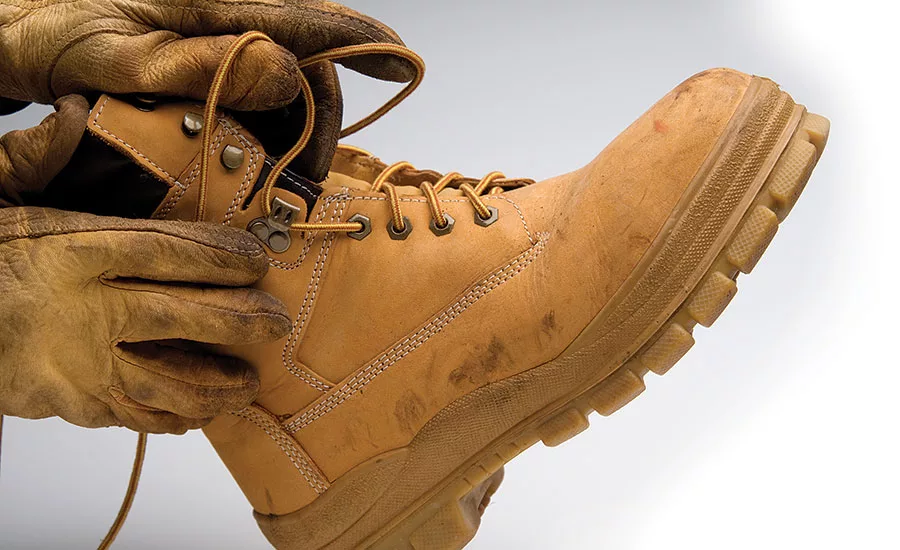
This image of a beaten up work boot helps visualize just how much safety footwear programs are needed in the workplace.
According to the National Safety Council’s (NSC) Injury Facts®, 2016 Edition, there were 43,570 foot injury cases involving days away from work in the United States in 2013. The NSC’s Injury Facts also reported that the average total incurred cost per claim for a foot/toe injury was slightly more than $24,900. This dollar figure justifies the importance of having a comprehensive safety footwear program supported by an all-inclusive point of sale solution for your organization.
The 29 Code of Federal Regulations (CFR) 1910.132(d)(1) states: “The employer shall assess the workplace to determine if hazards are present, or likely to be present, which necessitate the use of personal protective equipment (PPE)”. It then instructs employers to select properly fitting PPE based on the findings of the hazard assessment, and communicate to the affected employees the selection decisions.
Steps to take before conducting your footwear hazard assessment include interviewing affected employees and reviewing leading and lagging indicators such as near misses, associated workers’ compensation costs and OSHA’s form 300 for previous foot related injuries. The hazard assessment it can be conducted for an area, a job classification or for an individual.
The OSHA standard for safety footwear general requirements -- 29 CFR1910.136(a) --states that “The employer shall ensure that each affected employee uses protective footwear when working in areas where there is a danger of foot injuries due to falling or rolling objects, or objects piercing the sole, or when the use of protective footwear will protect the affected employee from an electrical hazard, such as static-discharge or electric shock hazard, that remains after the employer takes other necessary protective measures.”
When to use PPE
The last line of defense is PPE. PPE can be used until the more effective controls are implemented, if the engineering controls prove to be infeasible, or used in conjunction with other controls based on the PPE hazard assessment.
The footwear hazard assessment should look for common foot hazards such as:
◊ Chemical
◊ Compression
◊ Impact
◊ Penetrating
◊ Electrical
◊ Slippery/wet conditions
◊ Heat /cold
◊ Molten metal
Once you have identified a need for protective footwear for your facility, you need to qualify what is the best point of sale option(s) for your organization. Depending on your operation you could use one or a combination of the following point of sale methods:
◊ Online
◊ Shoemobile
◊ Store front
◊ On-site footwear center
Online
Web based online tools allow you to select from a menu of services to track employee purchases, administer payroll deductions, apply your company contribution subsidies and generate customized reports. You can set up footwear selection guidelines for your employees based on their work environment. With the use of drop down menus the employee can filter by men’s or women’s styles, sizing, toe type, variety of widths, sole rating and metatarsal guards. The user can also sort by brand name, color; price and other attributes to quickly narrow down their choices.
Shoemobile
This point of sale solution appeals to larger, multi-shift operations facility. The shoemobile will come to your facility with a large selection of brands and styles with their on-hand inventory. Trucks are stocked with footwear matched to your specific work environment. This service allows employees to shop while on their breaks and to walk out the door with a pair of professionally fitted safety shoes. There is no waiting for the shoes to be delivered.
Store front
Smaller organizations that may not have a formal protective footwear program will often allow their employees to shop for their safety shoes on their own time at a local store that stocks the most popular styles. The employee then brings in the receipt of purchase to the employer and is reimbursed based on the company’s subsidy.
On-site
This point of sale solution is for the larger facilities that have a lot of employees who are required to wear safety shoes. Organizations will often partner with a vendor to have an on-site, vendor-managed store for their employees’ convenience of not having to leave work to shop for safety shoes.
Benefit-managed system
Most organizations have a protective footwear program that includes a company contribution or “subsidy” to offset the cost of the footwear. The subsidy is regarded as an employee benefit and is often included in contract negotiations. The subsidy process typically involves human resources (HR) and the payroll department, which in most cases are often staffed on the lean side. There is a clear benefit to having the footwear supplier managing the transactions and payroll deductions that minimizes administrative time and paper work.
Features of a footwear benefits-managed system (BMS) include tracking employee purchases, administering payroll deductions and applying company contribution subsidies, and generating custom reports. By taking on the onus of managing the footwear program, the supplier takes over the tedious paper work and reducing the number of vendors.
Benefits-managed case study
A large manufacturer with more than 3,000 employees and a safety footwear reimbursement budget of more than $100,000 annually was recommended by Grainger consultants to use the shoemobile point of sale option. It had a $9.17 per reimbursement transaction cost and a 14-minute transaction time compared to a current cost of $33 per transaction and a 50-minute transaction time with the company’s existing supplier. The impact of the recommendations equated to more than 70 percent savings in processing time and cost; with an annual savings of more than $50,00.
Conclusion
To achieve the best comprehensive footwear program, start with performing a footwear PPE hazard assessment. Based on your hazard assessment, evaluate if the foot hazards can be eliminated using OSHA’s hierarchy of controls. If engineering and administrative controls do not adequately eliminate the need for protective footwear, define what areas require safety footwear and how many affected employees will be covered under the footwear program.
Select the styles appropriate for the hazards present. Then select the point of sale option(s) best suited for your situation. There is not a one-size-fits-all solution for every organization, and it could possibly include multiple solution channels. The last step is to do an annual review of your footwear program to determine if the solution you have still meets your needs.
Looking for a reprint of this article?
From high-res PDFs to custom plaques, order your copy today!