In the slickest conditions you can prevent slips, trips & falls

It’s easy to think that a slip, trip or fall won’t happen to you, your employees or your loved ones. But the statistics aren’t favorable to anyone. That’s why we echo OSHA’s recent improvements to the “Walking and Working Surface Rule” and call for increased prevention of slip, trip, and fall injuries.1
The 2017 Liberty Mutual Workplace Safety Index2 reported that three slip, trip and fall categories make up a whopping 30.7 percent of the total injury burden and have direct costs of more than $18.4 billion.
When workers go down, other things skyrocket: industrial insurance premiums and costs associated with training replacement workers, not to mention a person’s pain, temporary or permanent immobility, and risk of depression due to the compromised lifestyle.3
Preventing incidents
You now have good reason to evaluate your slip, trip, and fall prevention program. There’s no time like the present to address this issue.
Stage 1: Follow the Footprints – Identify Problem Areas4
Lagging indicators like OSHA recordable incidents show compliance. But safety professionals increasingly give merit to leading indicators to prevent injuries before they happen. Here are some tangible steps to employ this approach:
Research incident reports
Start by reviewing existing slip, trip, and fall incident reports for patterns. It’s essential to organize your thoughts by building out a small spreadsheet or checklist. Where do slips occur? What job functions are most likely to have slipping incidents? Are the slips seasonal? Are there incidents that may not look like a slip and fall, but slippery surfaces are the root cause?
Put together a team
Pull a team of three or four internal members and one outsider together to review the data. It’s best if you can have a combination of HSE, operations, workers, and another set of “outside eyes” to review the process. Team members should be problem solvers, safety conscious, and willing participants with a positive attitude.
Conduct an on-site audit
With your team assembled, it’s time to visit the incidents sites. It’s vital to visit during or recreate the same conditions relevant to the incident itself. As you go, analyze the root causes of each risk. Is it a housekeeping issue? Is it the walking or working surface itself? Was the risk not properly identified to workers? Could individual behaviors or attitudes impact the risk? What other external factors could play a role?
It’s crucial to catalog and photograph (whenever possible) your findings. It’s easy to convince yourself that you’ll be able to recall each of the issues that you witness on site. A simple memory recall won’t be sufficient. Save yourself the trouble and log the information as you go.
Stage 2: Implement a Plan to Reduce the Risks
During your site audit, you should have classified some of the key issues at hand. Now turn your problems into solutions. Here are some of our tips:
Maintain good housekeeping
Clear all walking and working surfaces of obstacles and keep them clean and sanitary. To establish your housekeeping routine, know what needs done and assign who is going to do it within a certain timeframe.
In the outdoors, it’s necessary to treat walking and working surfaces when rain, snow and ice are present. Encourage the removal of mud, muck and slush before climbing on equipment or transitioning to other buildings or vehicles. Conduct periodic inspections to ensure that the housekeeping is followed according to plan.
Improve surface traction
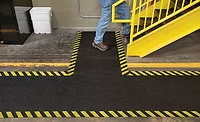
Improving traction is key to keeping surfaces safe. Utilize boot scrubbers and scrapers outside entrances, and employ moisture-absorbent, anti-skid mats with beveled edges in entrances to prevent the reduction of surface traction and improve shoe traction.
Communicate risks
Always use proper warning signs and robust facility identification materials to help identify risks. And don’t hesitate to simply block off high risk areas.
Train, train, train
Individual attitudes and behaviors are perhaps the toughest area to control. Incorporate slip, trip, and fall awareness into routine health and safety meetings or toolbox talks. Encourage workers to think twice about taking shortcuts, not watching where he or she is going, or using a cell phone on the job.
External factors
Evaluate root causes of incidents. If good housekeeping, proper surface traction, and well-communicated risk identification is in place, check a few subliminal issues such as weather, lighting, and PPE.
Housekeeping should take into account bad weather to ensure that you proactively mitigate risks 365 days a year. Ensure proper illumination for all walking and working surfaces at all times. Require that employees wear footwear appropriate for their duties.
References
- OSHA “Walking and Working Surface Rule” 1910.22. Source: OSHA Rule 1910.22
- Falls on the same level ranked second in the Top 10 Injury Causes with direct costs of $10.62 billion, accounting for 17.7 percent of the total injury burden. Falls to a lower level ranked third at $5.50 billion and 9.2 percent of the burden. Slips and trips without the fall occupied seventh place at $2.30 billion and 2.3 percent of the total injury burden. Source: 2017 Liberty Mutual Workplace Safety Index
- Donny Beaver has discussed the implications of tips for reducing slips in other articles. Visit the source: Construction Exec, “Get a Grep on Mobile Workplace Slips: Tips for Keeping Work Crews Sure-Footed .”
- Donny Beaver has authored articles that look at utilizing leading indicators to identify slip and fall risks in the Oil and Gas Industry. The source: Oil and Gas Marketplace, “Follow the Footprints to Stay Ahead of Slips and Falls.”
Looking for a reprint of this article?
From high-res PDFs to custom plaques, order your copy today!