How to reduce heavy lifting: Try this “soft sell” approach
To sell something, you often ease the customer into a buying mood. The following will help you convince management to adopt NIOSH’s 2013 Recommended Weight Limits.
How much weight can a worker manually lift without injury? The answer is elusive and begins with the historic 51 pounds that is reduced by various guidelines such as NIOSH revised lifting equation, Snook Tables, ACGIH® TLV® for Lifting Tasks, Michigan 3DSSPP, and Washington State lifting calculator, just to name a few.
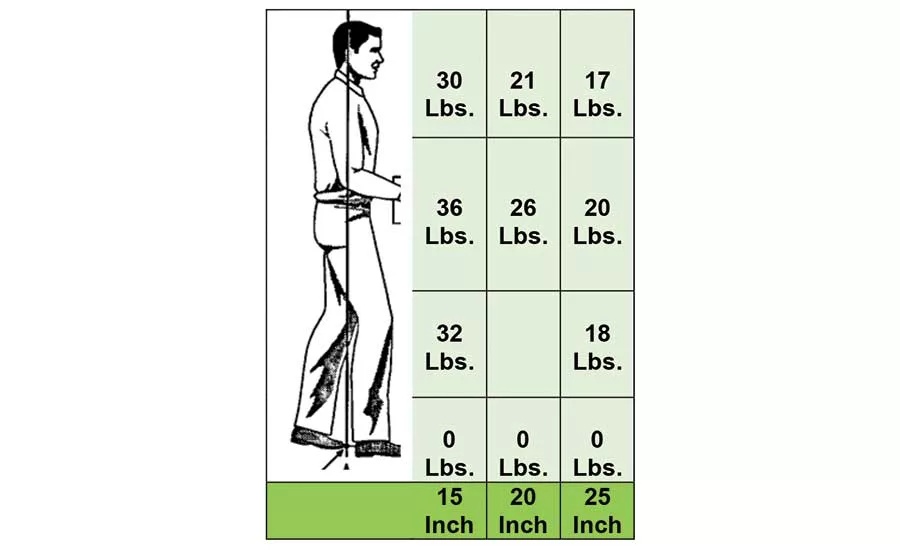
In 2013, NIOSH issued a new recommended weight limit (RWL), a portion re-illustrated for purposes of this article and shown in Figure 1.1
Figure 1 is for the most basic two-hand lift, done not more than once every five minutes and before grip, twisting, awkward posture, footing, and other variables come into play. Maximum RWL is 36 pounds that is reduced by zones — elevations and extension outward to about two feet, measured from mid-point of ankles. No weight should be lifted above the head or from floor to mid-shin.
Free calculators
Several free online lifting calculators may be used to compare RWLs in Figure 1. Calculators from the states of Ohio2, Oregon3 and Washington4 are popular. Other countries, such as Canada5, also provide free online lifting calculators. Be aware that different calculators offer differing guidelines for weights that are safe to manually lift.
The RWLs in Figure 1 most closely align, including layout of zones, with TLVs® for lifting tasks6. Particularly, TLVs® establish that there is “No known safe limit for repetitive lifting” from floor to mid-shin or above the head. Even for infrequent lifting, the TLV® allows zero weight from floor to mid-shin beginning from about 12 inches reach outward, measured from mid-point of the ankles. Different weights for various zones is a common practice in modern lifting guidelines. It is inappropriate today to specify a single weight that is safe to lift without acknowledging variables that will reduce the weight.
Convincing managers
To convince management to adopt the RWLs in Figure 1 you first must overcome resistance to the zero-weight lifted from floor to mid-shin. Technical argument for zero-weight begins with an explanation of center of mass and high compression forces on the lumbar region of the back when a worker reaches to the floor. This can result in back or other muscular skeletal injury – with resulting high costs. Before launching into technical arguments, set the stage with these discussions, listed in order:
- Modern workplace. In modern retail stores, for example, it is rare for a customer to have to pick up anything directly off the floor. Shelving, stacked boxes and pallets elevate the product to make lifts easier and reduce allegations of injury by customers. Modern assembly, production lines and similar work locations are set up this way, too.
- Current best practice. NIOSH’s revised lifting equation was issued in 1991 and ACGIH® Lifting Task TLV® was developed in 2004. Most lifting calculators borrow from these two main guidelines and may be assumed to be somewhat dated. Figure 1 is the most recent of all lifting guidelines.
- Visualization. A template or quick measurement tool may be created to readily visualize conformance/non-conformance to the weights in Figure 1. A visual template may be quicker than entering specific data into lifting formulas. Example, 1991 NIOSH formula is RWL = LC x HM x VM x DM x AM x FM x CM.
- Stretch goals. Figure 1 is more protective but compatible with the 1991 NIOSH lifting equation and 2004 TLV® for lifting tasks and will result in fewer back injuries. Figure 1 is a reasonable stretch goal.
- Ergonomic tools. Mobile scissors lifts, powered stackers, portable hoists and other ergonomic tools are readily available to help achieve Figure 1 goals. New tool pouches prevent dropping tools – no need to bend over and pick a tool off the floor anymore.
- Aging, overweight workforce. An aging workforce with diminished lifting capacity and many workers overweight (nearly one-third obese) is the new reality. If workplace health promotion programs don’t change the worker, then workplace conditions, such as Figure 1, must change.
- Workplace equality. HR says we must treat workers equally and not discriminate. Figure 1 should be adopted specifically because of this reason. With a growing number of women in the workforce, Figure 1 will protect workers with uncomplicated pregnancy up to 20 weeks from gestation.7 Knock off the first column and pregnant workers can safely lift those weights up until they give birth.
- Legal interest in lifting accommodations. The U.S. Supreme Court ruled on weight lifting accommodations for a pregnant worker, Peggy Young, in 2015. United Parcel Service may have saved themselves about a million dollars in defense costs and bad press if they had accommodated an early concept of Figure 1. About half of U.S. states passed pregnant worker fairness laws in the last six years. Each law has its differences but each discuss weight lifting accommodations for pregnant workers.
- Obligation. Do legal issues obligate an employer to promptly conform with Figure 1 if suggested by a physician? Probably. Engage HR and legal reps to review state/local laws for your workplace locations.
Additional issues can be added, particularly when local context is considered. The objective is to engage management to open minds to the merits of adopting Figure 1 as a goal.
References
- http://www.ajog.org/article/S0002-9378(13)00242-1/pdf
- https://www.bwc.ohio.gov/employer/programs/safety/liftguide/liftguide.asp
- http://www.cbs.state.or.us/external/comm/safe-lifting/lift-calculator.html
- http://ergo-plus.com/wisha-lifting-calculator/
- http://worksafebcmedia.com/misc/calculator/llc/
- http://personal.health.usf.edu/tbernard/HollowHills/LiftingTLV11.pdf
- https://www.ncbi.nlm.nih.gov/pmc/articles/PMC4606868/
Looking for a reprint of this article?
From high-res PDFs to custom plaques, order your copy today!