ISHN logo
search
cart
facebook twitter linkedin youtube
  • Sign In
  • Create Account
  • Sign Out
  • My Account
ISHN logo
  • NEWS
    • Today's News
    • Global Safety News
    • Government Regulations
  • PRODUCTS
    • Product Innovations
    • Featured Products
  • TOPICS
    • Environmental Health and Safety
    • Facility Safety
    • Workplace Health
    • Occupational Safety
    • PPE
    • More Topics
  • CONSTRUCTION
  • TECHNOLOGY
  • COLUMNS
    • Best Practices
    • Dave Johnson: What’s going on
    • Editorial Comments
    • Leading Safety
  • MULTIMEDIA
    • ISHN Podcast
    • Videos
    • Cold Stress Education Quiz
    • Webinars
    • White Papers
  • MORE
    • Buyer's Guide
    • Newsletters
    • Convention Companion
    • Polls
    • Events
    • ISHN Store
    • Sponsor Insights
  • EMAGAZINE
    • eMagazine
    • Archived Issues
    • Contact
    • Advertise
  • JOIN TODAY!
Government Safety RegulationsOccupational SafetySustainability in Health and SafetyConstruction Industry Safety and Health

Let’s take a different approach to ladder safety

Protection vs. prevention
By David Francis
Fall protection ladder safety
July 20, 2018

Every day 2,000 people are injured in a ladder-related accident. One hundred of those people suffer a long-term or permanent disability. And every day, one person dies; the numbers are continuing to rise.

Is fall protection the answer?

In just the last few years, more companies have started applying tie-off rules to portable ladders, even though OSHA and MSHA don’t require it. Although the standards vary from company to company, most follow a basic rule: If a ladder operator is working at a height of four feet or more, the operator must tie off to a suitable fall-arrest anchor point. If a suitable anchor point is not available, the operator must work from an approved enclosed platform, either a powered lift or scaffolding. 

Understanding the causes

Understanding how people use ladders and how they get injured is key to designing new, safer climbing products. Studying the statistics, we can divide ladder accidents into three categories. 

  • Ligament and muscle tears, herniated disks, and strains and sprains from unloading, carrying and setting up the ladder. Almost half of reported injuries involving ladders are caused by the awkward size and weight of the ladder. The easy solution to this problem is to make the ladder lighter.
  • Using the wrong type or size of ladder for the job. Often, this issue is caused by the first problem. The right size ladder is too heavy, so we grab the smaller one and try to make it work by climbing too high on the ladder. Or, we make do with the closest ladder at hand, when we really need a different type of ladder. Using a stepladder as a straight ladder is probably the most common example of using the wrong kind of ladder.
  • Falls from height from overreaching or improper setup. This issue is caused when the operator should climb down and move the ladder instead of leaning or when the operator does not follow the set-up rules.

A higher percentage of disabilities and fatalities come from catastrophic falls from height, so let's concentrate on that.

“I was just trying to reach that last thing” is the start to a lot of really bad ladder accident stories. Too often, we stretch to reach that one last thing instead of climbing down and moving the ladder. 

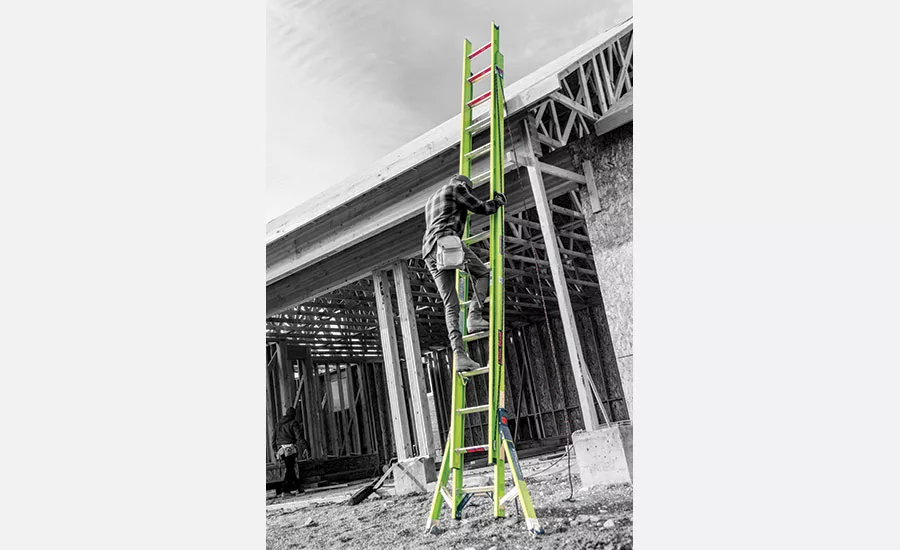
Another factor in side-tip accidents is how level the ground is in the set up. If a 28-foot extension ladder is one inch off at the base, the top of the ladder will be 19 inches off. That puts the top of the ladder completely outside the footprint of the ladder. Even if you are keeping your body between the side rails, your ladder will tip. 

Safety by design

By adding outriggers to an extension ladder’s design, we can increase the side-tip stability by more than 500 percent. Because level ground is such a big factor in most side-tip accidents, designing the outriggers to also level will also greatly reduce the possibility of a tip due to overreaching. 

Stepladders

Stepladders have different problems to overcome. You can still tip over because you overreach, but you also need to solve any three-points-of-contact issues or any tie-off rules that might have been written into your company safety policy. You also need to work on uneven surfaces or staircases.

Adjustable safety cages

Adjustable safety cages are a new category of climbing equipment, not really a ladder and not really a scaffold or lift. These innovations allow an operator to work in a height-adjustable, fully enclosed platform while in compliance with all tie-off requirements. 

Fence vs. ambulance

As a safety professional, would you rather build a fence at the top of a cliff, or park an ambulance at the bottom? Fall protection will always have its place, but when it comes to ladders and climbing equipment, fall prevention is the future.

KEYWORDS: Fall Protection ladder safety OSHA standards

Share This Story

Looking for a reprint of this article?
From high-res PDFs to custom plaques, order your copy today!

David Francis, national safety director for Little Giant Ladder Systems, has worked in the ladder industry for more than 30 years and travels all over the country performing free ladder safety training for all kinds of companies. He can be contacted via email at dave@ladders.com or www.laddersafetyhub.com.

Recommended Content

JOIN TODAY
to unlock your recommendations.

Already have an account? Sign In

  • forklift safety

    Exploring the latest technologies in forklift safety

    With more staff and more stock in warehousing now more...
    Workplace Training Strategies
    By: Josh Cramer
  • welding

    All about welder’s flash or arc eye

    A flash burn is a painful inflammation of the cornea,...
    Environmental Health and Safety
  • dangerous jobs

    The 10 most dangerous jobs in the U.S.

    On-the-job deaths have been rising — hitting the highest...
    Occupational Safety
    By: Benita Mehta
Manage My Account
  • eMagazine Subscriptions
  • ISHN Newsletter & Other Newsletter Alerts
  • Online Registration
  • Manage My Preferences
  • Subscription Customer Service

More Videos

Sponsored Content

Sponsored Content is a special paid section where industry companies provide high quality, objective, non-commercial content around topics of interest to the ISHN audience. All Sponsored Content is supplied by the advertising company and any opinions expressed in this article are those of the author and not necessarily reflect the views of ISHN or its parent company, BNP Media. Interested in participating in our Sponsored Content section? Contact your local rep!

close
  • man wearing the the Sundström SR200 Full Face Mask Respirator
    Sponsored byOHD

    5 Fit Testing Mistakes That Could Cost You

  • This image shows Magid AcuSpex polarized blue mirrored safety glasses.
    Sponsored byMagid Glove and Safety

    Construction PPE Guide: What Crews Need for Each Task

  • lone worker in confined space
    Sponsored byAlphasense Ltd.

    GET THE LEAD OUT of your Safety Oxygen Sensors!

Popular Stories

SpaceX 7 launch

OSHA Investigating Fatal Fall at SpaceX Starbase

Worker Impairment

How to Tell When a Co-Worker is Impaired? A Safety Pro’s Challenge

Automated loading dock equipment

After March 2026 Rivian Death, Safety Managers Reassess Loading Dock Systems Under OSHA's Warehouse Emphasis Program

top 10 most dangerous jobs

Poll

Seasonal Readiness

With the federal heat stress prevention rule on the horizon, which area of your safety program needs the most attention?
View Results Poll Archive

Products

Surviving an OSHA Audit A Management Guide, 2nd Edition

Surviving an OSHA Audit A Management Guide, 2nd Edition

See More Products

ISHN Podcasts

Related Articles

  • Products-Little-Giant-King-Kombo.jpg

    Little Giant Ladders, LLC to join Ladder Safety Month with a focus on safety in the trades

    See More
  • Confined Space United Rentals

    When working in confined spaces, take a team approach to create a safe environment

    See More
  • For ladder safety, focus on surroundings, job hazards, height needs

    For ladder safety, focus on surroundings, job hazards, height needs

    See More

Related Products

See More Products
  • 9781138749573.jpg

    Occupational Health and Safety Management: A Practical Approach, Third Edition

See More Products
×

Become a Leader in Safety Culture

Build your knowledge with ISHN, covering key safety, health and industrial hygiene news, products, and trends.

JOIN TODAY
  • RESOURCES
    • Advertise
    • Contact Us
    • Directories
    • Manufacturing Division
    • Store
    • Want More
  • SIGN UP TODAY
    • Create Account
    • eMagazine
    • Newsletters
    • Customer Service
    • Manage Preferences
  • SERVICES
    • Marketing Services
    • Reprints
    • Market Research
    • List Rental
    • Survey/Respondent Access
  • STAY CONNECTED
    • LinkedIn
    • Facebook
    • YouTube
    • X (Twitter)
  • PRIVACY
    • PRIVACY POLICY
    • TERMS & CONDITIONS
    • DO NOT SELL MY PERSONAL INFORMATION
    • PRIVACY REQUEST
    • ACCESSIBILITY

Copyright ©2026. All Rights Reserved BNP Media, Inc. and BNP Media II, LLC.

Design, CMS, Hosting & Web Development :: ePublishing