Welding robots are on the rise
What’s your strategy? Evaluate risks and select the right safeguarding systems
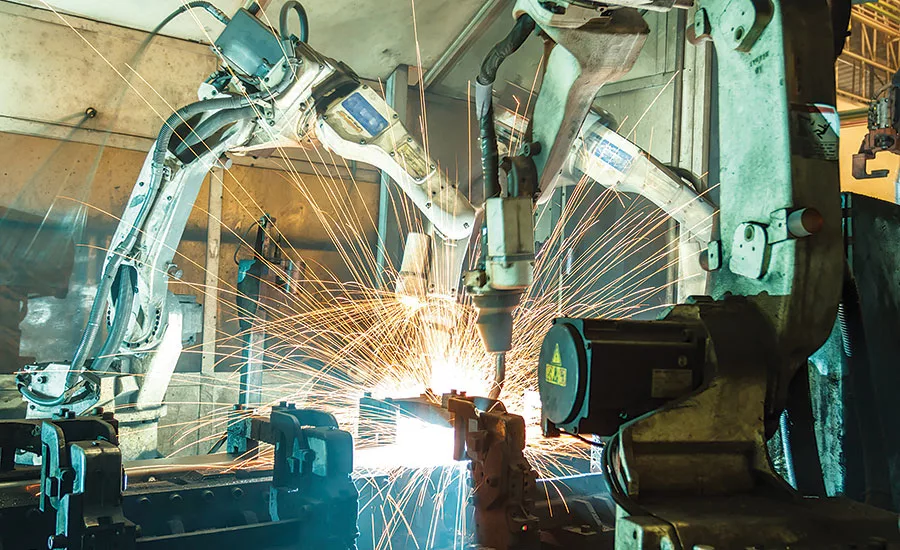
Robotic welding provides manufacturers with several competitive advantages. Most importantly, it makes them more productive while generating more consistent, higher quality welds and reducing waste. Robots also empower manufacturers to address the current shortage of skilled welders to recruit. According to the American Welding Society (AWS), 40 percent of manufacturing companies declined new contracts because not enough skilled welders were available, a problem that robots immediately solve.
In addition, by taking the human element out of the welding process, robots eliminate operator dangers such as electric shock, exposure to gases and toxic fumes, and flash burns to the eye’s cornea.
Ironically, new dangers have replaced the old ones, which is why it is critical for manufacturers to follow best safety practices when implementing a robotic welding program to avoid accidents.
Who is responsible for robot safety?
While OSHA does not have a specific set of regulations for robotics, other domestic and international safety standards clearly summarize robotic welder safety requirements. Robot safety is shared between all parties ranging from manufacture to end use, as outlined in ANSI/RIA R15.06-2012, which is now harmonized with ISO 10218-1 & 2.
First, the safety role of the Manufacturer is outlined in ANSI/RIA R15.06-2012 Part 1 “Industrial Robots,” which defines the industrial robot as the robot arm plus the robot controller; notice here there is no end effector and no work piece. That is the robot and that is the subject of Part 1.
Second, the safety role of the Integrator/Installer (or End-User if they are acting in the capacity of the Integrator) is covered in ANSI/RIA R15.06-2012 Part 2 “Industrial Robot Systems,” which defines the industrial robot system and includes the robot (robot arm+robot controller), plus the end effector plus the work piece plus peripheral equipment, such as safeguarding, jigs, etc. (i.e., any other equipment that makes it possible for the robot to complete its task). That is the robot system and that is the subject of Part 2.
The manufacturer, integrator and installer have the shared requirement to provide “information for use” to the user of the robot and robot system. The user has the responsibility to use this information in developing training and safe work practices. Safety must be a conscious effort on the part of all parties (manufacturer, integrator, installer and user) throughout the life cycle of the robot, starting with the initial design and continuing through integration, implementation, use and maintenance, then ultimately culminating in disposal.
Understanding safeguarding
The term “safeguarding” refers to protective measures for employees who operate or come into contact with dangerous moving machines in a manufacturing setting. Safeguarding devices will detect or prevent accidental or intentional access to a potential hazard. Safeguarding devices operate automatically to protect workers from hazards found at the point of machine operation, power transmission, and other places moving parts are found.
While the total number of workers injured each year has decreased significantly since 1970 when the Occupational Safety and Health Act was passed, experts say the rate of fatal and non-fatal worker injuries is still far too high. Machine guarding violations are one of the top 10 violations cited by OSHA in the industrial environment and are a major cause behind amputations and other traumatic injuries.
Besides being dangerous, a lack of machine safeguarding can also be expensive. For instance, OSHA recently cited a steel tubing manufacturer for repeat and serious machine guarding violations, resulting in a $139,800 fine, and placed the company in OSHA's Severe Violator Enforcement.
Infrequent incidents
Robotics professionals are quick to point out that while industrial accidents involving robots do happen they are infrequent. But again, they do happen. Accidents typically during non-routine operating conditions, such as programming, maintenance, testing, setup, or adjustment, when the employee is temporarily within the working envelop. Way back in 1979, the first recorded death by robot happened in a car factory where a worker collecting parts from a storage facility was hit and killed by a one-ton robotic arm. Fast forward to June 2015, when a German Volkswagen factory employee was crushed to death when setting up an industrial robot. A month later, a similar type accident involving a robot occurred in India.
Accident statistics maintained by OSHA identify 27 fatalities associated with robots in a 30-year period from 1984 to 2013, while the total number of workplace fatalities in the U.S. in 2013 alone was 4,585. In short, industrial accidents involving robotics are rare, but are building in numbers as their use proliferates across all manufacturing sectors.
Safeguarding robotic welders
The first step in developing a robotic welding safety strategy is to conduct a risk assessment that takes into account the severity of potential injury, frequency of exposure to a hazard, and the probability of injury. A risk evaluation is then performed to determine whether additional safety measures are needed to reduce the risk.
Typically, an effective safeguarding system for robotic welders is a combination of electrically interlocked perimeter guards, safety light curtains, safety laser scanners and pressure sensitive safety mats. Automatic weld curtains and high-volume ventilation systems can also minimize exposure to hazards in the welding environment. Torch length and robot reach must to be factored in when designing the system. Here is a review of suggested equipment:
Perimeter guards are designed to keep machine operators and other plant employees safely away from the robotic welding cell other than when they must enter for loading and unloading workpieces or maintaining the welding equipment, robot and other machinery. Perimeter guards are positioned around a robot work envelope and incorporate gates equipped with interlocks so that all automatic operations of the robot and associated machinery will stop when any gate is opened.
Robotic welders tend to do the same thing again and again, and cannot generally tell if a worker is in vicinity. That's why factories establish "danger" or "kill" zones with perimeter guards that people have to stay out of while the robot is operating. OSHA has issued citations for robotic welding cells that are unguarded or improperly guarded for not meeting 29 CFR 1910.212, also known as the “general duty clause.”
A laser scanner is a reliable, cost-effective safeguard installed around robotic welders. These are fully programmable devices, utilizing an infrared laser to scan its surroundings and measure distances. It can be set up to scan on a horizontal or vertical plane. Should a person or object come into contact with the infrared beam, hazardous machine motion stops.
A light curtain system is another common safeguard used with robotic welding equipment, including where an operator requires frequent access to a cell and the hazardous machine motion can be stopped relatively quickly. Most systems include a transmitter that emits infrared light to the receiver. The transmitter and receiver can be installed top to bottom (vertical protection field) or side to side (horizontal protection field). Should an object or the operator interrupt an infrared beam, it generates a stop signal to the machine control. The light screen sensing field can be desensitized to ignore some objects but respond to other objects of a defined size, or muted for temporary suspension to allow material feeding.
Pressure sensitive safety mats are yet another option for safeguarding robotic welding equipment. While they can be used around the perimeter of machines, more commonly they’re used as a secondary safety device located inside of perimeter guarding systems. When someone stands on the mat, the metal plates make contact and hazardous machine motion stops. Pressure sensitive safety mats are not be used as primary safeguarding except when all other means are not applicable.
Along with these measures, it is critical to remember the human variable. For instance, if a safeguard prevents the operator from loading and unloading parts from the cell, they may remove it without understanding the dire ramifications. More times than not, the problem is poor design. Improperly designed safety equipment frustrates workers and leads to a false sense of security, ultimately creating accidents.
Final thoughts
Welding has always been a dangerous job, and there is no doubt that robots are making it safer by performing dangerous, repetitive tasks. But given the fact that tens of thousands of robots are now working in a close, collaborative manner with employees and often do not have the sensory ability to detect if those employees are in their vicinity, safety needs to be kept top-of-mind. A simple programming error or hardware malfunction can lead to a powerful robotic arm unexpectedly moving large distances at a high rate of speed.
Safeguarding employees against these hazards is required to comply with stringent regulations. That same safeguarding equipment also provides an opportunity to make a positive impact on the bottom line since the cost of a robot-related injury goes far beyond hospital and medical costs.
Looking for a reprint of this article?
From high-res PDFs to custom plaques, order your copy today!