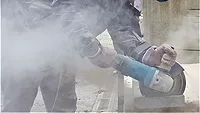
Connecting workers to cleaner air
How to control contaminants and utilize PPE to reduce risk

Photo credit: Funtay / iStock / Getty Images Plus
Working around dusts, mists, fumes, aerosols, gases, and vapors can be hazardous to your health. Depending on the contaminant, overexposure can cause lung disease; problems with the liver, kidneys, heart, or nervous system; or cancer.
Employers are responsible for determining the need for using respirators in the workplace. To control contaminants, operations can be enclosed or confined, install general and local ventilation, or substitute less toxic materials. If these controls do not eliminate the risk, wearing an appropriate respirator can protect you.
Conduct the initial medical evaluation before the employee’s fit test. OSHA’s general industry Respiratory Protection standard — §1910.134 — requires employers to make provisions for a medical evaluation before giving training. Appendix C of the regulation contains a questionnaire that includes the required information to be provided to the Physician or other Licensed Health Care Professional (PLHCP) conducting the evaluation.
Evaluate respiratory hazards
At §1910.134(d)(1)(iii), OSHA’s Respiratory Protection standard requires the employer to: “identify and evaluate the respiratory hazard(s) in the workplace; this evaluation shall include a reasonable estimate of employee exposures to respiratory hazard(s) and an identification of the contaminant’s chemical state and physical form. Where the employer cannot identify or reasonably estimate the employee exposure, the employer shall consider the atmosphere immediately dangerous to life or health (IDLH).”
Consider the atmosphere IDLH unless, under worst-case assumptions, exposures would not be IDLH. For example, some information may be available on air concentrations, but not enough data to reasonably estimate the actual employee exposures. However, by making reasonable assumptions about the maximum concentrations that could exist, the employer may be able to show that IDLH conditions would not occur. In other situations, it may not be feasible to identify all of the air contaminants. Still, through information on the process, you may be able to determine that IDLH conditions could not occur. This becomes more important when it comes to selecting the proper respirator.
Dust masks
OSHA refers to disposable paper respirators, or dust masks, as “filtering facepieces.” In 1910.134, OSHA defines these as “negative pressure particulate respirator with a filter that is an integral part of the facepiece or with the entire facepiece composed of the filter medium.” Most workers will call them dust masks.
In many cases, the working conditions do not require dust mask use, but employees wish to wear them voluntarily. Under this scenario, the employees must follow their employer’s specific training requirements.
When employees use dust masks voluntarily, the employer must make sure that the use of the respirator itself does not create a hazard. That is, to ensure that the use of dust masks does not in itself pose a hazard, or that their use does not interfere with the employee’s ability to work safely.
Employees who use dust masks voluntarily need to understand how to use and care for them properly to provide the best protection. Before using voluntary dust masks, provide each employee with basic information on the proper use of respirators. The information may be transmitted either in written form or verbally.
Selecting a respirator
Respirators must be NIOSH-certified. Respirator selection must be based on the respiratory hazards and consider applicable workplace and user factors that may affect performance and reliability. Your workplace evaluation needs to include a reasonable estimate of employee exposures and identify the contaminant’s chemical state and physical form.
Respirator selection must also consider the respirator’s assigned protection factor and the maximum use concentration for the application. There are two basic types of respirators:
- Atmosphere-supplying, and
- Air purifying.
Atmosphere-supplying respirators provide clean breathing air from a source separate from the contaminated area. Use these respirators when:
- There is not enough oxygen in the area,
- Contaminant concentrations are unknown, or
- Contaminant concentrations are Immediately Dangerous to Life or Health (IDLH).
Air-purifying respirators pass contaminated air through filters, cartridges, or canisters to clean the air as it is breathed. These only protect against certain contaminants and should not be used in an oxygen-deficient or IDLH situation.
Using your respirator and staying healthy
Fit test workers using any respirator with a tight-fitting facepiece (even those used in a positive-pressure mode). Conduct the test before initial use, upon changes to the type of facepiece used (or upon changes in the employee that could affect fit), and at least annually. There are two types of fit tests: quantitative and qualitative. Appendix A of the regulation details test protocols that are acceptable to OSHA. You must provide a sufficient number of respirator models and sizes so that the respirator is acceptable and correctly fits the user.
Use the respirator as it was designed to be used. Follow the operating instructions from the manufacturer or your employer. Leave the area if you can smell or taste the contaminant; if you need to change cartridges, filters, canisters, or cylinders; if you need to wash your face or the facepiece; or if you have any problems with the respirator.
Train first responders to respond to emergencies such as confined space rescue, hazardous spill response, or interior structural firefighting. When someone is wearing a respirator in an IDLH atmosphere, at least one person who is ready to provide rescue must remain outside and monitor the person in the IDLH area. (For firefighting, at least two employees must go into the IDLH area, and at least two people must remain outside.)
Care and training
§1910.134(k) requires employers to provide effective training to employees who are required to use respirators. The training must be comprehensive, understandable, and recur annually (more often if necessary).
Conduct training before respirator use. Provide retraining when there are indications that the employee’s knowledge is inadequate, and under any other circumstances, retraining would be necessary to ensure safe respirator use. Retrain annually whenever changes in the workplace or type of respirator would make previous training obsolete.
Thorough training in the care and maintenance of respirators will help keep your program running smoothly for a long time. Ensure you have sufficient equipment and supplies to provide for the cleaning and disinfecting, storage, inspection, and repair of respirators. The written program must include schedules and procedures for these activities. OSHA provides procedures for cleaning and disinfecting respirators in Appendix B-2 of the regulation. If manufacturer recommended procedures are used, they must be equally effective.
Remember, using a respirator puts additional stress on your body. Your health must be evaluated by a physician or health care professional before you can wear a respirator. Follow any recommendations from the evaluation. Report any signs or symptoms that may influence your ability to use a respirator, including shortness of breath, dizziness, coughing, wheezing, chest pain, chest injuries, lung diseases, cardiovascular conditions, or heart conditions.
Looking for a reprint of this article?
From high-res PDFs to custom plaques, order your copy today!