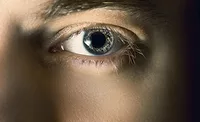
Watching your eyes
And given that accommodation (however temporary), what is your answer? Which of the senses would you go without, given the choice? Taste, touch, hearing, smell or sight?
Seems effortless
We can recognize a friend instantly - full-face, in profile, or even by the back of their head. We can distinguish millions of shades of color, as well as 10,000 smells. We can feel a feather as it brushes our skin, hear the faint rustle of a leaf, and taste the subtle hint of clove in hot apple cider. It all seems so effortless: we open our eyes, ears, mouth, hands or nose and let the world stream in.Yet anything we see, hear, feel, smell, touch or taste requires billions of nerve cells to flash urgent messages along cross-linked pathways and feedback loops in our brain, performing intricate calculations that scientists have only begun to decipher.
Those calculations, it is thought, merely approximate what is being sensed and then plug in previous experience or memory to tell the brain what it might be. For example, if you closed your eyes and held a lemon you might also think that it could be a lime. Smell and taste could verify, to an extent, what your touch is telling your brain but you might not be absolutely sure. Sight goes a long way in mapping the initial impression, which is then verified through the other senses.
Virtually realistic
What about those phantom smells, sounds, tactile sensations, images or tastes that come to us at times? Those senses that aren't really there but are brought about as a result of the brain recognizing a situation and putting the memory into a virtually realistic experience: "That makes me think of Thanksgiving 1962, mom baking pies . . . I can still see her at the stove in her apron, smell the cinnamon and taste how flaky her crust was."Think about the following questions to help you decide which of your senses you might decide to go without:
- Can you feel color? Smell it? Hear it?
- Can you feel light? Smell it? Hear it? Taste it?
- Can you feel a star? Hear it?
- Why is it important to use all five senses?
- What would happen to someone who didn't have all five senses?
- Can a person substitute one sense for another?
- Is it easier or harder to live without all five of the senses?
I will leave your personal answer to yourself. And ask you to consider the difference between having to choose to give up one of the five senses and having no choice in the matter, i.e. being given improper personal protective equipment and no training, task instruction, assistance or supervision.
Shortcuts by management, supervision and labor are on the rise as employee populations are cut, budgets are slashed and experienced help is no longer available. The challenge is to maintain the integrity of your day-to-day safety efforts.
Hard facts
You are probably already familiar with the statistics relating to eye injuries (according to OSHA Fact Sheet No. 93-03), but just to refresh you:
- 1,000 eye injuries occur in American workplaces daily;
- $300 million is lost in production time, medical expenses and workers' compensation each year;
- 75 percent were not wearing eye protection; 40 percent of which wore the wrong kind of eye protection;
- 70 percent resulted from flying or falling particles, or sparks; 60 percent of which were smaller than a pinhead;
- 20 percent were caused by chemical contact.
And, as well, you are probably already familiar with what is prescribed for protection per OSHA:
- Provide education and training;
- Assess work activities;
- Provide suitable eye and face protection;
- Enforce usage requirements;
- Minimize eye injuries when incidents occur;
- Recognize compliance.
Sixth sense
There isn't any reason - any good, sound, practical and thoughtful reason, at least - why eye injuries must continue to rob otherwise healthy and vital persons of the sense of sight. The key is to not rely on the assumption that everyone has the "sixth" sense that I alluded to earlier. That being "Good" sense.SIDEBAR: Of mice and men
Like animals, can we sense chemical signals?In addition to our sense of smell, do we have the ability to sense certain chemical signals emitted by people around us - without being aware of it? Many other mammals use a separate set of sensory receptor cells in their nose to receive social and sexual information from members of their own species, and there is growing suspicion that we do, too.
Recent scientific findings have revealed an "accessory olfactory system" that is a much more primitive structure which uses a different set of molecular machinery than the main olfactory system. This system starts with nerve cells in the vomeronasal organs (located behind the nostrils, in the nose's dividing wall) where the signals are first picked up. An alternate route to the brain, and bypassing the cerebral cortex, there is likely to be no conscious awareness of it.
A whiff of airborne chemicals from a female mouse, for instance, may spur a male mouse to mate immediately. Certain chemical messages from other males may make him aggressive. Other messages may produce changes in his physiology, as well as in that of the responding female.
The effects of such messages would be far less obvious in humans. If we do receive chemical signals from people in our vicinity, these signals must compete with many other factors that influence our behavior. Yet our physiology may be just as responsive to chemical messages as that of other mammals.
It is known that certain chemical messages from other mice lead to the onset of puberty in young males, while a different set of signals brings young female mice into estrus. Similarly, there are some suggestions that women may alter their hormonal cycles when exposed to chemical signals from other people. - Ernie Huelke
Looking for a reprint of this article?
From high-res PDFs to custom plaques, order your copy today!