ISHN logo
search
cart
facebook twitter linkedin youtube
  • Sign In
  • Create Account
  • Sign Out
  • My Account
ISHN logo
  • NEWS
    • Today's News
    • Global Safety News
    • Government Regulations
  • PRODUCTS
    • Product Innovations
    • Featured Products
  • TOPICS
    • Environmental Health and Safety
    • Facility Safety
    • Workplace Health
    • Occupational Safety
    • PPE
    • More Topics
  • CONSTRUCTION
  • TECHNOLOGY
  • COLUMNS
    • Best Practices
    • Dave Johnson: What’s going on
    • Editorial Comments
    • Leading Safety
  • MULTIMEDIA
    • ISHN Podcast
    • Videos
    • Cold Stress Education Quiz
    • Webinars
    • White Papers
  • MORE
    • Buyer's Guide
    • Newsletters
    • Convention Companion
    • Polls
    • Events
    • ISHN Store
    • Sponsor Insights
  • EMAGAZINE
    • eMagazine
    • Archived Issues
    • Contact
    • Advertise
  • JOIN TODAY!

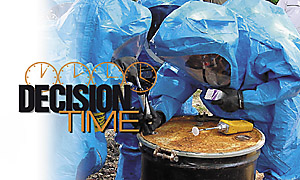
Decision Time

August 1, 2005


Every year, nearly ten million tons of industrial chemical liquids and gases used in U.S. manufacturing flow through 2.1 million miles of pipelines and across 200,000 miles of railroad track, highways and inland waterways. These toxic industrial chemicals, classified as Toxic Inhalation Hazards, are substances known to pose a danger to humans in the event of a release.

Challenges to first responders

The prevalence of these chemicals presents challenges to first-responder organizations, changing the nature and complexity of emergency situations in specific ways:

  • An incident may involve fire, a visible and readily-identifiable threat. But there may be other unseen threats — chemical vapors or radiation. Not long ago, response often focused on putting out fires and extricating people from structures without serious consideration of these unseen threats. Now the chemicals used in manufacturing, held in storage facilities and transported by truck and rail require a range of data collection and analysis tools to responsibly mitigate risks.

  • Local emergency response organizations, especially in smaller rural areas, may be staffed by volunteers, few of whom are broadly trained experts. Even fewer may have advanced training in hazmat assessment and remediation.

  • Experts required for situational analysis might be far removed from an incident site.

  • The complexity and scope of hazmat incidents might exceed response abilities, training and equipment of local first-responder organizations.

    These challenges are driving a new approach to response — one far more reliant on information. Here are five ways more, better and faster information is improving response efforts:

    1) Sensing & monitoring equipment

    Equipment to detect and alert responders to unseen threats has become a life-critical requirement. Effective response solutions must include personal protection and detection tools for rapid broadband detection of — and protection from — chemical vapor and radiological threats, combined with deployable monitoring networks to monitor site perimeters and alert incident commanders to the movement and nature of hazardous vapor clouds.

    For equipment to be effective, users must be continually trained in safe operation and how to interpret readings, and equipment must be functional and calibrated. Training should include not only operation of equipment in a classroom, but also when trainees are fully suited with respiratory protection, protective suits and multi-layered gloves.

    Equipment functionality can be assured by using manufacturer’s bump test or calibration procedures. Automated systems(1) available for auto-calibration, bump testing and charging can ensure that readings are accurate and that equipment is always ready to go.

    2) Decision support tools

    A bewildering array of possible toxic chemicals may exist at an incident site, making a chaotic situation difficult to manage. The National Fire Protection Association’s Standard for Professional Competence of Responders to Hazardous Materials Incidents 472 suggests that all responders collect physical clues to help identify materials involved in incidents.

    New technology has led to the availability of decision support systems(2) that use physically observed characteristics such as colors, textures, gas or liquid, heavier than air, and odors to quickly and systematically identify potential agents involved in an incident. Offering fast, real-time identification and assessment of hazards, the system addresses the unique needs of first responders. An integrated response database consists of more than 91,000 chemical, biological warfare and bioterror agents, trade names and improvised explosive devices.

    3) Access to expertise

    Once on scene, first responders often realize that they need additional private, state and federal agency expertise. One issue that must be addressed is how to export on-scene information in real-time without relying on voice communication. Best practices call for real-time delivery of data using remote access technology solutions to connect an incident commander’s data screen with remote experts.

    The most direct solution today involves using secure data transfer over the Internet. With today’s sophisticated incident command centers and their ability to connect securely to the Internet, one solution is to have remote servers that can aggregate and store sensor data from multiple networks(3) and enable responders to share this real-time data through a secure online interface(4) with experts in remote locations.

    4) Who to call?

    The Center for Toxicology and Environmental Health (CTEH) based in Little Rock, Ark., is an example of a private rapid-response company. CTEH provides a range of services, including toxicology, risk assessment, industrial hygiene, occupational health, litigation support, and response to emergencies or other events involving release or threat of release of chemicals. Dispatched by corporate jet, CTEH experts can assist local and regional first-responder organizations to quickly assess hazardous situations and define cost-effective and optimized responses to minimize the loss of life and property.

    5) Retention and reuse of real-time data

    Use of sensing and monitoring instruments in a hazardous environment provides valuable real-time data streams. This data can be used for training programs, reviewing response techniques and effectiveness, and can establish key events in a hazmat timeline for reporting and litigation support.

    From detection to decision

    Using information tools in conjunction with the latest sensing and monitoring technologies gives first responders and industrial hygienists the ability to move from detection to decision in a matter of seconds. A comprehensive knowledge base, advanced analytical capabilities, access to expertise and cutting-edge sensing equipment are all central to life-critical decision support and first-response capabilities.

    FOOTNOTES: (1) AutoRAE from RAE Systems, Inc. (2) HazRAE from RAE Systems, Inc. (3) AreaRAE networks from RAE Systems, Inc. (4) RAEShare Web-hosted incident data management from RAE Systems, Inc.

    SIDEBAR: The emerging role of industrial hygienists

    Never before have industrial hygienists been so relied on for their expertise in a complex world. The range of activities and responsibilities is greater than the title might imply — from developing techniques to anticipate and control potentially dangerous situations in the workplace and community to ensuring workers follow health and safety procedures and investigating and examining the workplace for hazards and potential dangers. Today's industrial hygienists are playing an increasing role in effective and safe emergency response.
  • Share This Story

    Looking for a reprint of this article?
    From high-res PDFs to custom plaques, order your copy today!

    Recommended Content

    JOIN TODAY
    to unlock your recommendations.

    Already have an account? Sign In

    • forklift safety

      Exploring the latest technologies in forklift safety

      With more staff and more stock in warehousing now more...
      Workplace Training Strategies
      By: Josh Cramer
    • welding

      All about welder’s flash or arc eye

      A flash burn is a painful inflammation of the cornea,...
      Environmental Health and Safety
    • dangerous jobs

      The 10 most dangerous jobs in the U.S.

      On-the-job deaths have been rising — hitting the highest...
      Occupational Safety
      By: Benita Mehta
    Manage My Account
    • eMagazine Subscriptions
    • ISHN Newsletter & Other Newsletter Alerts
    • Online Registration
    • Manage My Preferences
    • Subscription Customer Service

    More Videos

    Sponsored Content

    Sponsored Content is a special paid section where industry companies provide high quality, objective, non-commercial content around topics of interest to the ISHN audience. All Sponsored Content is supplied by the advertising company and any opinions expressed in this article are those of the author and not necessarily reflect the views of ISHN or its parent company, BNP Media. Interested in participating in our Sponsored Content section? Contact your local rep!

    close
    • man wearing the the Sundström SR200 Full Face Mask Respirator
      Sponsored byOHD

      5 Fit Testing Mistakes That Could Cost You

    • This image shows Magid AcuSpex polarized blue mirrored safety glasses.
      Sponsored byMagid Glove and Safety

      Construction PPE Guide: What Crews Need for Each Task

    • lone worker in confined space
      Sponsored byAlphasense Ltd.

      GET THE LEAD OUT of your Safety Oxygen Sensors!

    Popular Stories

    SpaceX 7 launch

    OSHA Investigating Fatal Fall at SpaceX Starbase

    Automated loading dock equipment

    After March 2026 Rivian Death, Safety Managers Reassess Loading Dock Systems Under OSHA's Warehouse Emphasis Program

    psychology in the workplace

    Most Workplaces Measure Psychological Safety, Ignoring Psychosocial Risks

    top 10 most dangerous jobs

    Poll

    Seasonal Readiness

    With the federal heat stress prevention rule on the horizon, which area of your safety program needs the most attention?
    View Results Poll Archive

    Products

    Surviving an OSHA Audit A Management Guide, 2nd Edition

    Surviving an OSHA Audit A Management Guide, 2nd Edition

    See More Products

    ISHN Podcasts

    Related Articles

    • Decision Time

      See More
    • ORCHSE

      Traps in Operational Decision Making: How Cognitive Biases Put Our Decision Making at Risk

      See More
    • Mobile app From 3M helps occupational health and safety professionals select respiratory protection for faster and easier decision making

      See More

    Related Products

    See More Products
    • 9781498773416.jpg

      The Legal Aspects of Industrial Hygiene and Safety

    • safety law.jpg

      Safety Law: Legal Aspects in Occupational Safety and Health

    • 0470074841.jpg

      Patty's Industrial Hygiene, Volume 1, Hazard Recognition , 6th Edition

    See More Products
    ×

    Become a Leader in Safety Culture

    Build your knowledge with ISHN, covering key safety, health and industrial hygiene news, products, and trends.

    JOIN TODAY
    • RESOURCES
      • Advertise
      • Contact Us
      • Directories
      • Manufacturing Division
      • Store
      • Want More
    • SIGN UP TODAY
      • Create Account
      • eMagazine
      • Newsletters
      • Customer Service
      • Manage Preferences
    • SERVICES
      • Marketing Services
      • Reprints
      • Market Research
      • List Rental
      • Survey/Respondent Access
    • STAY CONNECTED
      • LinkedIn
      • Facebook
      • YouTube
      • X (Twitter)
    • PRIVACY
      • PRIVACY POLICY
      • TERMS & CONDITIONS
      • DO NOT SELL MY PERSONAL INFORMATION
      • PRIVACY REQUEST
      • ACCESSIBILITY

    Copyright ©2026. All Rights Reserved BNP Media, Inc. and BNP Media II, LLC.

    Design, CMS, Hosting & Web Development :: ePublishing