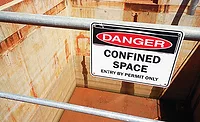
Confined space entry
In days of olde when Knights were bold and journeyed from their castles
They oft slumbered nights, in caves… they knew not of gas hazard hassles
They found themselves asleep so sound, they never woke at dawn
For CO gas had worn them down… forever… the Knights were gone
Or if the air was safe to breathe and per chance they lit a candle…
The methane gas could take the fire… our poor Knights were now in shambles
There were not warnings from OSHA Sentry… No rules for confined space entry
The hidden killers would win the battle… eliminating the Knight gentry
The Knights knew not the danger…
But the danger was alive…
Until gas monitors and OSHA came along… the danger, it did thrive.
Fortunately, in today’s world of technology and regulations, conquering confined spaces is clearly defined. Our forefather the Knight was not so lucky. Modern day civilization has the benefit of regulatory bodies such as the Occupational Safety and Health Administration (OSHA) as well as the advantage of having a multitude of equipment choices for meeting OSHA regulations for confined space metering.
To understand the types of monitoring protection available for workers in confined spaces, let’s first look at some definitions.
A confined space: 1) Has adequate size and configuration for employee entry; 2) Has limited means for access or egress; and 3) Is not designed for continuous employee occupancy.
Examples of confined spaces could be underground vaults in the telecommunications industry, aeronautical fuel tanks, sewers, silos and, yes, even caves or coal mines.
A “permit-required confined space†as defined by OSHA meets the definition of a confined space and has one or more of these characteristics: 1) Contains or has the potential to contain a hazardous atmosphere; 2) Contains a material that has the potential for engulfing the entrant; 3) Has an internal configuration that might cause an entrant to be trapped or asphyxiated by inwardly converging walls or by a floor that slopes downward and tapers to a smaller cross section; and/or 4) Contains any other recognized serious safety or health hazards.
Atmospheric testing
OSHA standard 29CFR.146 (c) subsection (C) states: Before an employee enters the space, the internal atmosphere shall be tested with a calibrated direct-reading instrument, for the following conditions in the order given: 1) oxygen content; 2) flammable gases and vapors; and 3) potential toxic air contaminants.Subsection (D): There may be no hazardous atmosphere within the space whenever any employee is inside the space.
This standard is the impetus for using a multi-gas detector to perform atmospheric testing prior to entering a confined space. It also clearly dictates that continuous monitoring of the space must take place for as long as the confined space is inhabited.
If atmospheric hazards are found in the space, OSHA standard 29CFR 1910.146 (c) subsection (E) must be followed. This standard reads: Continuous forced air ventilation shall be used, as follows: 1) An employee may not enter the space until the forced air ventilation has eliminated any hazardous atmosphere; 2) The forced air ventilation shall be so directed as to ventilate the immediate areas where an employee will be present within the space and shall continue until all employees have left the space; 3) The air supply for the forced air ventilation shall be from a clean source and may not increase the hazards of the space.
Choose your monitor
When choosing a monitor to test and continuously monitor a confined space, take into consideration several aspects of the monitor, and be sure to accessorize accordingly.First and foremost you will need a multi-gas monitor that is capable of monitoring for all of the OSHA target hazards: O2, flammable gases and potential toxic air contaminants that may be present as a result of the processes that take place in or around the confined space. Next, you should consider a monitor that has either an internal or external pump that is capable of properly pulling the air sample back to your fresh air monitoring point during initial testing of the space. The monitor should also have the capability of continuously monitoring the occupied space to ensure the workers’ continued safety. Other accessories such as sampling probes, durable carrying cases and rechargeable batteries can be beneficial as well.
Most of today’s monitors are equipped with bright visual and loud audible alarms to warn of potential hazards. However, an internal datalogger will help you comply with the documentation of your confined space hazards. A datalogger is a device containing a microprocessor that stores information electronically taken from an instrument. The levels of all hazards being monitored can be downloaded from the datalogger to a computer, or printed for reference and recordkeeping purposes.
Docking system
An instrument docking system can also be a plus when working in confined space applications. These systems provide the user with a myriad of capabilities including: Automated calibration/bump testing — OSHA mandates in 29 CFR 1910.146 that the only way to safely detect a hazardous atmosphere is with a “calibrated direct-reading instrument.†Automated calibration stations and full docking systems often provide single-button calibration options to help meet the OSHA requirements. Workers no longer have to calibrate their monitors manually.Recordkeeping — Docking systems automatically record and store valuable information such as bump and calibration records, recordkeeping of all hygiene information stored. Datalogging information is logged and stored through the event-logging mode, which records information when an incident or event occurs.
Recharging — Docking systems also can be used to charge monitors when not in use. This will ensure that the monitor is fully charged the next time it is used.
Instrument diagnostics — Automated maintenance systems can include technology that also provides a means for diagnosing potential problems with your monitor such as low or marginal sensor life, date of the last calibration, and the number of days until the next calibration is due.
In conclusion, it is safe to say that our modern day workers are much more educated to the potential hazards of confined spaces, than were our Knight ancestors. The combination of OSHA standards and gas-monitoring technology has, without a doubt, provided us with a means of protecting our most valuable commodity — our lives.
Looking for a reprint of this article?
From high-res PDFs to custom plaques, order your copy today!