EDITORIAL COMMENTS: It hits you "like a ton of bricks"

Daddy’s got to go to work,” a soldier tells his young child in a last phone call home before deployment from Fort Dix, New Jersey, to Iraq in 2004.
This is a different kind of work, of course. The Bureau of Labor Statistics does not count combat injuries and deaths in its annual surveys. If it did, the military would unquestionably qualify as America’s most dangerous job.
No, this dad going to “work” is not a lobsterman who might drown in a storm after getting entangled in nets and being dragged overboard. He’s not a logger who could get struck in the head and killed by a loose log rolling down a hillside. He’s not a crop duster, a steel worker, a power line installer, a truck driver, farm laborer, construction worker, a road-weary salesman. He’s not in any of the jobs ranked by the BLS as the ten most dangerous in the U.S.
“If you let the fear get to you…â€
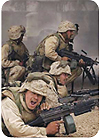
Sergeant Steve Pink, 24, was one of three National Guardsman who agreed to use small, hand-held cameras and film their year in Iraq. “An ongoing day-to-day account from the fine eyes of the soldiers of Charlie Company,” says one of them, in the documentary that resulted, “The War Tapes.”Pink approaches his work with a mental attitude similar to many who confront what might be called “high-hazard risks” on the job. “There are times you’re kind of afraid,” he says. “If you let the fear get to you, you’re really not going to be doing your job.”
Another of the soldier-filmmakers, Specialist Mike Moriarty, ponders at one point, “What motivates a soldier to go into a situation he might not come back from?”
Why would miners in Utah’s Crandall Canyon mine trek 1,500 feet under an unstable “bouncing” mountain as one miner described, day after day? What makes ironworkers scale skeletons of skyscrapers and bridge spans? Motivates fishermen to go out to the seas in ships in some terrible weather conditions, and risk falling overboard and drowning?
For many, it’s more than a paycheck. Pride, for instance.
The morning commute
“For many occupations danger is part of the job description,” reported CNNMoney.com in an article on America’s most dangerous jobs. None more so than soldiering in a war zone. Charlie Company arrives at Camp Anaconda in Iraq. “You are in danger right here, right now,” is the official greeting they receive in a pre-recorded televised briefing.Among the risks: Improvised explosive devices — IEDs. Rocket-propelled grenades — RPGs. Suicide car bombers. Mortar attacks. Ambushes. Friendly fire and highway accidents. Charlie Company’s job is to go out every day and provide convoy security for tractor-trailers and tankers moving, among other supplies, cheese, food, soda, paper, fuel and raw sewage.
They ride inside tan Humvees weighing 10,300 pounds each with four-inch thick, 75-pound windows. “On your way out to work, you can roll up to a Burger King drive-through window, with the driveway widened for the Humvees, and get a burger and fries, just like home,” says one soldier.
“It’s ‘sporting chance Tuesday’,” says another, as they roll out one morning. “We like to give the opposition an advantage so we ride with the windows down.” He pauses. “Not true. Not frickin’ safe. We ride with the windows up.”
“It’s our safety before theirs. Unfortunately, you don’t know which civilians might be insurgents.”
Keep out
The dangers of the job are on the minds, in the back of the minds, or never far from the minds of the men of Charlie Company. They simply seldom talk about it. “You almost have to have a false sense of security to do this business,” says one. “You almost have to convince yourself in your head that it won’t happen to me.” “I shook a man’s hand that wasn’t attached to his arm today,” says Sergeant Pink. “If I play the odds, one of us will die before the tour is over. It’s something I don’t like to think about.”At one point in the film, Pink’s wife says, “Steve doesn’t really like to let people in. He thinks his problems are his burden, and not anyone else’s.” Something to remember the next time you’re trying to get your employees to open up at a safety meeting and talk about their feelings toward the risks of their jobs.
Chaos on camera
One scene in “The War Tapes” is filmed through the greenish glow of a night vision camera filter. “It’s O-dark thirty and we’re rolling out. Things are hot and heavy out there,” says a soldier. Then all hell breaks loose. Ka-boom. “IED! IED!” “Are we on fire? Where’s our target?” Rat-ta-tat-tat-tat, metal buckling, explosions, flames, tracers in the night, shouts, machine guns rattling. The camera jerks, rolling upside down at one point. Images are blurred like an earthquake is being filmed. It is the so-called “fog of war.” No one knows what is happening.“Keep your vest on.” “Get to the gate.” “That’s a car bomb. Stay low.”
“We come back to camp,” says a soldier. “A couple hours later it comes down on you like a ton of bricks. How close you came to never seeing your family again. Never seeing my kids again.”
Something to keep in mind the next time at a safety meeting you want to discuss close calls, near misses. These feelings, this fear of the consequences, it is there inside. Drawing it out is another matter.
“Every time you hear a boom…â€
How do soldiers in fire zones, or employees in any kind of dangerous work, deal with the reality of their daily risks? Creeping along on patrol, one soldier recalls “a debate we had this morning over the consistency and texture of a severed limb. It was very real to us. One guy thought it was like ground-up, uncooked hamburger. Another guy said no, it was like pot roast.”The soldiers in Charlie Company don’t deny their reality, not all the time. “Every single time you go out, there are IEDs, if not hitting you, hitting someone,” says one of the men. There’s no way to defend IEDs. It’s unbelievable.” Says another: “Every time you hear a boom, somebody’s going to heaven.”
Dark humor. These guys have coping mechanisms the same as you’d find on a construction site or in a factory:
“If you’re a guy, this whole macho kick-ass thing sounds pretty good. I dare you to shoot. Just once.”
“Mike likes to play macho sometimes like it hasn’t affected him,” says his wife, “but I know it has.”
“You gotta have a thick skin. Everybody rags on everybody.”
“Bitch. Bitch. Bitch. Everyone bitches.”
“On a practical level, when I’m out there on the road, it’s my guys versus them.” Camaraderie.
“We’re tired. We’re so cynical, man. It’s only a matter of time before our number is up.” Fatalism.
“Going through today’s events in our heads, whether we want to or not,” says one guy. “I really should thank God for saving my sorry ass today.” Faith.
Honesty. “My main fear as a leader is making a mistake that could cost my guys their lives. They’ve given me this responsibility.”
Something to think about at a safety meeting when your audience seems asleep, apathetic, in denial. Maybe so. Maybe no. Know the coping mechanisms. Know the difference between apathy and denial. Charlie Company is absolutely not apathetic about their own safety, about getting home alive.
“I thought of my momâ€
A final scene: Charlie Company is on night patrol. “This is crazy, going this fast. It’s pitch black out,” says one soldier. Suddenly a vehicle pulls out and cuts across the road. Then a young woman steps out of the darkness. “We heard the crash of her body hitting the Humvee. The worst thing of my life I saw,” says one of the Charlie Company men. “The Humvee barreling at 50 miles an hour and we never saw her. She’s in pieces now. She ran out in front of us. Unbelievable. I remember looking down and seeing crumbled cookies. She was carrying cookies. I thought of my mom.“I will remember that for the rest of my life.” — Dave Johnson, Editor
Looking for a reprint of this article?
From high-res PDFs to custom plaques, order your copy today!