MANAGING BEST PRACTICES: What is an e-forklift fast charge?

The Dana Corporation facility in Toledo, Ohio, helps keep the nearby Jeep assembly complex running smoothly by providing just-in-time suspension modules. Moving materials efficiently at the Dana facility from receiving, throughout production and shipping, is critical to their operation. When Dana decided to upgrade its fleet of LPG forklifts in 2007, management planned to achieve environmental, health and safety best practices.
Addressing EHS concerns
“One of our key objectives was to eliminate exhaust gases that come with using an internal combustion engine and we also wanted a quieter operation,” says Paul Young, maintenance manager. Paul further explains, “But we didn’t want to trade one problem for another. Space is limited and installing battery-charging bays with overhead hoists, venting hydrogen gas during charging cycles, and exposing employees to corrosive liquids made the selection of conventional electric operated forklifts unattractive. When we explored the issue further, we found that electric forklifts using advanced fast charge technology would provide the best EHS benefits.”Conventional battery charging
Conventional charging requires that a battery receive a flow of electricity (16-18A/100Ahrs) over an average of eight to ten hours to obtain a 100 percent state of charge. To reach the 100 percent charge, considerable hydrogen gas is evolved that must be vented to avoid flammable conditions. Over-charging will accelerate the off-gassing of hydrogen. In multi-shift operations, additional batteries must be available for each forklift.Generally, on each shift, a battery (that may weigh in excess of 2,000 pounds) is hoisted from a forklift, stored and charged while another freshly charged battery is installed in the same forklift to keep it in operation.
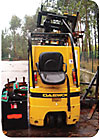
Forklift crashes can be devastating. Photo courtesy: ForkliftAction.com
Fast charge technology
According to ForkliftAction.com, March 2006 Newsletter #252 “Fast charging – What is it?,” the technology arose from efforts in the 1990s to develop a fast charge technology for electric cars to meet California mandates to reduce air pollution from transport sources. The use in electric cars never took off, but the technology found a growth opportunity in e-forklifts.With fast charge technology, batteries are charged at higher amperage than the conventional rate at every opportunity. A target of 80-85 percent state of charge is sought. This generally entails having the battery plugged to a charger unit, the battery remains in the forklift, and charging may take place during the short time periods at lunch breaks, between shifts, etc. A cumulative total of about 30 minutes of charging may allow the battery to operate for about eight hours.
Fast charge technology eliminates or reduces many EHS concerns. At 85 percent state of charge, hydrogen off-gassing is minimal and the need for special venting is avoided. Charging units are small and may be placed strategically throughout the work area, as opposed to a central bay that is usually necessary for conventional charging. Since the battery remains in the forklift during charging, hoist equipment and additional batteries are eliminated. The technology often employs advanced battery design such as sealed units that reduce or eliminate contact with corrosive acid located inside the battery. The need for special PPE, eyewash, etc., for working near the battery is avoided or substantially reduced.
Fast charge batteries must be equalized — charged to 100 percent state of charge at least once a week. Employers that use this technology usually schedule this work to be done on the weekend by one or two employees who are trained in the process, and who may also focus on keeping forklifts in top operating condition.
Safety-bump stop feature
Besides health and comfort benefits such as no exhaust toxic gas, no exhaust heat load to the work environment, and being quiet, the e-forklifts have an important safety benefit.“The new forklifts come with a bump stop feature that will turn the unit off if it hits something with sufficient force, and we can program the amount of force it takes to shut the unit off,” says Paul. The availability of the bump stop feature may help management address the challenge of getting forklift operators to report near-miss incidents, such as bumping into building structures.
Paul explains, “To get a forklift running again, the operator must contact their supervisor who has a code for restarting the equipment.”
Although the bump stop feature may seem like a nuisance at first, it should lead to safer driving. The benefits of safer driving should not be underestimated. National statistics show on average 100 workers are killed and 20,000 are injured from forklift mishaps. More than 35 percent of these mishaps occur when a forklift strikes or crushes a pedestrian worker. If the bump stop feature leads to more near-miss investigations only involving property damage, then injuries or worse will be avoided.
Environmental/social benefits
Although the Dana Modules facility considered environmental and social benefits, they did not put these at the top of their list when they chose to move to e-forklifts from LPG (propane). If the company’s facility was located in California, this would be a very different matter.California has been aggressive in addressing concerns posed by climate change resulting from greenhouse gases and concerns over petroleum consumption. To address these concerns, the state has enacted and proposed laws such as AB 32, California Global Warming Solutions Act of 2006 and AB 1007, State Alternative Fuels Plan. Using these and other initiatives, California encourages employers to use e-forklifts rather than models using LPG, gasoline or diesel fuels. California’s Carl Moyer program, for example, provides monetary grants to help employers purchase e-forklifts, with the benefits of fast charge technology further encouraging employers to move in this direction.
ROI
The return-on-investment in choosing an e-forklift over other technologies involves many considerations. The specific type of equipment and features, how often they’re used, when used, etc., all play into the ROI formula. And as noted above, there are benefits that may be hard to quantify in ROI calculations. A major consideration is that the initial cost for an e-forklift may be 20-40 percent higher than similar internal combustion models. When all costs and benefits are tallied, though, there is often a positive ROI by using an e-forklift over similar internal combustion models.To conclude
Companies are finding advantages in e-forklift fast charge technology. ForkliftAction.com (Newsletter #252) reports that Ford Motor Company has committed to replace its battery rooms with fast chargers at all its North American plants. If you’re looking to upgrade forklifts or other powered industrial trucks, fast charge technology should be considered for its various EHS benefits.Looking for a reprint of this article?
From high-res PDFs to custom plaques, order your copy today!


