Determining nanotechnology health effects
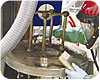
Worker cleaning out a metal nanoparticle vapor deposition reactor.
The National Science Foundation has estimated that two million workers will be needed to support nanotechnology industries worldwide within 15 years. And a whole new world of human exposure assessment methodologies and technologies will spring forth with that future workforce.
But at present, the nano industry poses more exposure questions than it supplies answers for industrial hygienists, epidemiologists, and others specializing in nanotechnology health and safety risks.
As a NIOSH blog post stated, “Determining whether a material or substance poses an occupational health risk depends on knowing not only the potential toxic characteristics of the material, but also the characteristics of exposure. To what concentrations are workers exposed, for how long, and in what ways?” Exposure assessment is crucial to answer the looming question of whether nanomaterials pose work-related health risks. Very little exposure data have been reported in the scientific literature due to the relative newness of nanotechnology. At this stage, “measuring or determining risk becomes a little like trying to solve a mystery when major clues are missing,” according to NIOSH.
Filling the void
Several initiatives are underway to fill the information void. NIOSH collaborated with the U.S. Nanoscale Science, Engineering and Technology Subcommittee (NSET) to co-sponsor the workshop on Human and Environmental Exposure Assessment of Nanomaterials on Feb. 24-25, 2009, in Bethesda, Md.
Five plenary presentations were as follows:
- Characterize Exposure among workers – Dr. Robert Herrick, Harvard University;
- Identify population groups and environments exposed to engineered nanoscale materials – Dr. David MacIntosh, Environmental Health & Engineering, Inc.;
- Characterize exposure to the general population from industrial processes and industrial and consumer products containing nanomaterials – Dr. Paul Lioy, Rutgers;
- Characterize health of exposed populations and environments – Dr. William Halperin, University of Medicine & Dentistry of New Jersey;
- Understand workplace processes and factors that determine exposure to nanomaterials – Dr. Susan Woskie, University of Massachusetts, Lowell.
So what is a nano?
Nanotechnology is the understanding and control of matter at dimensions between approximately 1 and 100 nanometers, where unique phenomena enable novel applications. Encompassing nanoscale science, engineering, and technology, nanotechnology involves imaging, measuring, modeling, and manipulating matter at this length scale.
A nanometer is one-billionth of a meter. A sheet of paper is about 100,000 nanometers thick. Nanotechnology is different from older technologies because unusual physical, chemical, and biological properties can emerge in materials at the nanoscale.
These properties may differ in important ways from the properties of bulk materials and single atoms or molecules. Researchers who try to understand the fundamentals of these size-dependent properties call their work nanoscience, while those focusing on how to effectively use the properties call their work nanoengineering.
Current applications
Nanomaterials are used to add strength to composite materials used to make lightweight tennis rackets, baseball bats, and bicycles. Nanostructured catalysts are used to make chemical manufacturing processes more efficient, saving energy and reducing the waste products. A few pharmaceutical products have been reformulated with nanosized particles to improve their absorption and make them easier to administer. Opticians apply nanocoatings to eyeglasses to make them easier to keep clean and harder to scratch.
Occupational safety
In 2007, NIOSH issued the following recommendations as precautionary measures for employers and workers handling engineered nanomaterials:
- For most processes and job tasks, the control of airborne exposure to nanoaerosols can be accomplished using a wide variety of engineering control techniques similar to those used in reducing exposure to general aerosols.
- The implementation of a risk management program
in workplaces where exposure to nanomaterials exists
can help to minimize the potential for exposure to nanoaerosols.
Elements of such a program should include:
- evaluating the hazard posed by the nanomaterial based on available physical and chemical property data and toxicology or health effects data.
- assessing potential worker exposure to determine the degree of risk.
- the education and training of workers in the proper handling of nanomaterials (e.g., good work practices).
- the establishment of criteria and procedures for installing and evaluating engineering controls (e.g., exhaust, ventilation) at locations where exposure to nanoparticles might occur.
- the development of procedures for determining the need and selection of personal protective equipment (e.g., clothing, gloves, respirators).
- the systematic evaluation of exposures to ensure that control measures are working properly and that workers are being provided the appropriate personal protective equipment.
- Engineering control techniques such as source enclosure (i.e., isolating the generation source from the worker) and local exhaust ventilation systems should be effective for capturing airborne nanoparticles. Current knowledge indicates that a well-designed exhaust system with a high-efficiency particulate air (HEPA) filter should effectively remove nanoparticles.
- The use of good work practices can help to minimize worker exposures to nanomaterials. Examples of good practices include: cleaning of work areas using HEPA vacuum pickup and wet wiping methods, preventing the consumption of food or beverages in workplaces where nanomaterials are handled, and providing hand-washing facilities and facilities for showering and changing clothes.
- No guidelines are currently available on the selection of clothing or other apparel (e.g. gloves) for the prevention of dermal exposure to nanoaerosols. However, some clothing standards incorporate testing with nanoscale particles and therefore provide some indication of the effectiveness of protective clothing with regard to nanoparticles.
- Respirators may be necessary when engineering and administrative controls do not adequately prevent exposures. Currently, there are no specific exposure limits for airborne exposures to engineered nanoparticles although occupational exposure limits exist for larger particles of similar chemical composition.
Preliminary evidence shows that for respirator filtration media there is no deviation from the classical single-fiber theory for particulates as small as 2.5 nm in diameter. While this evidence needs confirmation, it is likely that NIOSH-certified respirators will be useful for protecting workers from nanoparticle inhalation when properly selected and fit tested as part of a complete respiratory protection program.
Consensus guidelines
The EHS global consultancy of ORC Worldwide, based in Washington, D.C., has posted on its website a selection of peer-reviewed environmental health and safety tools and reference materials that ORC says may be useful to practitioners involved in nanotechnology.
The tools and references are formatted in a table with nine columns representing critical issues such as hazard characteristic assessment, worker exposure assessment, process safety assessment considerations, environmental emissions assessment, and overall risk assessment. Within each area, a special ORC task force of member companies has identified a number of specific materials (tools, useful references etc.) that are linked into the document. If you click on blue underlined text you will access a table. Column One contains a link to the reference material or tool. Column Two contains a peer review of the tool.
ORC states that the table is a “living document” which will be updated as new knowledge becomes available.
Visit ORC’s Nanotechnology Consensus Workplace Safety Guidelines at www.orc-dc.com/?q=node/1962.
Looking for a reprint of this article?
From high-res PDFs to custom plaques, order your copy today!


