Clean air for construction workers
You wear a respirator to protect you from breathing dangerous dusts, fumes or gases - like silica, welding fumes, or carbon monoxide. Respirators come in different styles and with different filters or cartridges, depending on what you’re protecting against and how much is in the air.
Types of respirators
There are two kinds of respirators - supplied air and air purifying.
- Supplied-air respirators give you clean breathing air from a compressor or compressed-air cylinder. These respirators are used in some of the most dangerous conditions. There are self-contained breathing apparatuses (SCBAs) like firefighters wear on their backs or air-line respirators connected to a hose. If there is not enough oxygen or no one is sure what is in the air where you’re working, OSHA says you must use an SCBA or air-line respirator with a small compressed-air cylinder for backup. If you use a supplied-air respirator without the right training, you can be killed. (Most construction jobs that require breathing protection use air-purifying respirators.)
- Air-purifying respirators clean the air you breathe. Some have a blower to make it easier to breathe. But they do not provide oxygen. Air-purifying respirators are disposable or rubber or rubber-like masks. One may cover your whole face or part of your face. Each mask has 1 or 2 filters or cartridges that get changed. You must have the right filter or cartridge for each hazard.
Filters
Filters can protect against tiny particles, dusts, mists, or fumes. Filters have the letters “HEPA” or have a letter and number like P-100 or N-95. The letters tell if the filter works when there is oil in the air:
- N means Not resistant to oil
- R means Resistant to oil
- P means oil-Proof.
A bigger number after the letter means the filter protects better. (For dusts like asbestos, lead, and silica, you must use a HEPA or a 100 filter.) You must change a filter when it is hard to breathe through.
Cartridges
Cartridges can protect against solvents, acid gases, or other gases and vapors. A cartridge for acid gases will not protect you if you are exposed to solvents. Some combination cartridges can protect against dusts and gases, but no cartridge can protect against all hazards. You and your employer must learn when to change the cartridges, depending on the type and amount of toxic gases or vapors in the air.
Protect yourself
You may need a respirator if, for instance:
- You are working around asbestos or lead-based paint
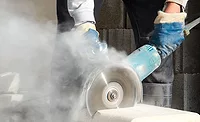
- You are chipping or cutting concrete or drilling rock that contains silica
- You are sanding, cutting, torching, or welding - or using a generator - in a space without good ventilation.
- The toxics in the air are above the permissible exposure limit (PEL) set by OSHA - or you don’t know they are not above the PEL
- There is no other way to keep down the exposure levels. Local-exhaust ventilation, new tools, and changes in the way you do the work (such as wet methods) do not take care of the problem.
OSHA says the employer must choose the right respirator for you, depending on the hazard. If a respirator is required, OSHA says the employer pays for the respirator and parts.
Before you use a respirator, OSHA says:*
- Your employer must have tried to use other controls, like ventilation or safer materials.
- To make sure it is safe for you to wear a respirator, your employer must pay for you to have a medical evaluation (unless you’re using a disposable dust respirator that is not required). You may be asked to fill out a questionnaire for a doctor or health care practitioner to check. Or you may need a physical exam if you work around some materials like lead or asbestos.
- You must be trained to use a respirator.
- A mask must be fitted to your face. A quantitative fit test is best.
- Your employer must have a written respirator program.
- You must use a respirator that is approved by the National Institute for Occupational Safety and Health, NIOSH. (A NIOSH-approved respirator says “NIOSH” and/or 42 CFR on the box and on filters or cartridges.) Read the NIOSH-approved instructions for the respirator.
Every time you use a respirator:
- Check for worn, damaged, or missing parts.
- Check the face seal. Use a negative and positive seal check.
Follow the manufacturer’s guidelines for care. After you use a respirator:
- Clean it: Put on surgical gloves. Remove filters or cartridges. Wash the mask in 110° F water using the manufacturer’s recommended cleaner or mild detergent. Rinse, then dry.
- Store the respirator in a rigid plastic container away from heat and light.
- Dispose of used parts properly.
Take care of the respirator so it can take care of you.
This article is a Hazard Alert card produced by CPWR - The Center for Construction Research and Training. This information and 24 more Hazard Alert cards, in English and Spanish, can be found on CPWR’s website: www.cpwr.com/rp-hazardalerts.html.
Reprinted courtesy CPWR-The Center for Construction Research and Training (formerly the Center to Protect Workers’ Rights)
© 2003, The Center to Protect Workers’ Rights. All rights reserved. CPWR is a research, development, and training arm of the Building and Construction Trades Dept., AFL-CIO: CPWR, Suite 1000, 8484 Georgia Ave., Silver Spring, MD 20910. (Edward C. Sullivan is president of the Building and Construction Trades Dept. and of CPWR and Sean McGarvey is secretary-treasurer.) Production of this card was supported by grant CCU317202 from the National Institute for Occupational Safety and Health and grants U45-ES09764 and U45-ES06185 from the National Institute of Environmental Health Sciences. The contents are solely the responsibility of the authors and do not necessarily represent the official views of NIOSH or NIEHS.
*OSHA’s respiratory protection standard for general industry and construction is 29 CFR 1910.134.
Looking for a reprint of this article?
From high-res PDFs to custom plaques, order your copy today!