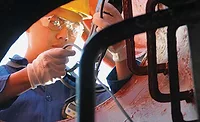
Confined spaces in construction
Ten key differences from general industry
History of hazards
A brief history lesson is in order first before we explore the differences. Confined spaces have always been described with the following three points: A space large enough and so configured that an employee can bodily enter and perform assigned work; has limited or restricted means for entry or exit; not designed for continuous employee occupancy.
Although it seemed people knew confined spaces were dangerous, OSHA did some
research and found workers were still getting killed and injured in them. So, in January 1993, OSHA issued the general industry confined space rule (29 CFR 1910.146), and then a similar rule for the shipyard industry (29 CFR 1915.7) in 1994. The general industry standard requires employers to classify hazardous confined spaces as “permit-required confined spaces” and to implement procedures to ensure safety for the employees who enter them.
In late 1993, the United Steel Workers of America had concerns with the newly delivered general industry standard and, after litigation, OSHA agreed in a settlement to issue a proposed rule to extend confined space protection to construction employees. On February 18, 1994, OSHA submitted a draft proposed standard for confined spaces in construction to the Advisory Committee for Construction Safety and Health (ACCSH) for comment.
The ACCSH found that the confined spaces encountered or created in construction were not usually identified or classified prior to the beginning of a project. OSHA used this advice from the Committee, along with fatality and injury data and their own enforcement experience, to ultimately determine that the general rule does not adequately protect construction workers in confined spaces from atmospheric, mechanical and other hazards. The wheels of government started turning and, in November 2007, the “proposed rule” (CFR 1926 Confined Spaces in Construction) was issued for public opinion.
Today, OSHA stipulates a confined space that is subject to hazards must be classified. These classifications determine what accident prevention and protection requirements apply to that space. The four classifications are: Continuous System-Permit-Required Confined Space (CS-PRCS), Permit-Required Confined Space (PRCS), Controlled-Atmosphere Confined Space (CACS) and Isolated-Hazard Confined Space (IHCS).
Down to the differences
There are five key differences between the general industry and construction standards.
They are:
1) Organization of the Standard
General Rule (GR) – Begins with requirements for entering a PRCS, and specifies the four criteria that make for a PRCS.
Construction Standard (CS) – Proposes a step-by-step approach, explaining how to classify a space, determine its hazards and how to safely enter.
2) Information Exchange
GR – Requires the host employer to coordinate entry operations with both the contractor and his own employees when working in or around the permit space.
CS – Requires the controlling contractor to coordinate with all contractors that have employees in a confined space, regardless of whether or not the controlling contractor has employees in that space.
3) Confined Space with Hazards Isolated
GR – Does not address working in confined spaces in which the hazard has been isolated.
CS – Allows employers to establish an IHCS by isolating or eliminating physical and atmospheric hazards in the confined space. There are guidelines for lockout-tagout. The standard is 29 CFR 1910.147.
4) Controlled-Atmosphere Permit-Required Confined Space
GR – Specifies monitoring required as necessary.
CS - Requires continuous monitoring unless the employer can demonstrate that periodic
monitoring is sufficient. Note that continuous monitoring of the atmosphere is the only
sure way of knowing you will be safe at all times. However, conditions can change and
any work being performed may also cause the atmosphere to change.
5) Permit-Required Confined Spaces
GR – No definitive requirements for entry supervisors to monitor PRCS conditions during entry.
CS – Requires for the entry supervisor to monitor PRCS conditions during entry.
GR – Requires a written PRCS plan.
CS – No plan is required when the employer maintains a copy of the standard at the worksite.
GR – No early-warning requirements for any up-stream hazards.
CS – Requires early-warning requirements for up-stream hazards in sewer-type spaces.
OSHA placed more importance in this area because many construction workers in sewer systems are unfamiliar with the hazards associated with these worksites.
Training & other areas to address
One issue that OSHA addresses, and does it well, is rescue and the procedures surrounding it regarding work in confined spaces. OSHA lays out a set of guidelines that include procedures, equipment and training that will ensure safety for both the rescuer and victim. If you are new to confined space rescue, the preamble of 29 CFR 1926 describes the necessary training requirements and the equipment necessary to carry out a successful rescue.
Recognizing the importance of training, OSHA defines the areas in which a proper training exercise should be conducted. A “Simulated Permit-Required Confined Space” is a confined space, or mock-up of one, that is designed to prevent injuries or death from occurring during rescue training drills.
Other areas to evaluate in order to make your confined spaces on construction sites safe are lockout-tagout recommendations, and trenching and shoring. These, if addressed correctly, will ensure worker safety.
Are practices and procedures in confined spaces between industry and construction different? You’d better believe it, and prepare accordingly. Good luck.
Looking for a reprint of this article?
From high-res PDFs to custom plaques, order your copy today!