Midnight in your warehouse
Track your chemical inventory stock
Correlating that message to the idea of managing chemical inventories is the focus of this article. We all know that employee exposure to hazardous materials in the workplace is one of the greatest sources of risk for companies. To combat that risk, chemical safety in your facilities needs to start with a timely and accurate chemical inventory.
An inaccurate chemical inventory can result in:
• Lack of precautionary and protective measures to prevent employee exposure
• Lack of emergency response information and preparedness
• Higher regulatory compliance risk, specifically for hazard communication rules
• Inaccurate, incomplete regulatory reporting
• Increased corporate liability
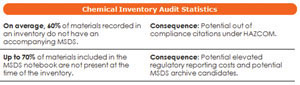
So, how do most companies fare with respect to chemical inventory accuracy?
These statistics from our chemical inventory audit highlight two important consequences of inaccurate chemical inventories:
1) If chemicals are present but lack an accompanying MSDS, you risk being out of compliance with chemical hazard communication laws.
2) Companies may face unnecessary liability for materials that are no longer present but remain documented in the MSDS repository or notebook. While this may be due to temporary stock shortages, sometimes materials are exchanged for similar or improved chemicals that are not reflected in the MSDS.
 Check your foundation for cracks
An accurate chemical inventory is the foundation for your overall chemical management initiatives. It will ensure that there are no cracks in your foundation, which should be built on an understanding of what chemicals you have on site and where they’re located. Understanding the entry points for chemicals is also critical. Without it, all downstream processes for hazard communication, regulatory reporting, and even internal sustainability initiatives will suffer.
Once your foundation is firm, you can build on that base knowledge with data that will help you identify and quantify hazards and risk levels by work area, by facility, and for the entire corporation and allow you to reduce risk, costs and corporate liability.
A process flow that works
Chemical management is the process of controlling the activities, data, and exposures of chemicals in the workplace. A best practices approach takes into account people, process and technology considerations. Ideally, you want to be able to control the introduction of chemicals into the workplace, track chemical locations and use, generate reports and access hazard information. This process flow is illustrated in the diagram below, where material approval, chemical inventory, MSDS management, and regulatory reporting function as an integrated process for the EHS team.
Ensure chemical approval
First, know and track what is coming in. Most organizations utilize supply chain and procurement systems to purchase, track, and control the majority of their materials and goods, but indirect purchases made outside of procurement can trip up safety and compliance safeguards. Even when companies utilize procurement systems, these systems aren’t always in sync with EHS systems and processes. The chemical introduction process warrants greater attention than some of the standard purchasing processes because of the impact to worker safety, environmental consequences and regulatory oversight.
Some of today’s MSDS management systems embed material approval functions into the software functionality. The most functionally complete systems allow for custom approval forms, multi-level approvals, and automated workflow and business logic for supply chain approval.
Elements of an effective chemical inventory
A solid chemical inventory will leverage good business process, conscientious staff and technology to perform an inventory that is tied to your electronic MSDS notebook. The advantage? Greater efficiency than with traditional paper and pencil methods. Your facility will be pre-sorted by chemical area with an initial ledger of materials in that area, so your inventory team will be performing look-ups rather than raw data entry. This can be done with compact inventory tablets with embedded barcode scanning for “no-touch” lookups, standard laptops, or even using an iPad.
An even greater benefit of integrating chemical inventory applications with your MSDS management system is the ability to automate the syncing or reconciliation process to your current MSDS notebook. The MSDS system can then quickly auto-reconcile which materials match the notebook, which materials are physically present but not in the notebook, and which materials are in the notebook but no longer purchased or physically present. Based on your preference, the system will then initiate the workflow to perform the proper action by either initiating a service request to your MSDS service provider or archiving materials in your notebook, resulting in data management savings.
Some specific considerations for performing the inventory include: what to record, time to complete, tools to use, how to prepare, and how often to perform an inventory. As long as your organization is addressing the other elements of material approval and MSDS management, annual inventories at major sites should be sufficient.
The following data points should be recorded: chemical name, manufacturer, location, product ID, container and container size, and quantity levels. This information will serve the reconciliation and reporting steps well once the inventory is complete. Time to complete will vary by location, but expect an inventory specialist with the right tools to complete around 200 – 300 materials per day.
Downstream benefits
There are connection and downstream benefits to your MSDS management, labeling, and regulatory reporting responsibilities. Direct, automated reconciliation into the electronic MSDS notebook saves time and is ideal for both compliance and efficiency purposes. Additionally, if you employ a MSDS service provider that fully indexes the MSDS — including health and physical hazards — your container labeling efforts are much easier and consistent.
Finally, your regulatory and internal reporting efforts will be streamlined if you include quantity, count, and location information in your inventories. For Tier II annual reporting, chemical inventories can help quantify and establish the maximum and average amounts on hand during the year. Other regulations, such as Form R reporting, require annual usage amounts. If your organization maintains adequate purchasing records, the chemical inventory snapshot can help reconcile estimated usage amounts for the year.
Not knowing is not an option
Better compliance and greater chemical management efficiency are just a few of the immediate benefits of sound chemical inventory practices. The core data coming out of a chemical inventory can improve purchasing decisions, hazard and risk assessments, internal sustainability initiatives and risk reduction in your company. Not knowing is not an option, so move forward with your chemical inventory initiatives to make sure that you and your chemical management plan are on a solid foundation.
Looking for a reprint of this article?
From high-res PDFs to custom plaques, order your copy today!