Predict thermal comfort of FR garments
Wear trials are a great tool to gauge the comfort of garments in specific work environments, but using wear trials alone can be become extremely time-consuming and expensive, particularly if multiple fabric choices are under evaluation. In order to gather accurate information during a wear trial, the trial needs to be of adequate duration and size, and span the range of environmental conditions and activity loads that are expected for each job.
With the rapid growth of flame resistant workwear over the last several years, many new fabric suppliers and new fabric options have become available to service the large number of new users in an increasingly diverse hazard environment. Methods for screening garments based on fabric properties must be employed to reduce the wear trial scope and focus on the garments that are likely to be best suited for the environment. Although measuring a single fabric property may not always be an accurate predictor of thermal comfort, with a combination of fabric properties, including weight, air permeability, heat loss, and moisture management, a reasonable comparison can be made of candidate fabrics prior to constructing garments for wear trials.
Heat loss measurements
Heat loss is one the fundamental fabric properties that drives thermal comfort. It measures the ability of the fabric to pass heat from the wearer to the environment. Fortunately, simply measuring the air permeability, which measures the volume of air that will pass through the fabric at a standard pressure, and the fabric weight, can provide a reasonable approximation of thermal heat loss properties of a fabric.
In general, lighter weight fabrics with higher air permeability will trap less heat and provide greater comfort in warm environments.
More advanced measurements can be conducted to gain a deeper understanding of the thermal heat loss properties of fabrics, particularly for jobs involving strenuous activity or in high-heat environments.
For example, the permeability index (Im), indicates the ability for moist heat to pass through the fabric. The values range from 0 (totally impermeable) to 1 (totally permeable). Fabrics with higher values will generally be more comfortable in conditions where the wearer sweats. A combined measurement that takes into account both the dry and evaporative (sweating) heat loss through the fabric is termed the total heat loss (Qt). Measured at 100 percent wet skin conditions, it predicts the amount of activity that a wearer may sustain and still remain comfortable. Higher values indicate that a more strenuous level of activity is possible without creating heat stress.
Moisture management properties
Another major contributor to comfort is the ability of the fabric to transport moisture (sweat) from the inside of the fabric to the outside, where it can evaporate and provide cooling. The absorbent capacity of the fabric, although important, should not be considered alone. The ability of the fabric to release the moisture through evaporation is a much better indicator of comfort in high-heat environments. Heavier fabrics tend to absorb more moisture (think flannel or denim), but also tend to retain that moisture longer, potentially leading to a saturation condition where the sweat rate exceeds the evaporation rate. The evaporation properties of fabric can be determined by measuring two key parameters: the percent evaporation (Ep), and the drying time.
The percent evaporation is the ratio of the amount of moisture evaporated to the amount of moisture absorbed during a 1000 second (approximately 17 minute) test. In this test, water is supplied from a reservoir to the fabric through a porous test plate. The water is wicked into the fabric laterally while it is simultaneously evaporating.
At the end of the test period, the amount of water consumed from the reservoir is compared to the amount of water remaining on the fabric. The difference is the amount of water evaporated during the test. Higher values in this test indicate a greater ability of the fabric to disperse and evaporate moisture. The drying time is a good measure of the ability of the fabric to cool the wearer if it were to become saturated. It is simply a measurement of the amount of time required for the fabric to go from completely wet to completely dry in controlled conditions.
Example comparison of fabrics
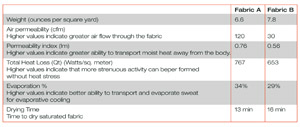
As an example, two commercially available 88/12 cotton/nylon, flame resistant fabrics were submitted to North Carolina State University to measure thermal comfort parameters. Both fabrics are certified to NFPA 2112 standards, are HRC2 rated, and have identical arc ratings at 8.7 Cal/cm2. Although the flame protection properties of these two fabrics are virtually the same, the thermal comfort properties predict a clear distinction in comfort.
The thermal properties of air permeability, the permeability index, and total heat loss indicate that Fabric A will be better able to transport moist heat away from the user, and that more strenuous activity can be performed while remaining at a comfortable temperature. In addition, the moisture management properties of evaporation percent and drying time demonstrate that fabric A will have a greater ability to transport and evaporate moisture than Fabric B.
Naturally, other factors need to be considered when selecting fabrics. Other comfort parameters, such as fabric “hand”, which is a combination of softness, stiffness, and stretch, will also contribute to overall comfort. If the primary concern is thermal comfort, however, comparing the basic fabric properties of permeability, weight, and the ability to transport moisture will help determine the fabric/garment best suited to your worker’s environment.
Looking for a reprint of this article?
From high-res PDFs to custom plaques, order your copy today!