Point-of-Use Tempered Water for Emergency Showers
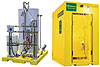
Matched and balanced tempered water systems can
be either skid mounted or contained in an Enclosed Emergency Environments (E3)
booth.
ANSI's 2004 update of the Z358.1 standard governing emergency showers and eyewashes provided a much greater degree of clarity around the issue of providing tepid water through emergency shower and eyewashes. The 2004 Z358.1 revision provided clear tepid water temperature range… now what?
Heating cool input water or cooling warm water seems, at first blush, to be relatively simple. But how do you know what "state-of-the-art" looks like, if you only occasionally design such a system?
Engineered solutions
A significant number of engineered solutions lately are aimed at providing point-of-use tempering to accommodate ANSI's outlet water temperature requirements. Piping and recirculating hot water, for example, over potentially vast distances to outlying showers is simply not feasible sometimes, so "making" suitable water at the point-of-use is an idea that is getting significant traction.The resulting products most often provide a "plug-and-play" package — in either open skid or enclosed booth configuration — that can be literally dropped into the appropriate location or locations anywhere within the plant.
Warming cold inlet water temperatures
The most prevalent need for tempering is an application where inlet water temperatures are below the 60ºF threshold. Even in areas where water temperatures are thought to be moderate, sustained running (for 15 minutes at 20 gpm) often results in lowering temperatures through the shower use cycle, approaching source water temperature. And that source water temperature is very often below the minimum 60ºF.As a general rule, tempered water blending systems designed to warm inlet water consist of three major components: a hot water storage tank, a heater and a blending valve. A fourth component, a booster pump, is sometimes specified where water pressure might be too low to run multiple pieces of emergency equipment at a combined peak demand.
Importantly, the specific requirements that the showers or eyewashes impose on the system need to be taken into account when sizing the componentry for the tempered water system. This is an important point. By considering the tempering componentry and the demands of the showers and eyewashes within the system, the specifier can build a complete, matched system. An ANSI-compliant shower may not actually be compliant if the upstream tempering components are sized improperly. That's because ANSI compliance is sought and granted based on specific pressure and flow ranges.
When your objective is to warm cold inlet water, the heart of the tempered water delivery system is the mixing valve. It ensures that the emergency equipment safely receives water at the required temperature by monitoring output temperatures and adjusting cold and warm input streams accordingly.
Emergency equipment manufacturers are in the best position to design appropriate mixing valves, since thet understand the equipment and the specific flow rate requirements. Determining flow requirements not only helps the emergency equipment manufacturer to properly size the mixing valve, it also allows them to determine the size of the required hot water source.
Once the mixing valve capacity is calculated, a common oversight is underestimating the pressure required to drive the emergency equipment after it has passed through the mixing valve and the flowing pressure available. You might find that there is insufficient pressure at the facility to run the system. If this is the case, you will have to either add a booster pump to the supply, or limit the number of showers and/or eyewashes on the system. Other options are to look at increasing the pipe size one or two sizes so that the friction losses are less.
Once you have the essential data to size your system, you need to ask your emergency equipment manufacturer about the safety redundancies of their valve. You need to ensure that the mixing valve can offer a full flow bypass of cold water. In the event there is a loss of hot water at the valve, or the cold-water inlet at the valve becomes restricted, it is essential that there is a means to offer a full flow of cold water to the equipment.
If you are considering a mixing valve stated to have an internal cold water bypass, you need to ask if this bypass can handle the maximum flow of the system design. If the bypass is less, there is a good possibility that an eyewash, for example, will not flow water if it is needed concurrently with a shower.
The offered mixing valve must also have a positive means of hot water shutoff in the event of a cold-water failure. If there is a sudden loss of pressure on the cold side, the mixing valve must shut off completely and not allow any hot water to pass. You do not want a valve to pass only hot water, as there may be enough flow to operate an eyewash. As mentioned earlier, temperatures in excess of 100°F have been determined to be harmful to the eyes. Safety redundancies should be external to the main mixing valve so that their performance is not jeopardized by the performance of the mixing valve itself.
Cooling hot inlet water temperatures
Now, let's discuss emergency equipment outlet water temperatures that exceed the 100°F maximum. With respect to cooling high ambient temperature water to bring it within the guidelines, the most popular approach is to size a chiller to handle the maximum anticipated load.A variety of different products are available, based on the volume of water required at peak demand and the footprint of the recirculation loop specified. As is also the case with warming technologies, all components must be matched to assure the availability of proper peak flow rates and temperatures.
Looking for a reprint of this article?
From high-res PDFs to custom plaques, order your copy today!


