What you need to know about welding safety
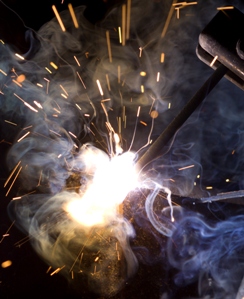 Welding is the most common method of joining metals in industry today. When welded, two pieces of similar metals are fused (melted) together. Once completed, the welded joint is as strong or stronger than the pieces from which the joint is formed. General hazards of welding include impact, penetration, harmful dust, smoke, fumes, heat and light radiation. The proper personal protective equipment can protect you from these hazards.
Types of welding
Gas welding: Two metals are joined by melting or fusing their adjoining surfaces. This is done by directing a gas flame over the metals until a molten puddle is formed. The energy for gas welding comes from the combustion of a fuel with oxygen or air. A few of the most popular fuels are acetylene, Mapp gas and hydrogen. Since gas welding is slower and easier to control than electric arc welding, it is often used in applications such as general maintenance work, brazing and soldering.
Arc welding: Two metals are joined by generating an electric arc between a covered metal electrode and the base metals. Heat is produced by the arc, which in turn, melts the metal and mixes the molten deposits of the coated electrode. The arc energy is provided by a power supply unit that furnishes direct or alternating current. The electrodes carry the current to form the arc, producing a gas that shields the arc from the atmosphere, and add metal to control the weld shape.
When an arc is struck using a coated electrode, the intense heat melts the top of the electrode. The drops of metal from the electrode enter the arc stream and are deposited on the base metal.
The equipment needed for electric arc welding is a power supply, electrode holder, ground clamp, protective shield and welder's protective clothing.
- Oxygen and arc cutting: Metal cutting in welding is the severing or removal of metal by a flame or arc. The most common cutting processes are:
- Oxygen cutting: Metal is heated by gas flame, and an oxygen jet does the cutting
- Arc cutting: Intense heat of electric arc melts away the metal
Personal Protective Equipment
Eye and face protection: Proper eye and face protection for welding safety varies depending on the particular task being performed. Helmet, hand shield, goggles and safety glasses or combination of these are acceptable protection in various applications. All filter lenses and plates must meet the test for transmission of radiant energy prescribed in ANSI/ISEA Z87.1-2010, Practice for Occupational and Educational Eye and Face Protection.
According to OSHA 29 CFR 1910.252, "Helmets and hand shields shall protect the face, forehead, neck and ears to a vertical line in back of the ears, from the arc direct radiant energy and weld splatter."
Welding helmets with filter plates are intended to protect users from arc rays and from weld sparks and spatters, which strike directly against the helmet. They are not intended to protect against slag chips, grinding fragments, wire wheel bristles and similar hazards, which can ricochet under the helmet. Spectacles, goggles or other appropriate eye protection must also be worn to protect against these impact hazards.
OSHA requires that when arc cutting and arc welding with open arc, helmets or hand shields with filter lenses and cover plates shall be used by operators. Nearby personnel viewing the arc are also subject to wear proper protection. Safety glasses with a shade 2 lens are recommended for general-purpose protection for viewers. When resistance welding or brazing, operators must use face shields, safety glasses or goggles, depending on the particular job, to protect their faces and eyes from welding hazards.
Protective Clothing: According to ANSI Z49.1:2012: Welding and Cutting (4.3), appropriate protective clothing for any welding or cutting operation will vary with the size, nature and location of the work to be performed. Clothing shall provide sufficient coverage and be made of suitable materials to minimize skin burns caused by sparks, spatter or radiation. Covering all parts of the body is recommended to protect against ultraviolet and infrared ray flash burn.
Dark clothing works best to reduce reflection under the face shield. Heavier materials, such as wool clothing, heavy cotton or leather, are preferred as they resist deterioration. Materials that can melt or cause severe burn due to sparks that may lodge in rolled-up sleeves, pockets of clothing or pant cuffs are not recommended.
The ANSI standard requires all welders and cutters to wear protective flame-resistant gloves, such as leather welder's gloves, which provide the heat resistance needed for welding. A gauntlet cuff offers additional arm protection, and insulated linings should be used to protect areas exposed to high radiant energy.
Other protective clothing for welding safety would include durable, flame-resistant aprons made of leather or other suitable materials to provide protection to the front of the body when additional protection against sparks and radiant energy is needed.
Ventilation
Ventilation refers to changes of room air as often as necessary to prevent welders and other workers from breathing high levels of airborne contaminants. Ventilation is a means of providing adequate breathing air, and it must be provided for all welding, cutting, brazing and related operations. Adequate ventilation depends on the following factors:
- Volume and configuration of the space where the welding operations occur
- Number and type of operations that are generating contaminants
- Natural air flow rate where operations are taking place
- Location of the welders' and other workers' breathing zones in relation to contaminants or sources
- Proper ventilation can be obtained either naturally or mechanically.
- Natural Ventilation: Natural ventilation is considered sufficient for welding and brazing operations if the present work area meets these requirements:
- Space of more than 10,000 square feet is provided per welder
- A ceiling height of more than 16 feet
- Welding is not done in a confined space
- Welding space does not contain partitions, balconies or structured barriers that obstruct cross ventilation
If your specific operation does not fall within these guidelines, mechanical ventilation will be required.
Mechanical Ventilation: Mechanical ventilation options generally fall into two basic categories. The first is the low-vacuum system, which takes large volumes of air at low velocities. This system consists of hoods positioned at a distance from the work area. The hood and housing may have to be repositioned by the worker to get maximum benefit from this means of ventilation. Hoods generally remove the fumes and contaminated air through ducting and exhaust the contaminants to the outdoors. Hoods should be placed as near as practical to the work and should provide effective air flow with a velocity of 100 linear feet (30m) per minute at its most remote distance from the point of welding. Processes where low-vacuum systems work best are arc air gouging, taking afterburner and arc cutting.
Another category of mechanical ventilation is the high-vacuum system. This system consists of a close-range extractor aimed at capturing and extracting fumes as near to the work as possible. Fume extractors often have an immediate area of welding. By removing a small volume of air at a high velocity, the potentially hazardous materials are effectively removed before reaching the welder's breathing zone. These systems often are equipped with a fan that pulls the contaminants into a filtration system, with a HEPA (High Efficiency Particulate Absolute) filter or combination of HEPA filter and prefilter and then recirculates the clean air back into the work area. Advantages of high-vacuum systems are greater flexibility for job adaptation, more efficient means of fume removal and greater visibility to the welder due to reduced clouds of fumes and vapors being created.
Fumes and gases from welding and cutting cannot be easily classified. The quantity of fumes and gases is relative to the metal being worked and the processes and consumable material being used, such as coatings (like paint, galvanizing and platings), along with contaminants in the atmosphere, such as halogenated hydrocarbon vapors from cleaning and degreasing activities.
Air sampling to verify the concentration levels of toxic fumes and gases is necessary. Respiratory protection is required along with mechanical ventilation in the cutting and/or welding of certain metals and compounds. For more information, see OSHA 29 CFR 1910.252 on welding regulations.
Source: W.W. Grainger
Looking for a reprint of this article?
From high-res PDFs to custom plaques, order your copy today!