ISHN logo
search
cart
facebook twitter linkedin youtube
  • Sign In
  • Create Account
  • Sign Out
  • My Account
ISHN logo
  • NEWS
    • Today's News
    • Global Safety News
    • Government Regulations
  • PRODUCTS
    • Product Innovations
    • Featured Products
  • TOPICS
    • Environmental Health and Safety
    • Facility Safety
    • Workplace Health
    • Occupational Safety
    • PPE
    • More Topics
  • CONSTRUCTION
  • TECHNOLOGY
  • COLUMNS
    • Best Practices
    • Dave Johnson: What’s going on
    • Editorial Comments
    • Leading Safety
  • MULTIMEDIA
    • ISHN Podcast
    • Videos
    • Cold Stress Education Quiz
    • Webinars
    • White Papers
  • MORE
    • Buyer's Guide
    • Newsletters
    • Convention Companion
    • Polls
    • Events
    • ISHN Store
    • Sponsor Insights
  • EMAGAZINE
    • eMagazine
    • Archived Issues
    • Contact
    • Advertise
  • JOIN TODAY!
Columns

PSYCHOLOGY OF SAFETY: The "Big Five" and you

July 1, 2004
Faithful readers of this column may have noticed that most of my articles this year have addressed how personality factors relate to individual safety performance. But I believe there is much to be learned about the personality/behavior connection, and especially the implications for workplace health and safety.

My intent with this series of columns, is to stir the pot, to stimulate thinking and conversations among safety and health professionals and hopefully some breakthrough research on the role of personality traits and states in achieving an injury-free workplace. Clearly, there is much to be gained from a better understanding of how personality characteristics affect safety performance.

Increasing risks

For instance, I believe, as I stated in my May column, that certain personality characteristics increase the chance that an individual will perform at-risk behaviors and experience an unintended injury. Other personality dimensions influence one’s willingness to engage in injury preventive behaviors. In other words, there are personality factors that contribute to injury proneness, and other factors that lead to injury preventiveness.

Sometimes, a personality factor can work both ways. For example, one research study showed that people who scored high on a measure of personal control were more likely to take risks, making them more injury prone. But these individuals were also more likely to follow safety precautions, making them more injury preventive.

States & traits

We can’t get too far into a discussion of personality factors and safety performance without distinguishing between personality states and traits, which was the topic of my April column. I’m biased to the state perspective. This is the idea that personality is dramatically shaped by the environmental context. That is, personality characteristics are not etched in stone, but fluctuate according to the situation. For example, a person might be an optimistic success-seeker in recreational activities but be a pessimistic failure avoider when it comes to work.

This is what you find in most self-help books and audiotapes. Change conditions of your situation and follow certain self-management steps and you can improve your attitude, behavior and even career success. You can be whatever you want to be, proclaim some of these pop psychologists. It’s a matter of changing your “state” of mind.

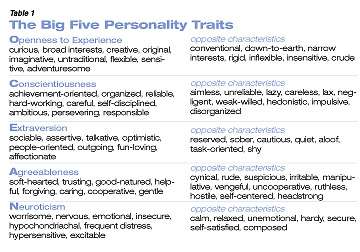
Table 1

Limits of change

Of course we simply cannot become any kind of person we’d like to become, even if all the relevant environmental variables are on our side. We do face physical limitations. And certain personality characteristics are indeed genetically determined and inherited, according to psychological research conducted in the past two decades.

For example, a systematic comparison of identical twins reared apart after only five months of age with twins raised together showed that those twin pairs raised in the same home were not more similar than those raised separately in respect to various personality traits.

This and similar research has led to the conclusion that genetics account for about 50 percent of individual differences in personality.

So recent psychological research has swung the pendulum back toward the nature side of the nature/nurture question. This doesn’t diminish environmental factors as being inconsequential. Behavior is determined by an interaction of the context in which we perform with personality characteristics. Sometimes situations are the primary determinant of behavior, sometimes personality shapes behavior.

Table 2

Primary factors

Now to take our discussion of personality further, let’s examine personality types. Every research-based textbook among more than 20 I consulted that covered personality traits identified the same five primary person factors.

Table 1 identifies these traits as bipolar dimensions, referred to in the research literature as the “Big Five.” Note that the order of the dimensions presented in Table 1 spell the word “ocean,” making it easy to remember these critical personality characteristics.

These dimensions remain relatively stable over an individual’s lifetime, and carry across (generalize) cultural lines, according to substantial research conducted in the 1990s. Plus, the “Big Five” personality traits have been found to be 40 percent to 60 percent inheritable.

Table 2 provides a few representative questions per each of the “Big Five” traits. Higher numbers reflect qualities of the particular trait, except for those items followed by an “R.” These need to be reverse scored, meaning the number circled should be subtracted from “6” to make the score consistent with other items.

Please don’t consider your totals on these select items to be a valid measure of the “Big Five.” Rather, read them to improve your understanding of each trait, and use individual scores to trigger conversations about these constructs and their relation to safety-related behaviors. How do the “Big Five” affect safety performance?

We don’t really know the answer to that – yet. Research to date has not studied specific connections between “Big Five” traits and injury proneness or injury preventiveness.

But still, certain relations between these personality traits and safety-related behaviors seem reasonable and worth our serious consideration:

  • For example, my April column made a case for a positive correlation between anxiety and proactive injury prevention, and the definition of anxiety I used is similar to the neuroticism dimension.

  • Plus, it is likely that individuals scoring high on conscientiousness are more apt to partake in injury-prevention processes.

  • I also predict that those scoring relatively high on openness to experience will be more likely to accept and participate in an innovative approach to preventing injuries.

  • And common sense suggests that injury-prevention procedures requiring interpersonal conversation (such as behavioral observation and feedback) will be more accepted by those who score high on extroversion and agreeableness.

  • It’s also likely those with these personality traits will be more successful at implementing an interpersonal coaching process.

    These hypotheses reflect only a few of the possible ways the “Big Five” could influence workplace safety. Clearly, we need systematic research in this area, especially given the pervasive behavioral influence of these five genetically determined dimensions of human personality. As I mentioned at the outset, we have much to learn about personality that could benefit our safety initiatives in the workplace.

  • Share This Story

    Looking for a reprint of this article?
    From high-res PDFs to custom plaques, order your copy today!

    Recommended Content

    JOIN TODAY
    to unlock your recommendations.

    Already have an account? Sign In

    • forklift safety

      Exploring the latest technologies in forklift safety

      With more staff and more stock in warehousing now more...
      Facility Safety
      By: Josh Cramer
    • welding

      All about welder’s flash or arc eye

      A flash burn is a painful inflammation of the cornea,...
      Environmental Health and Safety
    • dangerous jobs

      The 10 most dangerous jobs in the U.S.

      On-the-job deaths have been rising — hitting the highest...
      Construction Industry Safety and Health
      By: Benita Mehta
    Manage My Account
    • eMagazine Subscriptions
    • ISHN Newsletter & Other Newsletter Alerts
    • Online Registration
    • Manage My Preferences
    • Subscription Customer Service

    More Videos

    Sponsored Content

    Sponsored Content is a special paid section where industry companies provide high quality, objective, non-commercial content around topics of interest to the ISHN audience. All Sponsored Content is supplied by the advertising company and any opinions expressed in this article are those of the author and not necessarily reflect the views of ISHN or its parent company, BNP Media. Interested in participating in our Sponsored Content section? Contact your local rep!

    close
    • man wearing the the Sundström SR200 Full Face Mask Respirator
      Sponsored byOHD

      5 Fit Testing Mistakes That Could Cost You

    • This image shows Magid AcuSpex polarized blue mirrored safety glasses.
      Sponsored byMagid Glove and Safety

      Construction PPE Guide: What Crews Need for Each Task

    • lone worker in confined space
      Sponsored byAlphasense Ltd.

      GET THE LEAD OUT of your Safety Oxygen Sensors!

    Popular Stories

    SpaceX 7 launch

    OSHA Investigating Fatal Fall at SpaceX Starbase

    Automated loading dock equipment

    After March 2026 Rivian Death, Safety Managers Reassess Loading Dock Systems Under OSHA's Warehouse Emphasis Program

    psychology in the workplace

    Most Workplaces Measure Psychological Safety, Ignoring Psychosocial Risks

    top 10 most dangerous jobs

    Poll

    Seasonal Readiness

    With the federal heat stress prevention rule on the horizon, which area of your safety program needs the most attention?
    View Results Poll Archive

    Products

    Surviving an OSHA Audit A Management Guide, 2nd Edition

    Surviving an OSHA Audit A Management Guide, 2nd Edition

    See More Products

    ISHN Podcasts

    Related Articles

    • PSYCHOLOGY OF SAFETY: The psychology of recovery

      See More
    • PSYCHOLOGY OF SAFETY: The power of safety communication

      See More
    • PSYCHOLOGY OF SAFETY: The power of a "guilt trip"

      See More

    Related Products

    See More Products
    • fearless world.jpg

      The Fearless World of Professional Safety in the 21st Century

    See More Products

    Related Directories

    • American Society of Safety Professionals (ASSP)

      The American Society of Safety Professionals (ASSP) is a global association of occupational safety and health professionals who are dedicated to workplace safety. We provide education, safety standards, advocacy and a professional community that supports our diverse members and the profession.
    • MSA - The Safety Co.

      WE KNOW WHAT'S AT STAKE. Unpredictable work environments are often part of the job. That's why it's critically important to have the right safety equipment at the moment it matters most. MSA's complete lines of safety solutions help protect those workers at the heart of your operation.
    • The Safety Knife Co. LLC

      The Safety Knife Company has developed a quality range of safety knives for all industries. These knives have no exposed blades and only cut cardboard deep, protecting employees against lacerations as well as product.
    ×

    Become a Leader in Safety Culture

    Build your knowledge with ISHN, covering key safety, health and industrial hygiene news, products, and trends.

    JOIN TODAY
    • RESOURCES
      • Advertise
      • Contact Us
      • Directories
      • Manufacturing Division
      • Store
      • Want More
    • SIGN UP TODAY
      • Create Account
      • eMagazine
      • Newsletters
      • Customer Service
      • Manage Preferences
    • SERVICES
      • Marketing Services
      • Reprints
      • Market Research
      • List Rental
      • Survey/Respondent Access
    • STAY CONNECTED
      • LinkedIn
      • Facebook
      • YouTube
      • X (Twitter)
    • PRIVACY
      • PRIVACY POLICY
      • TERMS & CONDITIONS
      • DO NOT SELL MY PERSONAL INFORMATION
      • PRIVACY REQUEST
      • ACCESSIBILITY

    Copyright ©2026. All Rights Reserved BNP Media, Inc. and BNP Media II, LLC.

    Design, CMS, Hosting & Web Development :: ePublishing