ISHN logo
search
cart
facebook twitter linkedin youtube
  • Sign In
  • Create Account
  • Sign Out
  • My Account
ISHN logo
  • NEWS
    • Today's News
    • Global Safety News
    • Government Regulations
  • PRODUCTS
    • Product Innovations
    • Featured Products
  • TOPICS
    • Environmental Health and Safety
    • Facility Safety
    • Workplace Health
    • Occupational Safety
    • PPE
    • More Topics
  • CONSTRUCTION
  • TECHNOLOGY
  • COLUMNS
    • Best Practices
    • Dave Johnson: What’s going on
    • Editorial Comments
    • Leading Safety
  • MULTIMEDIA
    • ISHN Podcast
    • Videos
    • Cold Stress Education Quiz
    • Webinars
    • White Papers
  • MORE
    • Buyer's Guide
    • Newsletters
    • Convention Companion
    • Polls
    • Events
    • ISHN Store
    • Sponsor Insights
  • EMAGAZINE
    • eMagazine
    • Archived Issues
    • Contact
    • Advertise
  • JOIN TODAY!

Where's your AED?

By Sara Wesche
March 1, 2008


Each year it is estimated that as many as 450,000 Americans suffer from sudden cardiac arrest and that 90-95 percent of people suffering SCA will die. In many of these cases, electrical shocks delivered to the heart within four minutes of the onset of abnormal heart function produce as high as a 70 percent chance of survival.

Unfortunately, after ten minutes without treatment, the survival rate for someone suffering from sudden cardiac arrest drops to only 2 percent. Sudden cardiac arrest can occur during a heart attack, electrocution or asphyxiation, caused by inadequate oxygen in the work environment, such as in a confined space.

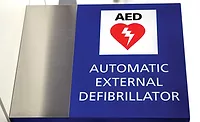
An automated external defibrillator (AED) is a small device that can help save the life of somebody in sudden cardiac arrest. It is often no bigger or heavier than the average laptop computer, and delivers a small but powerful shock that may be able to reset the heart rhythm of somebody in cardiac arrest. Once the adhesive pads are placed on the victim, the AED can monitor the person’s heart rhythm, determine if they are in need of a shock, and instruct the user to administer a shock or CPR accordingly. A conveniently located AED and trained responders in your workplace could mean the difference between life and death for an employee.

AED training
Early defibrillation means having immediate access to a properly working AED. This allows trained lay rescuers to give a potentially lifesaving electrical shock to the victim’s heart during a cardiac arrest.

Organizations need to consider who is responsible for AED program oversight. This responsibility usually rests with staff members who already have safety as part of their job description. However, specific training for these individuals on first-aid, CPR and AED use is critical. Organizations must also determine if any non-safety staff members will have a responsibility to respond. If so, these individuals will also require proper training.

Even though all AEDs work in roughly the same manner, there may be small differences between different brands. Because of these small differences, you should train those responsible for operating AEDs in your organization to use the specific AED brand in your facility before they attempt a lifesaving measure using an AED. Persons responsible for administering AEDs should also receive CPR training, a critical part of the cardiac chain of survival discussed below, and first-aid or lifesaving measure training. As in the case of any emergency, train all employees on the specific reporting and emergency action procedures at your site.

AEDs are not a replacement for professional medical help. Only perform these lifesaving measures after you have contacted EMS. Provide the victim with AED treatment while waiting for EMS to arrive.

Recognized by the American Red Cross, the American Heart Association, hospitals and EMS personnel, the Cardiac Chain of Survival is a series of four steps for treating victims of sudden cardiac arrest:
  1. Early access to care — call 911 or other emergency number
  2. Early cardiopulmonary resuscitation (CPR)
  3. Early defibrillation (use of AED)
  4. Early advanced cardiac life support, as needed.
Early defibrillation is recognized as the most critical step in restoring cardiac rhythm and resuscitating a victim. By following the links in the cardiac chain of survival you can increase the victim’s chances of survival.

AED placement
OSHA recommends the following guidelines for placement of AEDs within your organization:
  • AEDs should be conveniently installed to ensure response within 3-5 minutes;
  • Areas where many people work closely together, such as assembly lines and office buildings;
  • Close to a confined space;
  • Areas where electric-powered devices are used;
  • Outdoor worksites where lightning may occur;
  • Health units where workers may seek treatment for heart attack symptoms;
  • Company fitness units and cafeterias;
  • Remote sites, such as off-shore drilling rigs, construction projects, marine vessels, power transmission lines and energy pipe lines.
With an AED in your workplace and properly trained employees, you can stop the loss of precious minutes waiting for EMS. Store the AED in an easily accessible place. Keep the AED maintained properly, following manufacturer’s guidelines, and install new batteries as needed. Ensure all persons responsible for administering the AED have proper training on using your specific AED and CPR training.

Persons responsible should review procedures for use every three to six months. Follow the steps of the chain of survival to ensure the victim receives proper treatment.

Share This Story

Looking for a reprint of this article?
From high-res PDFs to custom plaques, order your copy today!

Sara has been with Summit Training Source for over seven years, managing the marketing department since 2003. Sara’s focus has been developing Summit’s World Wide Web presence, to generate sales leads through multiple media, and to create marketing support materials that solidify Summit’s position as the complete EH&S training solution provider. Sara can be reached at SaraW@safetyontheweb.comor @ SafetyTraining1 on Twitter.

Recommended Content

JOIN TODAY
to unlock your recommendations.

Already have an account? Sign In

  • forklift safety

    Exploring the latest technologies in forklift safety

    With more staff and more stock in warehousing now more...
    Facility Safety
    By: Josh Cramer
  • welding

    All about welder’s flash or arc eye

    A flash burn is a painful inflammation of the cornea,...
    Environmental Health and Safety
  • dangerous jobs

    The 10 most dangerous jobs in the U.S.

    On-the-job deaths have been rising — hitting the highest...
    Transportation Safety
    By: Benita Mehta
Manage My Account
  • eMagazine Subscriptions
  • ISHN Newsletter & Other Newsletter Alerts
  • Online Registration
  • Manage My Preferences
  • Subscription Customer Service

More Videos

Sponsored Content

Sponsored Content is a special paid section where industry companies provide high quality, objective, non-commercial content around topics of interest to the ISHN audience. All Sponsored Content is supplied by the advertising company and any opinions expressed in this article are those of the author and not necessarily reflect the views of ISHN or its parent company, BNP Media. Interested in participating in our Sponsored Content section? Contact your local rep!

close
  • man wearing the the Sundström SR200 Full Face Mask Respirator
    Sponsored byOHD

    5 Fit Testing Mistakes That Could Cost You

  • This image shows Magid AcuSpex polarized blue mirrored safety glasses.
    Sponsored byMagid Glove and Safety

    Construction PPE Guide: What Crews Need for Each Task

  • lone worker in confined space
    Sponsored byAlphasense Ltd.

    GET THE LEAD OUT of your Safety Oxygen Sensors!

Popular Stories

SpaceX 7 launch

OSHA Investigating Fatal Fall at SpaceX Starbase

Worker Impairment

How to Tell When a Co-Worker is Impaired? A Safety Pro’s Challenge

psychology in the workplace

Most Workplaces Measure Psychological Safety, Ignoring Psychosocial Risks

top 10 most dangerous jobs

Poll

Seasonal Readiness

With the federal heat stress prevention rule on the horizon, which area of your safety program needs the most attention?
View Results Poll Archive

Products

Surviving an OSHA Audit A Management Guide, 2nd Edition

Surviving an OSHA Audit A Management Guide, 2nd Edition

See More Products

ISHN Podcasts

Related Articles

  • ISHN0317_F9_pic.jpg

    Location, location, location: Where should you place your AED?

    See More
  • Is outsourcing your AED program the answer?

    See More
  • Is outsourcing your AED program the answer?

    See More

Related Directories

  • A V Systems Inc.

    MIRS Online collects and manages data for your SARA, TRI, CAA, CWA, RCRA, SDS management and OSHA hazard communication reporting needs.
×

Become a Leader in Safety Culture

Build your knowledge with ISHN, covering key safety, health and industrial hygiene news, products, and trends.

JOIN TODAY
  • RESOURCES
    • Advertise
    • Contact Us
    • Directories
    • Manufacturing Division
    • Store
    • Want More
  • SIGN UP TODAY
    • Create Account
    • eMagazine
    • Newsletters
    • Customer Service
    • Manage Preferences
  • SERVICES
    • Marketing Services
    • Reprints
    • Market Research
    • List Rental
    • Survey/Respondent Access
  • STAY CONNECTED
    • LinkedIn
    • Facebook
    • YouTube
    • X (Twitter)
  • PRIVACY
    • PRIVACY POLICY
    • TERMS & CONDITIONS
    • DO NOT SELL MY PERSONAL INFORMATION
    • PRIVACY REQUEST
    • ACCESSIBILITY

Copyright ©2026. All Rights Reserved BNP Media, Inc. and BNP Media II, LLC.

Design, CMS, Hosting & Web Development :: ePublishing