Aging eyes
Today, our nation’s workforce is comprised of the highest percentage of workers aged 55 and older since the Bureau of Labor Statistics (BLS) began reporting labor force data in 1948. Furthermore, the BLS projects that more than 90 percent of all growth in the U.S. labor force from 2006 to 2016 will be workers aged 55 and older. Baby boomers are living longer and working longer, dramatically altering the face of U.S. worker demographics. As the workforce changes, the ways that we protect it must change as well.
In a recent study of 137 North American safety directors*, nearly all recognized a growing need for prescription eyewear among workers. According to The Vision Council, 70 percent of workers today require vision correction, and that number is on the rise. The leading reason behind this trend is the rapidly expanding population of Baby Boomers in the workplace.
Like everyone, boomers rely on their eyes as their primary means of experiencing the world — and making a living. Clear vision also plays a vital role in helping to keep individuals out of harm’s way among workplace hazards. Safety managers need to know how to protect workers as they experience reduced visual capacity.
What happens to vision as we age?
Born between 1946 and 1964, the baby boomer population is now reaching the age when it is common to experience reduced visual capacity. Yet, vision loss often occurs so gradually that even the individual doesn’t notice it happening. The most common vision issue for people is nearsightedness, or difficulty seeing things that are far away. But by their early 40s, most people experience farsightedness, or difficulty seeing things that are nearby. Over time, eye muscles get tired and eye lenses become less flexible. As a result, it is more difficult for the eyes to shift from focusing far to near like they used to.Once in their 50s, most individuals’ ability to see middle distance (typically the distance from which we view a computer) also deteriorates. This natural progression of vision loss requires multifocal lens corrective eyewear, which is worn by roughly 55 percent of people wearing corrective lenses.
Safety directors are not typically trained to be alert to workers’ vision needs and most companies do not have vision screening programs in place to detect and meet employees’ needs. However, when vision loss goes uncorrected, companies put themselves and their workers at risk. A worker can lose his or her vision due to injury; companies can experience decreased productivity and pay thousands, even millions, in direct and indirect costs related to an eye injury. So why aren’t more companies providing prescription safety eyewear programs?
When meeting requirements isn't enough
The use of over-the-glass (OTG) safety eyewear is the leading reason for not having a formal prescription safety eyewear program, with approximately 20 percent of the companies surveyed indicating the use of OTGs in lieu of a prescription safety eyewear program. Another 10 percent indicated that they rely upon that individual’s own prescription eyewear.OTGs that meet the requirements of the American National Standards Institute (ANSI) and that can provide the necessary impact protection may not be the optimal choice. When selecting any safety eyewear, including OTGs, worker acceptance is critical. Comfort, fit and styling all play an important role in the selection process. If their eyewear is uncomfortable, workers are more likely to remove it on the job, putting themselves at risk. Because OTGs are worn over existing prescription frames, comfort and fit are even more important. Pay attention to the weight and size of the OTGs. If they are too large or heavy, they may become uncomfortable if worn throughout the day. In addition, look for OTGs that offer adjustability features, such as wire core temples, that allow for a more customized fit. Furthermore, because OTGs require a worker to look through two lenses — their own corrective eyewear as well as the OTG lens –— they may experience optical distortion if the eyewear is not fitted properly. Safety managers should be aware of this and check in with their workers to make sure there are no problems.
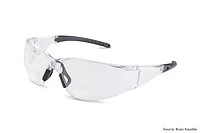
While OTGs are an excellent option for visitors or short-term use, truly the best option for protecting workers who require corrective lenses throughout the day is prescription safety eyewear. Each set of prescription safety eyewear is manufactured individually to meet the worker’s specific needs with a single, comfortable solution. Prescription safety eyewear can feature optional side shield capabilities to provide frontal and appropriate side coverage. It can deliver fantastic results: an individual’s vision is corrected, they feel more comfortable in their eyewear, and as a result they are more likely to leave it on throughout the workday, improving worker safety.
Revised standard calls for greater testing
In 2010, revisions were made to the ANSI Z87.1 standard, which encompasses workplace eye and face protection. However, research* conducted in April shows that while the majority of safety directors are “very” or “somewhat” familiar with ANSI Z87.1, nearly all safety directors surveyed were unfamiliar with the important 2010 changes, most of which affect the prescription safety eyewear category.ANSI Z87.1-2010 now calls for testing by the manufacturers of prescription safety eyewear by specified types. Furthermore, it states that manufacturers of lenses, frames and complete prescription safety eyewear devices, as well as component manufacturers, must provide test results to the purchaser upon request. These are important steps forward in ensuring that all aspects of the safety standard are met in every pair of prescription safety eyewear.
Three steps to protecting aging eyes
It is important for companies to consider the vision requirements of the aging workforce to ensure safety.1) Employ a vision screening program for early detection and correction to help prevent existing problems from getting worse. Screening is fast, inexpensive and can often be done on-site for free.
2) Next, look for quality safety frames and lenses that meet the ANSI Z87.1- 2010 standard. If in doubt, request test data from the manufacturers to ensure that the entire device meets your company’s specific needs based on hazard type.
3) Finally, conduct regular checks to be sure workers are always wearing their safety eyewear on the job.
To ensure a long and healthy work life for our nation’s baby boomers, it is important that employers address the specific vision-related needs of this rapidly growing segment. Now is the time to help workers detect a vision problem and get the safety eyewear they need to carry out their work safely, effectively and comfortably. After all, eye safety is not just about eye protection — it’s about wearing the right kind of protection.
* Honeywell Rx Safety Eyewear Market Study, April 2011.
Looking for a reprint of this article?
From high-res PDFs to custom plaques, order your copy today!