Wind industry accused of blowing off worker safety rule
 Posted with permission from FairWarning.org:
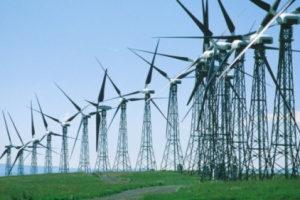
Wind power is riding a strong breeze. In the last five years, generating capacity in the U.S. has nearly quadrupled. Clusters of tubular wind towers, rising up to 300 feet above ridgelines and gusty plains, are an increasingly familiar sight.
But in the scramble to expand clean energy and green jobs, the wind industry has fallen short on worker safety.
Thousands of the giant wind machines violate a federal requirement to give technicians who work inside the towers enough maneuvering space to get up and down their ladders safely. The standard says the space near the ladder should be free of permanent obstructions that could cause serious head or back injuries if a climber slips or is moving fast.
There are about 36,000 of the wind towers in the U.S., and more are being added all the time. Most are produced overseas to meet international codes. For reasons they won’t explain, the manufacturers either ignored the U.S. standard, or thought it wouldn’t apply to them.
The companies “evidently didn’t look into U.S. codes and standards, especially safety standards, in doing their designs,” said Patrick Bell, a senior safety engineer with the California Division of Occupational Safety and Health, or Cal-OSHA, and a member of a federal OSHA wind energy task force.
OSHA officials say they’re not aware of any serious injuries so far. Still, the violations are so widespread that they have flummoxed safety regulators, who are trying to figure out the extent of the hazard and what to do about it.
“We could conceivably issue citations,” said Bell of Cal-OSHA, “but we might end up taking all of our compliance officers off other industries to run from one wind farm to the next.”
“We are trying to work with the industry,” he said, “because it’s a huge industry with all the wind towers going up.”
The manufacturers have been reluctant to talk about the problem. Officials with Vestas Americas, part of Vestas Wind Systems A/S of Denmark, the world’s biggest turbine supplier, declined to be interviewed and would not respond to written questions. GE Energy, the top U.S. wind turbine maker, took the same stance. Both companies referred inquiries to the American Wind Energy Assn., a trade group.
Michele M. Mihelic, the association’s manager of labor, health and safety policy, said in an email to FairWarning that the group “cannot make a blanket statement that all wind turbines comply or not.”
“Each wind turbine make and model is different,” she said.
The OSHA standard dates to the 1970s, and applies to the use of fixed ladders at work sites generally, not to wind towers specifically. It requires a clearance of 30 inches from the ladder so workers can safely move up and down. If there are permanent obstructions within the climbing space, they must be shielded so workers can squeeze past without getting hurt.
The main issue with tower designs is the use of heavy steel bolts and rims known as flanges to join their long, tubular sections. In the two or three spots where the sections are fastened, the bolts and flanges intrude at least several inches into the safety space.
Two field technicians have sought to draw attention to the issue, saying they were stunned by the prevalence of the problem.
“Between my friends and I … we’ve been in thousands of wind turbines and haven’t found one that’s compliant with this issue,” said Ed Oliver, 47, of Dana Point, Calif.
“We can’t believe this exists everywhere we go,” said Nick Nichols, 45, of Zephyr Cove, Nev. “The regulations are there for a reason.”
The men said they have seen nothing worse than bruised tailbones and minor scrapes from encounters with the flanges. But they said it’s only a matter of time before there are serious injuries. They pointed to the growing use of “climb assists” that use motors and pulleys to support part of the weight of technicians, allowing them to climb faster and basically rappel downward in the descent.
Oliver and Nichols have complained to OSHA. They also took the unusual step of offering the industry their own version of a safety device, called a deflector. The website for their company, Pinnacle Wind USA, shows what looks like a short section of a playground slide covering a flange. “Developed BY tower climbers, FOR tower climbers,” it says.
Their efforts haven’t brought any love from the wind industry. In August, they were stunned by an email to Nichols from Mihelic of the wind association.
“You should…be aware that there are people posing as OSHA compliance officers and/or OSHA consultants and are threatening people in the industry with citations if they don’t buy your product,” the email said.
Mihelic added that OSHA had been told about the scheme and “has requested that if any of our members are approached in this manner to please report it to them so they can investigate.”
The two men immediately suspected it was a bogus claim designed to discredit them. Soon after, Nichols enlisted the help of U.S. Sen. Dean Heller, R-Nev., to see what OSHA knew about it.
David Michaels, assistant secretary of labor for Occupational Safety and Health, responded Oct. 11 with a letter to Heller that seemed to contradict Mihelic. OSHA officials were unaware of “any reported cases of OSHA impersonators threatening companies to purchase Pinnacle Wind USA products,” the letter said.
Mihelic told FairWarning she stood by her email to Nichols.
Meanwhile, the ladder issue remains up in the air.
OSHA has not yet issued citations for violations of the standard. Brian Sturtecky, OSHA’s area director in Jacksonville, Fla., and chairman of its wind energy task force, said the agency is preparing a “Letter of Interpretation” to clarify how the standard will be applied.
The result could be a mandate for the industry to retrofit thousands of towers. Or, the industry could get a pass if the agency decides the hazard can be controlled by other measures, such as training.
The task force is examining other safety issues in the industry in the wake of some serious accidents.
In August, 2007, a worker was killed and another injured in the collapse of a tower at a wind farm near Wasco, Ore. Also, OSHA fined Outland Energy Services $378,000 for safety violations after an employee suffered serious electrical burns at an Illinois wind farm in October, 2010.
About FairWarning
FairWarning (www.fairwarning.org) is a nonprofit, online news organization focused on issues of safety, health and government and business accountability.
Looking for a reprint of this article?
From high-res PDFs to custom plaques, order your copy today!
 Myron Levin founded FairWarning after more than 20 years as a staff writer for the Los Angeles Times, where he was a member of the California investigations desk. He has won numerous honors and awards for his detailed investigations of health and safety matters, including an Alicia Patterson Foundation fellowship and the National Press Club’s Consumer Journalism Award. He has reported on the tobacco industry, auto and tire safety, and a variety of product liability issues. He likes hiking and playing racquetball, and he owns a minuscule share of a professional minor league baseball team. Myron is a member of FairWarning’s board of directors.