Tips for selecting welding respiratory protection
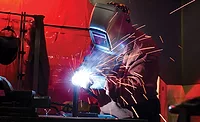
Welding involves joining metal together by applying heat and often a filler metal. The welding process is essential in many manufacturing, construction and maintenance sectors and therefore is an area of concern for OSHA. The filler metal, base material, coatings and/or gases utilized in welding can emit various forms of particulate into the environment, often referred to as welding fume. Welding fume has the potential to be hazardous, depending on the fume’s composition and concentration.
Respiratory solutions ideal for Welding Applications |
| Half-Mask Respirators |
| Powered Air Purifying Respirators (PAPR) |
| Supplied Air Respirators (SAR) |
Handling the hazards
There are numerous elements found in welding fume, with hexavalent chromium and zinc causing the most concern for welders because of its commonality in welding environments. Hexavalent chromium is present when welding on stainless steel or using stainless steel filler metals. OSHA has mandated that prolonged exposure to fumes containing hexavalent chromium be kept below an 8-hour time-weighted average (TWA) Permissible Exposure Limit (PEL) of 5 µg/m3 (micrograms per cubic meter of air) with an Action Level of 2.5 µg/m3. Zinc, the other common element in welding environments, is a byproduct of welding steel with a galvanized coating and has an 8-hour TWA PEL of 5 mg/m3 (milligrams per cubic meter of air).
OSHA requires companies to maintain exposure levels below identified PELs by implementing engineering and work practice controls. Engineering controls require changes such as material substitution, isolation, industrial ventilation or source capture (fume extractors or fume extraction welding guns). According to OSHA, engineering controls are preferred because of their ability to remove contaminated air at the source prior to spreading throughout the facility and reaching a worker’s breathing zone. Work practice controls require adjustments in the way a task is performed like changing an operator’s position. If these controls are not feasible or do not reduce exposures below established PELs, then personal protective equipment (PPE) solutions, such as respirators, are needed.
If respiratory protection is the control measure for welding fumes, OSHA 29 CFR 1910.134 should be followed to establish and maintain effective respiratory programs. OSHA requires companies to evaluate their facilities to ensure the respiratory program is being followed and also to review the program if workplace conditions change or on an annual basis. Selecting the proper respiratory protection involves understanding the hazard, relevant work restrictions or requirements, and personal factors such as comfort and productivity. Any respirator chosen should be NIOSH-certified.
A note: every welding environment is unique and should be evaluated by a certified safety professional or industrial hygienist to determine the appropriate course of action. This article is presented for awareness and educational purposes and does not replace professional consultation.
Respiratory options in welding applications
There are three primary types of respiratory solutions ideal for welding applications:
- Half-Mask Respirators: Classified as tight-fitting respirators, these units extend from the user’s nose to the chin, requiring a tight face seal to be effective. Employers should check to ensure the selected half-mask can fit underneath a welding helmet without obstructing the welder’s field of vision. Most half mask respirators available for welding applications feature an assigned protection factor (APF) of 10. Selecting the correct filter for your half mask is also extremely important. Particulate filters are classified based on oil resistance: N – not resistant to oil, R – resistant to oil and P – oil proof. Filters are then separated based on filter efficiency: 95, 99 or 100 percent. The greater stated efficiency, the more particulate the filter will trap. P100 filters are widely used by welders because they filter out 99.97 percent of airborne particles and oil aerosols common in welding environments.
- Powered Air Purifying Respirators (PAPR): According to OSHA, a PAPR is an air-purifying respirator that uses a blower to force ambient air through an air-purifying element and a hose to the user’s hood or helmet. PAPRs offer an elevated level of protection in comparison to half-mask respirators. In welding applications, a PAPR paired with a welding helmet and head seal offers an APF of 25. PAPR designs have become less intrusive in recent years with low-profile blower units, lighter battery packs and shoulder straps that evenly distribute the weight of the system for users. Systems that further integrate flip-up welding lenses to expose grinding shields allow operators to perform both welding and grinding tasks without removing their helmet and head seal — minimizing opportunities for exposure to environments exceeding PELs. PAPRs often feature high efficiency particulate air (HEPA) filters that can remove 99.97 percent of airborne particulates 0.3 micrometers in diameter. In addition to protecting the welder from their environment, the continuous flow of air keeps the welder cool, potentially reducing heat stress-related injuries.
- Supplied Air Respirators (SAR): These systems are classified by OSHA as atmosphere-supplying respirators that provide clean air from an uncontaminated source. In welding environments, the welder would connect his/her helmet with head seal to a belt-mounted unit that is then connected to an air-purification panel using an air hose. SARs offer APFs starting at 25 and can vary depending on the unit configuration. These units allow welders to regulate the airflow while also heating or cooling the air entering their helmet.
What is the right solution?
Selecting the correct respiratory solution for your environment is critical. According to OSHA, one of the most frequent errors in respirator selection is choosing the wrong type of respiratory protection, potentially leading to employees being exposed to large concentrations of harmful contaminants. Once the proper type of respirator is determined using OSHA guidelines, companies are encouraged to bring in samples of various sizes, brands and styles for employees to try on.
Respirators only provide the protection specified if they fit correctly, and in some cases, multiple sizes or styles may be necessary to properly protect all affected employees. Respirator manufacturers have gone to great lengths in recent years to reduce the size, weight and physical presence of these solutions, making them easier to use and less of a burden on the welder. Aside from the obvious protection benefits, increased comfort and productivity that respirators offer, in many circumstances, have improved the total work experience of both employers and employees. Finding respiratory solutions that provide optimal fit, comfort and performance can result in safer, more productive environments as well as increased job satisfaction and employee morale.
Looking for a reprint of this article?
From high-res PDFs to custom plaques, order your copy today!