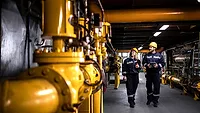
Protect oil & gas workers from noise, confined spaces, respiratory & fall risks
Hazardous noise
Long-term exposure to hazardous noise can result in permanent hearing loss. Oil and gas workers are often exposed to harmful noise levels on the job. According to WorkSafeBC1, noise sources can include:
- Mud pumps and tanks
- Shale shaker/centrifuge
- Offloading, main oil, and cement pumps
- Gas compression and water injection
- Fracturing
- Derrick, dog house, and pipe decks
- Diesel/gas turbine power generators
- Air system and air tugger
The first line of defense against excessive noise exposure is to reduce or eliminate the risks with engineering and administrative controls, such as: using low-noise tools and machinery as well as barriers such as sound walls or curtains; operating noisy equipment when fewer people are exposed; limiting time spent at a noise source; providing quiet areas; and restricting worker proximity to noise sources.
Hearing protection devices (HPDs), such as earmuffs and plugs, are generally used when controls are not feasible or when worker’s hearing tests indicate significant hearing damage.
OSHA requires employers in general industry to implement an effective hearing conservation program whenever worker noise exposure is equal to or greater than 85 dBA for an 8 hour exposure. Key elements include:
- Workplace noise sampling to identify at-risk workers.
- Providing affected workers or their authorized representatives with an opportunity to observe any noise measurements conducted.
- Maintaining a worker audiometric testing program (hearing tests).
- Implementing comprehensive hearing protection follow-up procedures for workers who show a loss of hearing (standard threshold shift) after completing baseline (first) and yearly audiometric testing.
- Proper selection of hearing protection.
- Evaluate the hearing protector’s attenuation and effectiveness for the specific workplace noise.
- Training and information that ensures workers are aware of the hazard from excessive noise exposures and how to properly use protective equipment.
- Data management of and worker access to records regarding monitoring and noise sampling.
Confined spaces
Confined spaces are common in the oil and gas industry. Workers are often required to enter confined spaces such as petroleum and other storage tanks, mud pits, reserve pits and other excavated areas, sand storage containers, and other confined spaces around a wellhead. Safety hazards associated with confined spaces include ignition of flammable vapors or gases. Health hazards include asphyxiation and exposure to hazardous chemicals. Confined spaces that contain or have the potential to contain a serious atmospheric hazard must be classified as permit-required confined spaces, tested prior to entry, and continuously monitored, OSHA says.
Workers must not be allowed to enter such spaces unless proper training, equipment and procedures are in place. A confined space must be evaluated to determine if it is a permit-required space. Employers must have a written confined space entry program and comply with all requirements outlined in OSHA 1910.146 Permit-required confined spaces.
Respiratory risks
There are many respiratory threats in the oil and gas industry, including exposure to hydrogen sulfide, drilling fluids and mercury vapor. This section focuses specifically on silica.
Workers might be exposed to respirable crystalline silica during processes that use sand, such as hydraulic fracturing. These types of exposures can lead to the development of disabling and sometimes fatal lung diseases, including silicosis and lung cancer, OSHA says.
Employers must determine which jobs expose workers to silica and take actions to control overexposures and protect workers. A combination of engineering controls, work practice, protective equipment, and product substitution where feasible, along with worker training, is needed to protect workers who are exposed to silica during hydraulic fracturing operations, according to the OSHA-NIOSH Hazard Alert “Worker Exposure to Silica during Hydraulic Fracturing.”
When engineering and work practice controls are not feasible, while they are being implemented, or when they do not reduce silica levels below OSHA PELs, employers must provide workers with respirators. Whenever respirators are used, the employer must have a respiratory protection program that meets the requirements of OSHA’s Respiratory Protection standard (29 CFR 1910.134). This program must include proper respirator selection, fit testing, medical evaluations, and training.
According to the OSHA-NIOSH Hazard Alert, if respirators are provided, use at least a NIOSH-approved N95 respirator. If the silica level is more than 10 times the PEL, a half-face respirator is not protective and a respirator that offers a greater level of protection (e.g., a full-facepiece respirator, which will protect workers at silica levels up to 50 times the PEL) must be used. Full-face powered air-purifying respirators (PAPR) provide more protection than half-face air-purifying respirators. In general, workers find PAPRs to be more comfortable.
Fall hazards
Workers in the oil and gas industry might be required to access platforms and equipment located high above the ground. OSHA requires fall protection to prevent falls from the mast, drilling platform, and other elevated equipment. Other fall hazards include:
- Uneven working surfaces
- Unprotected sides and edges
- Ladders
- Open pits
- Climbing and working from the derrick
- Working off the bed of trucks
- Floor holes
- Stairs
- Getting on and off mobile equipment
- Equipment, materials, lines, etc. on rig floor or ground
- To prevent employees from being injured from falls, OSHA says employers must:
- Guard every floor hole into which a worker can accidentally walk by use of a railing and toeboard or a floor hole cover.
- Provide a guardrail and toeboard around every open-sided platform, floor or runway that is 4 feet or higher off the ground or next level.
- Regardless of height, if a worker can fall into or onto dangerous machines or equipment, employers must provide guardrails and toeboards to prevent workers from falling and getting injured.
- Other means of fall protection that may be required on certain jobs include safety harness and line, safety nets, stair railings and handrails.
OSHA requires employers to:
- Provide working conditions that are free of known dangers.
- Keep floors in work areas clean and sanitary.
- Select and provide required personal protective equipment at no cost to workers.
- Train workers about job hazards in a language that they can understand.
Footnote
WorkSafeBC, Occupational disease hazards in the oil and gas industry, www2.worksafebc.com/i/posters/2013/WS_13_02.html
Looking for a reprint of this article?
From high-res PDFs to custom plaques, order your copy today!