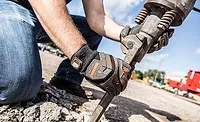
Bad Vibrations: What to do about hand and arm vibration syndrome
It's a serious concern, says Wasserman, because once exposed to steady vibration on the job, symptoms can appear within as little as a year's time. Once the chronic, progressive disorder passes its early stages, the effects are irreversible.
The former chief of occupational vibration at NIOSH, Wasserman' along with other researchers, studied workers exposed to hand-arm vibration from pneumatic chipping hammers and grinders at two foundries and a shipyard in the early 1980s and found that almost half (47 percent) of the foundry workers exposed had advanced vibration syndrome, along with 19 percent of the shipyard workers. The researchers concluded that a direct relationship existed between years of exposure and severity of HAVS. NIOSH published a Current Intelligence Bulletin on vibration syndrome in 1983.
Still, HAVS has not received the publicity given to other ergonomic-related ills, such as back injuries and carpal tunnel syndrome. Many workers see the telltale signs of whitened fingers and numbness and attribute it to aging. Plus, symptoms don't usually occur when a worker visits a physician.
Expert advice
Wasserman has spent recent years criss-crossing the country trying to make managers, supervisors, and employees more aware of the deleterious effects of repeated exposure to vibration on the job. First, be aware of the symptoms, he says. Early signs include tingling or numbness of fingers that persistently flares up, and occurs without immediate exposure to vibration.As the condition worsens, fingertips start to whiten (called Raynaud's Syndrome), a sign of constricted blood flow. Cold weather often triggers this flare up, which can last for five to ten minutes. The average time for the onset of blanching among the foundry workers studied was two years. As it progresses further, blanching spreads beyond the tips of fingers, and occurs during summer and winter. The exact point at which HAVS becomes irreversible varies from person to person, according to NIOSH research.
When symptoms surface, it's best to see an occupational physician immediately, says Wasserman. A medical textbook, "Hand-Arm Vibration, A Comprehensive Guide for Occupational Health Professionals," which Wasserman co-authored, has increased awareness among physicians. (The book can be purchased by calling Wasserman at 513-891-9084.)
Wasserman offers these suggestions for preventing hand and arm vibration syndrome:
- Ideally, vibration exposure should be eliminated through job redesigns.
- If that's not possible, use newer and better-designed power tools that produce as little vibration as possible. Look for tools with non-slip handles, low torque, and ergonomic design.
- Use anti-vibration chain saws for outdoor workers.
- Wear sturdy, well-fitting, anti-vibration gloves that fully cover all fingers. Visco-elastic and Gelfom are damping materials used in these gloves.
- Keep hands warm and dry (cold aggravates HAVS).
- Don't smoke (smoking is a vasoconstrictor and reduces blood flow).
- Let the tool do the work by holding it as lightly as possible.
Voluntary standards
OSHA's forays into workplace ergonomic problems in the past decade have not focused on hand-arm vibration-related issues. But, OSHA issues ergonomic hazard letters to employers, warning them of HAVS hazards in workplaces. If employers don't correct those hazards, the agency can fine companies under the General Duty Clause.Raynaud's Syndrome is one of the easier ergonomic-related health effects to investigate, says Graciela M. Perez ScD, CPE, OSHA's National Ergonomics Enforcement Coordinator. "You don't have to second guess the health outcome because the relationship between exposure to vibration and Reynauds is well-documented in the literature," she says.
There are no OSHA standards addressing vibration hazards, but the recently released draft version of American National Standard Control of Cumulative Trauma Disorders offers these suggestions to avoid excessive amounts of vibration on hands:
- minimize grip by using state-of-the-art hand tools,
- choose lightweight hand tools and those with least amounts of vibration,
- use tool handle diameters to accommodate gripping when forceful exertions of the tool are needed,
- allow fingers to fit on the tool's entire handle,
- use grip span of two-handled tools, such as wire cutters,
- don't use tools with handles that will dig into the hand (soft coatings on handles reduce stress),
- direct exhaust away from the hands (cold aggravates HAVS),
- activate triggers with both middle and index fingers, and position tool triggers so the distal portion of the finger is not performing the task, and
- incorporate rest periods into shifts and alternate short periods of stressful and less stressful tasks.
For a complete copy of the draft standard, contact National Safety Council officials at (630) 285-1613. Comments on the draft are being accepted until July 27.
Other voluntary HAVS and ergonomic guidelines available to safety and health professionals are:
- American Conference of Governmental Industrial Hygienists (ACGIH), 1994-95 Hand-Arm Vibration Threshold Limit Values (TLVs) for Chemical Substances and Physical Agents and Biological Exposure Indices. For a copy, visit the ACGIH website at www.acgih.org/.
- ANSI S3.34 Guide for the Measurement, Evaluation of Human Exposure to Vibration Transmitted to the Hand. For a copy, visit the ANSI website at web.ansi.org/default_js.htm.
- International Standard Organization (ISO) 5349 standards regarding exposure to hand and arm vibration. For a copy, visit the ISO website at www.hike.te.chiba-u.ac.jp/ikeda/ISO/home.html
- NIOSH Central Intelligence Bulletin 38 on Vibration Syndrome (March 1983). For a copy, visit the NIOSH website at www.niosh/cibs2.html.
Looking for a reprint of this article?
From high-res PDFs to custom plaques, order your copy today!