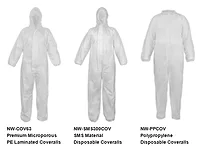
Disposable clothing
Walter Casey, MRO buyer for a maker of residential air conditioners, agrees. "We have a lot of messy jobs here. Disposable clothing has always made sense to us," he says. "Our workers who install insulation in the air conditioners wear disposable coveralls to protect their clothing from glue. The insulation is installed with spray-on glue. You can imagine what a mess it would be to try to clean glue off of washable clothing. We want to protect our workers from getting that glue on their own clothing."
Casey has found that Tyvek coveralls are well able to withstand the glue. Made of a spunbonded polyethylene called olefin, Tyvek from DuPont is a material that's light enough to comfortably wear over clothing but is also tear-resistant and extremely durable. "It's really as light as paper but works more like a strong cloth," says Casey.
Winter and Casey will attest that there are certain jobs where disposable clothing is the most effective solution for protecting workers. Whether the job is wet or dry, dirty or clean, light or heavy, disposable clothing can provide the specific type of protection needed for the job.
It's a dirty job
John Hines, purchasing manager for a manufacturer of ophthalmic lenses, says that disposable protective clothing is a must for his workers. "We're working with monomer, the base material that lenses are made from. It's a clear plastic resin. It's pretty gooey - and definitely not washable. Actually, if you try to wash monomer off of clothes, it cakes up and clogs the washing machine. Disposable clothing is the best way our workers can protect their clothing from monomer. We use it in all the areas - manufacturing, assembly, molding, maintenance and packaging."Painting is another job that is aided by disposable clothing. "Painting is a messy job, no matter how careful you are," says Casey. "Our workers wear coveralls and caps to keep the paint off of themselves and their clothing."
At a manufacturer of livestock trailers, car haulers and racecar transporters, painting is always a big job and sometimes a sloppy job as well. "Our painters wear disposable coveralls," says Jim Krandle, supervisor. "With the large painting jobs that we have here, it just makes sense to use disposables. The cleanup for washable coveralls would be too much labor."
Versatile protection
Disposable clothing can provide the extra protection needed for highly special jobs. For example, at the trailer/hauler/transporter manufacturer, the workers who varnish and finish the trailer floors wear shoe covers to protect their shoes as well as the floors. And workers who are building and cutting trailer materials wear lab coats to keep the fiberglass off."It's not the standard use of lab coats," says Krandle, "but we've found the coats to be a very effective and simple way to protect workers from particles." And at the ophthalmic lens manufacturer, where workers manufacture 60,000 to 70,000 eyeglass lenses a day, workers use disposable face masks for protection from the various chemicals used in the process.
At a manufacturer of structural components for automobiles, most of the work involves stamping or assembly. Workers there use disposable sleeves to help keep shavings off of their arms when doing hand grinding. "The sleeves protect their clothing from the shavings," explains Frank Pollak, stores and environmental coordinator," but they also provide some cut protection. They're tough products that you use only once."
When temperatures get hot, disposable clothing is often a lightweight, comfortable solution. "It can be as hot as 120 F on any given day here," says Winter of the turbine engine manufacturer. "Our workers are much more comfortable with the lighter weight disposable coveralls. They breathe."
In the press department at the air conditioner company, where temperatures can get extremely hot, workers often wear disposable sleeves for extra protection. "It's cooler than wearing a whole suit," Casey explains.
Easier to control
Some manufacturers are hesitant to use disposable clothing because they are concerned about the costs of clothing that gets thrown away after a few uses. But five years ago, Winter of the turbine engine manufacturer looked at the value of disposable clothing versus maintaining an inventory of washable protective clothing."There was no question about it," she says. "Disposable wins hands down. We have more than 900 employees in this facility. They rotate jobs fairly often. It would be one major job to maintain and clean an inventory of washable clothing that would fit all shapes and sizes for all the different jobs. It's a lot easier to control with disposable clothing."
Looking for a reprint of this article?
From high-res PDFs to custom plaques, order your copy today!