EDITORIAL COMMENTS: Seeing dignity beyond despair
Not long ago I was on the phone with Garrett Brown. Garrett is my “go-to” guy for corporate social responsibility and all things relating to workplace safety and heath in developing nations. He’s written several provocative articles for ISHN on worker abuses overseas, and he is the coordinator of the Maquiladora Health & Safety Support Network, an all-volunteer organization of 400 occupational health and safety professionals founded in October 1993.
Since 2000, the Network has expanded its work into Indonesia, China and Central America. Network volunteers donate their time and expertise pro bono. Their projects involve one basic goal: to build the capability of workers and their organizations to understand health and safety issues and to be able to speak and act on their own behalf to protect their health and exercise their rights.
Garrett’s group does this through a variety of activities: educating and training workers, plant safety committees and communities; helping workers file complaints under international trade agreements; and providing technical information for grassroots organizations monitoring transnational corporations.
The Support Network is very clear that it is not set up to generate business for private consultants.
About these Google Alerts
“I get Google Alerts every day with the keyword ‘corporate social responsibility’,” I told Garrett. “Most of it seems ‘it’s-all-good’ candy from corporate to me, companies planting trees, building clinics, doling out vaccines. Fine enough, but not much relation to actual workplace safety and health conditions. Garrett, should I be paying any attention to this stuff?”“No.”
That’s one thing a reporter likes about Garrett. He’s to the point. He’s not antagonistic. He speaks what he knows. He’s conducted hundreds and hundreds of inspections for the California Division of Occupational Safety and Health (Ca/OSHA). He’s always very clear that he never speaks in any official capacity as a Cal/OSHA inspector. He speaks from his experiences talking to workers and observing conditions in the “maquiladora” (foreign-owned assembly) plants along the U.S.-Mexican border, and in shabby shops and decrepit factories in the Far East and Central America.
Garrett articulates the way the global economy works — its reliance on and disinterest in dirt-poor, often illiterate, often very young (12- to 14-year-old) workers — in an obviously urgent, yet far from the radical-with-the-bullhorn-in-your-face fanaticism. He’s a seasoned, reasoned, humorous man with a Masters in Public Health degree from Cal/Berkeley and a card-carrying certified industrial hygienist.
The way the world works
He explains that many of the companies highlighted in Google corporate social responsibility alerts really don’t know much about how outsourced, shadowy factories operate and all-but-disposable employees are treated “far down the food (or supply) chain.” Globalization is a series of contracts and sub-contracts and sub-sub contracts to usually the cheapest supplier in a far land where safety laws are an unenforced inconvenience to economic growth. Just to be safe, some companies keep three sets of injury books depending on who’s coming to audit. “What keeps you keeping on?” I ask Garrett. “You’re taking on global economics, global multinationals, global supply chains that lead God knows where. What keeps you motivated?”Finding meaning
“One, I feel I have a moral obligation,” he says. “We consume what these workers are making. Two, I’m inspired by these workers. They are the real heroes. It’s one thing for a New Hampshire license plate to say, ‘Live free or die,’ and another for a worker in one of these countries to have the courage to stand and fight for his rights, to fight against having his pay stolen, against long hours, and unsafe work conditions. He or she literally will either live or die, get killed, get fired, go hungry and starve. And third, I look at this situation and say, ‘What can I do in my own little way to make a contribution to defend those families who can’t defend themselves? And what we are doing works; it makes a difference.”Where the supply chain starts
Garrett’s words connect to a Bloomberg News story from this past July about Adon Kalenga, age 13, homeless, who works seven days a week collecting minerals from the ground with his bare hands. He lives in Katanga province in the Democratic Republic of Congo. Earning about $3 per day, Adon collects stones infused with copper and cobalt, two minerals in demand worldwide. Copper is used in the electrical wiring that lights the world’s cities. Cobalt is used to make jet engines, ink, and mobile phone batteries.Adon digs alongside about 200 other boys and men and a handful of women in Kamatanda mine, a one-square-mile area with holes 80 feet deep. The hand diggers aren’t employees, they are freelancers — independent contractors we’d call them in the states — who sell what they’ve dug and cleaned to middlemen, brokers, who mark up the price 100 percent and sell the minerals to smelters, most owned by Chinese businessmen. China’s fantastically booming economy devours raw materials like copper and cobalt from abroad, because China is not self-sufficient in natural resources. Katanga province’s governor is quoted in the Bloomberg story saying more than 60 of Katanga’s 70 processing plants are owned by Chinese companies.
So Adon, mired in muck, wearing black rubber boots, a hooded sweatshirt, and ripped jeans that hang on his skinny frame, precariously stands as an independent contractor at the lonely, grimy beginning of a global supply chain that eventually sees processed cobalt and copper sold by the Chinese to companies such as Sony Corporation, Nokia Oyj, the world’s largest cell phone maker, and Samsung Electronics.
“My life is hard,” says Adon.
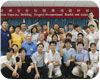
Garrett Brown, second row, fourth from the left, and UC Berkeley occupational health professionals with part of a 90-person training team in Dongguan, China, working to establish plant-level health and safety committees in three sports shoe factories with a combined workforce of 51,000 workers.
“Tragic optimismâ€
Garrett Brown knows that. He knows how corrupt, deceitful, and cold the snaking supply chain can be. Despite his awareness, Garrett possesses what the psychiatrist Viktor Frankl called “tragic optimism.” Garrett, in his own way, says “yes” to life, as Frankl put it, he sees a meaning to life, despite the death and pain and hopelessness of so many workers.Garrett is not alone in his optimism. There are the 400 volunteers of the Maquiladora Safety and Health Support Network. There are 39 current members of the American Industrial Hygiene Association’s Social Concerns Committee. Hundreds more have served in the past. There are 42 members of AIHA’s International Committee, with projects on-going in Asia-Pacific, Bulgaria, Ethiopia, Israel, Jamaica, Latvia, Pakistan, Poland, and Romania. The American Society of Safety Engineers has its burgeoning International Practice Specialty. There is Canadian Andrew Cutz, who just emailed me that for the AIHce 2009 in Toronto, the AIHA Social Concerns Committee is hoping to put together a roundtable on “Aboriginal OH&S Issues.” Andrew Cutz is far from alone in his interests and caring.
“What your conscience commands…â€
What Garrett and Andrew and many others share is this: despite the premium on pleasure-seeking, power and success — academics call it “achievement orientation” — that define status in American culture, these pros have found meaning in their work, through caring, through courage, that’s not a matter of status. They have taken Frankl at his word: “I want you to listen to what your conscience commands you do and go on to carry it out to the best of your knowledge.”Looking for a reprint of this article?
From high-res PDFs to custom plaques, order your copy today!