Handicapped accessible emergency showers & eyewashes
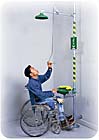
Individuals with physical limitations are due the same access to emergency response facilities as are the able-bodied — period.
By current definition, the Americans with Disabilities Act (ADA) guidelines do not provide accessible dimension requirements specifically for emergency drench showers or eyewashes. Still, it’s important for specifiers to recognize that failure to comply with general ADA accessibility guidelines when designing an emergency eyewash and drench shower system can have serious consequences, as existing accessibility guidelines can easily be applied.
While the American National Standards Institute provides design configuration, capabilities and access guidance for the installation, operation and maintenance of emergency showers and eyewashes (ANSI Z358.1), it does not specifically distinguish between handicapped and non-handicapped accident victims. So the assumption can be made that the ANSI guidelines apply to all victims, handicapped or not. A reasonable assumption can also be made that designs should probably comply with the requirements of both ADA and ANSI, if there is any possibility of handicapped individuals being in the area.
ADA in general
In its general requirements (Section 36.201) the ADA states, “No individual shall be discriminated against on the basis of disability in the full and equal enjoyment of the goods, services, facilities, privileges, advantages, or accommodations of any place of public accommodation.” That means disabled persons must be given free access to anything within a facility that is freely available to someone who is not handicapped.Likewise, it could easily be interpreted that access to a specific feature of a facility should also be provided in the timeframe established as a safe maximum for the non-handicapped. Consider the ANSI requirement for ten-seconds transit time to the nearest eyewash and/or shower station and all of the other associated requirements in the context of ADA. It can pose a significant challenge to system designs for laboratories or other facilities where handicapped individuals might be employed.
Using eyewashes and/or showers
If you consider the ADA Accessibility Guidelines (ADAAG) Section 4.3.1, Accessible Buildings for New Construction (paragraph 18) requires:“If fixed or built-in seating or tables (including, but not limited to, study carrels and student laboratory stations), are provided in accessible public or common use areas, at least five percent (5%), but not less than one, of the fixed or built-in seating areas or tables shall comply with 4.32.”
That section of ADAAG deals with knee clearances and table/counter heights for protruding objects. Eyewashes and/or combination eyewash-shower could be included in this grouping.
Then, in Section 4.1.5 “Building Additions” and again in Section 4.1.6 “Building Alterations” ADAAG requires that such building modifications conform to the rules prescribed in Section 4.3.1 for New Construction (above).
In “Work Areas Used by Employees” (Section A 4.1.1(3)) the ADAAG elaborates on Section 4.1.3 by adding:
“Where there are individual work stations (e.g., laboratories, service counters, ticket booths), 5%, but not less than one, of each type of work station should be constructed so that an individual with disabilities can maneuver within the work stations.”
This clarification establishes that all laboratories, public and private, new construction and renovations, must have provisions making them accessible to the disabled.
A disabled person can not be denied access to laboratory equipment at an accessible workstation, thus potentially exposing them to hazardous substances. At the same time, that handicapped person must then, logically be afforded the same access to emergency response resources available to a non-handicapped individual. This is the point at which ADA and ANSI Z358.1 overlap: Equal access is a civil right per ADA, and measurement of access is a function of ANSI Z 358.1, which makes no distinction between handicapped and non-handicapped individuals.
More and more government and private entities are taking steps to comply with both ADAAG and ANSI. California’s D.S.A. Policy 98-03 now requires a disabled-accessible shower and eyewash in every laboratory classroom, for all school modernization or new construction projects that receive state funding.
ADA accessible emergency showers & eyewashes
Dimensional parameters for accessible emergency showers and eyewashes can be interpreted from the ADAAG standards, as the general dimensions for wheelchair access and for wheelchair users’ surrounding space and protruding object requirements.For example, “Space Allowance and Reach Ranges” (Section 4.2) covers the minimum floor space, the width of approach and the maximum forward reach and side reach ranges. Specific applications will require adjustments, when circumstances warrant: Section 4.2.4.1 calls for a 30-in.-wide (minimum) approach for a wheelchair, while Section A4.2.1 states, “If the wheelchair must be turned at the opening or if ‘sudden’ movements are needed, then a clear width of 32-in. is adequate.” The 32-in.-wide approach allows for a slightly larger margin of safety that is appropriate wherever emergency equipment, life safety and emergency egress is an issue.
The forward and side reach ranges of the wheelchair user are covered in Sections 4.2.5 and 4.2.6. If an installed eyewash, for example, were to be 20 in. long or less (out from the wall mounting), the pull rod handle, for actuation of a combination shower, would have to be 48 in. or less above the floor. However, if the eyewash were longer than 20 in., the pull rod could be no more than 44 in. above the floor. Additional maximum and minimum dimensional information is provided in the ADAAG, including the standard 27-in. minimum knee clearance.
“Protruding Objects” that are typically mounted on the wall, such as eyewashes, and objects that hang down into the required headroom space, such as shower heads, are covered in Section 4.4. Likewise, “Gratings,” where they are used for emergency shower floor drainage, are covered in Section 4.5.4. Finally, “Controls and Operating Mechanisms,” their maximum and minimum heights for control location — and the force required to effect the operation of any device — are covered in Section 4.27.
As mentioned earlier, laboratory work stations — per Section 4.1.3, paragraph (18) — are required to meet Section 4.32, which includes the 27-in.-high knee clearance repeated throughout the ADAAG. Counter tops must be between 28 in. and 34 in. in height, obviously affecting all counter-mounted eyewashes. Recent developments in swing-down eyewash products enable the eyewash, in its down or operable position, to maintain outlet placement level with the top of the installed sink.
Specifiers should note that ANSI Z358.1, Section 5.4.1 allows for the eyewash spray heads to be as low as 33 in., even for the non-disabled person. That means that a single shower and eyewash can serve either the able-bodied or the disabled, if installed recognizing both ANSI and ADAAG guidelines.
Looking for a reprint of this article?
From high-res PDFs to custom plaques, order your copy today!