Keeping your eye on safety
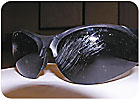
A grinding incident could have been disastrous for the employee wearing these safety glasses.
Each day about 2,000 U.S. workers have job-related eye injuries that require medical treatment, according to labor statistics. About one-third of these injuries are treated in hospital emergency departments and more than 100 result in one or more days of lost work.
One of our employees recently lost some days and required minor surgery following a grinding incident. He was using a 4-inch, hand-held grinder with wire cup brush mounted on the grinder when it “kicked-up” without warning and struck him on his safety glasses and on the side of his nose. The photo on this page shows the glasses he was wearing. Judging from the scratched lens, his safety glasses paid big dividends! Wearing a full face shield could have prevented the incident entirely.
To reduce, and hopefully eliminate, eye injuries, you must employ engineering controls. When eye hazards do exist, use personal protective eyewear, such as goggles, face shields, safety glasses or full face respirators. Obviously, eye protection chosen for specific work situations will depend on the nature and extent of the hazard, the circumstances of exposure, other protective equipment used, and personal vision needs. Eye protection should fit or be adjustable to provide an appropriate level of safety to the worker. It should be comfortable and allow for sufficient peripheral vision. Selection of protective eyewear appropriate for a given task should be made based on a hazard assessment of each activity, including regulatory requirements where applicable.
Helpful hints
The following information and guidelines are provided by the National Institute for Occupational Safety and Health (NIOSH).
Minimum necessary eye protection guidelines
- Use ANSI Z87.1 certified industrial eye protection with Z87 on the frames/lens.
- Wear safety glasses with side protection at the minimum.
- Most workers should wear goggles.
- Add a face shield over glasses or goggles for greater protection.
- Welders should use a welding helmet or goggles with the appropriate lens shade. (See section on the next page for more details.)
- Welder’s helpers, other workers and bystanders must have welding light protection when near cutting or welding operations.
- Dust, dirt, aggregate, exhaust byproducts and metal particles.
- Falling or shifting debris.
- Smoke, noxious/poisonous gases.
- Chemicals (acids, bases, fuels, solvents).
- Welding light and electrical arc.
- Thermal hazards and fires.
- Corneal abrasions and conjunctivitis (red eyes).
- Aggregate or metal particles or slivers embedded in the eye.
- Chemical or petroleum splash or burn.
- Welder’s flashburn.
- Eyeball laceration.
- Facial contusion and black eye.
- Bloodborne pathogen exposure from blood or other body fluids.
Safety glasses – minimum required
- Use safety glasses for general working conditions where there may be minor dust, chips or flying particles.
- Use safety glasses with side protection such as side shields or wrap-around style.
- Use safety glasses treated for anti-fog.
- Use an eyewear retainer to keep the glasses tight to the face or hanging from the neck if not in use.
- Use goggles for higher impact protection, greater dust, chemical splash and welding light protection. One example of a good application for goggles is when sooging overhead.
- Goggles for splash or fine dust protection should have indirect venting. Use direct vented goggles for less fogging when working with large particles.
- Safety goggles designed after ski-type goggles with high airflow minimize fogging while providing better particle and splash protection.
For greater impact and face protection use a shield over safety glasses/goggles.
- Use face shields for highest impact, full-face protection for spraying, chipping and grinding hazards.
- Face shields may be tinted or metal-coated for heat and splatter protection.
- The curve of the face shield will deflect particles, paints or chemicals coming from the side into the eyes.
- Always wear safety glasses or goggles under a face shield.
- Exposure to welding light causes severe burns to the eye and surrounding tissue — “welder’s flash.”
- Lens for welding light protection must be marked with the “Shade Number” (1.5-14, where 14 = darkest). Use the darkest shade possible: torch soldering: 1.5-3; torch brazing/cutting: 3-6; gas welding: 4-8; electric arc welding: 10-14.
- Protect the eyes even when the helmet is lifted up.
- Protect the welder, welder’s helper, and anyone observing.
- Workers who wear prescription glasses should wear tight-fitting goggles over normal street-wear glasses or contact lenses.
- Goggles should also be worn over prescription safety glasses in high-dust environments. If worn alone, prescription safety glasses must have side shields.
- Prescription safety lenses with tempered glass or acrylic plastic lenses are not suitable for high impact. These types of safety glasses should not be used when working in debris areas unless covered by goggles or a face shield.
- Polycarbonate or Trivex® lenses should be used when working in high impact areas. Lenses should be hard-coated to reduce scratching. Contact lenses may present a significant corneal abrasion risk when working in dusty areas unless tight-fitting goggles or a full-face respirator are worn.
- Full-face respirators will not seal properly over street-wear glasses or safety glasses. Prescription inserts compatible with a respirator should be used. Respirators should be professionally fitted.
Looking for a reprint of this article?
From high-res PDFs to custom plaques, order your copy today!